

Indian Rupee rebounds as oil prices slump on Iran-Israel truce
- The Indian Rupee bounces back against the US Dollar as Israel-Iran ceasefire pushes oil prices lower.
- US President Trump expresses confidence that a total victory over Iran could be announced in two weeks.
- Investors shift focus to the US-India CPI data for May.
The Indian Rupee (INR) rebounds against the US Dollar (USD) at open on Tuesday after a sharp decline the previous day. The USD/INR pair drops to near 95.50 as oil prices tumble, following reports of a ceasefire between Israel and Iran after the exchange of attacks over the weekend.

As of writing, the MCX Crude Oil contract expiring on June 18 is down 1% to near 8,600. Currencies from economies, such as India, which rely heavily on oil imports to meet their energy needs, tend to underperform in a high oil price environment.
Iran-Israel ceasefire drags oil prices
Oil prices started retreating after a strong start on Monday, following confirmation from Iran that it will stop attacking on Israeli territory. However, Iran’s armed forces warned of harsher attacks if Israel resumes attacks on Lebanon.
Iran agreed to a truce with Israel after United States (US) President Donald Trump urged both to stop attacking each other immediately.
On late Monday, US President Trump expressed confidence that Washington can announce a total victory over Iran in the next two weeks and “oil prices will come tumbling down”.
FIIs keep paring stake in Indian stock market
Overseas investors continue to lighten their stakes in the Indian stock market amid growing concerns over India Inc.’ earnings projections in the wake of higher energy prices. So far in June, Foreign Institutional Investors (FIIs) have remained net sellers on all trading days, and have offloaded their stake worth Rs. 36,370.14 crore. In May, FIIs also remained net sellers and sold their investments worth Rs. 55,963.33 crore.
Investors await US-India CPI data
This week, major triggers for USD/INR will be the Consumer Price Index (CPI) data for May from both the US and India, which will be released on Wednesday and Friday, respectively. The US headline CPI is expected to arrive higher at 4.2% Year-on-Year (YoY) from 3.8% in April. In the same period, the US core CPI – which excludes volatile food and energy items – is seen higher at 2.9% from the previous reading of 2.8%.
Signs of US inflationary pressures accelerating further would prompt expectations of interest rate hikes by the Federal Reserve (Fed) this year.
Meanwhile, India’s CPI data for May is also expected to come in higher at 4% YoY from 3.48% in April.
Last week, the Reserve Bank of India (RBI) warned of upside inflation risks in the monetary policy announcement and stated that it would act if it becomes more persistent. “If inflation becomes generalized, persistent and starts influencing inflation expectations, policy action may become necessary," the RBI Governor Sanjay Malhotra said.
Technical Analysis: USD/INR sees downside below 95.00
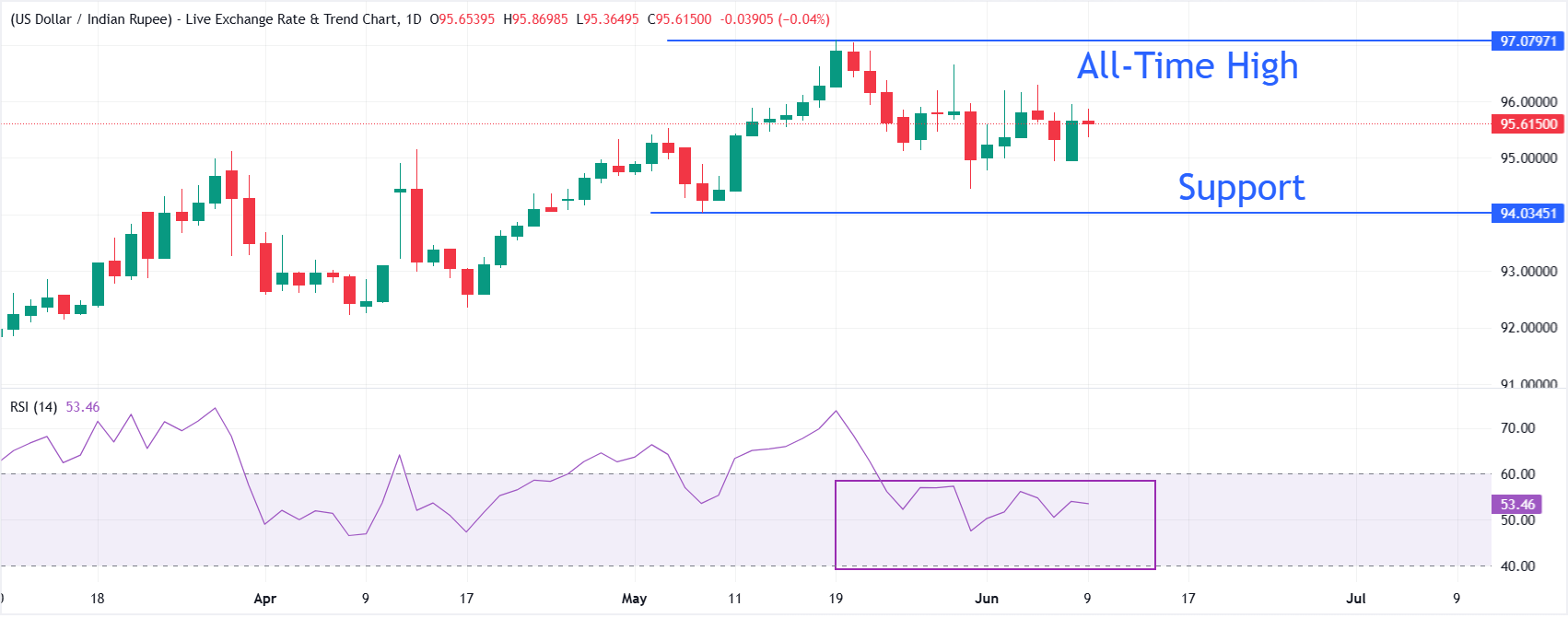
USD/INR trades slightly lower at around 95.50. The pair is essentially flat, trading sideways for almost two weeks. The Relative Strength Index (RSI) at 53.46 hovers just above the midline, hinting at balanced momentum with only a slight bullish tilt but no clear directional conviction.
On the downside, the pair could slide towards the May 07 low at 94.03 if it fails to hold the key support level of 95.00. Looking up, the pair could aim to revisit the all-time high above 97.00 if it manages to recover above the June 4 high at 96.30.
(The technical analysis of this story was written with the help of an AI tool.)
Indian Rupee FAQs
The Indian Rupee (INR) is one of the most sensitive currencies to external factors. The price of Crude Oil (the country is highly dependent on imported Oil), the value of the US Dollar – most trade is conducted in USD – and the level of foreign investment, are all influential. Direct intervention by the Reserve Bank of India (RBI) in FX markets to keep the exchange rate stable, as well as the level of interest rates set by the RBI, are further major influencing factors on the Rupee.
The Reserve Bank of India (RBI) actively intervenes in forex markets to maintain a stable exchange rate, to help facilitate trade. In addition, the RBI tries to maintain the inflation rate at its 4% target by adjusting interest rates. Higher interest rates usually strengthen the Rupee. This is due to the role of the ‘carry trade’ in which investors borrow in countries with lower interest rates so as to place their money in countries’ offering relatively higher interest rates and profit from the difference.
Macroeconomic factors that influence the value of the Rupee include inflation, interest rates, the economic growth rate (GDP), the balance of trade, and inflows from foreign investment. A higher growth rate can lead to more overseas investment, pushing up demand for the Rupee. A less negative balance of trade will eventually lead to a stronger Rupee. Higher interest rates, especially real rates (interest rates less inflation) are also positive for the Rupee. A risk-on environment can lead to greater inflows of Foreign Direct and Indirect Investment (FDI and FII), which also benefit the Rupee.
Higher inflation, particularly, if it is comparatively higher than India’s peers, is generally negative for the currency as it reflects devaluation through oversupply. Inflation also increases the cost of exports, leading to more Rupees being sold to purchase foreign imports, which is Rupee-negative. At the same time, higher inflation usually leads to the Reserve Bank of India (RBI) raising interest rates and this can be positive for the Rupee, due to increased demand from international investors. The opposite effect is true of lower inflation.













