

Trade The World
EUR/USD slides below 1.1700 as slowdown in Europe, weighs
作者 Christian Borjon Valencia
发布日期: 7 Jan 2026 | 修改日期: 7 Jan 2026


POPULAR ARTICLES

The EUR/USD dives over 0.28% on Tuesday even though economic data in the United States (US) was mixed, while Federal Reserve officials delivered neutral-to-dovish comments. Meanwhile, data in the Eurozone shows that economic activity is decelerating in the bloc.
- EUR/USD drops over 0.28% as Eurozone services PMIs signal decelerating economic momentum.
- German inflation slips below 2%, reinforcing expectations that ECB easing is largely complete.
- Traders await EU inflation data and key US releases including ADP, ISM Services and JOLTS.
The EUR/USD dives over 0.28% on Tuesday even though economic data in the United States (US) was mixed, while Federal Reserve officials delivered neutral-to-dovish comments. Meanwhile, data in the Eurozone shows that economic activity is decelerating in the bloc. The pair trades at 1.1690 after hitting a high of 1.1742.
Euro tumbles on weak data; fading geopolitical risks offset mixed US numbers, dovish Fed tones
The US Dollar is trimming some of Monday’s losses. Market participants shrugged off geopolitical risks after the US captured the Venezuelan President Nicolas Maduro over the weekend. Also, the lack of progress of peace talks to resolve the Ukraine-Russia conflict, keeps the shared currency pressured.
In the US, Purchasing Managers’ Indices (PMI) weakened in December, compared to the previous month. Meanwhile, Fed Governor Stephen Miran was dovish as expected, while Richmond Fed President Thomas Barkin is leaning neutral-hawkish, as he acknowledged that policy is within neutral.
In Europe, PMIs revealed a slowdown in activity in the services sector. Inflation in Germany, the largest European economy dipped below the European Central Bank (ECB) 2% goal, a reaffirmation that the ECB’s has concluded, unless economic growth is compromised.
Ahead, the EU economic docket will feature the EU’s Harmonized Index of Consumer Prices (HICP) for December, along with inflation figures on Italy and Retail Sales in Germany.
On the US front, traders focus would be on the ADP Employment Change figures, the ISM Services PMI, the JOLTS Job Openings and speeches by Fed officials.
Daily digest market movers: Euro pressured by dip on German inflation
- December’s S&P Global Services PMI showed that business activity is losing momentum in the US. The index eased from 54.1 to 52.5 while the Composite PMI dipped to 52.7 from 54.2.
- Chris Williamson, Chief Business Economist at S&P Global Market Intelligence noted that “Business activity continued to expand in December, rounding off another quarter of robust growth, but the resilience of the US economy is showing signs of cracking.”
- Fed officials crossed the wires. Richmond’s Thomas Barkin said future rate decisions will need to be “finely tuned,” citing competing risks to the labor market and inflation. He added that the current policy rate sits within the neutral range and stressed the importance of monitoring both sides of the Fed’s dual mandate.
- Earlier, Stephen Miran struck a dovish tone, saying the central bank is likely to adjust rates lower as incoming data point toward the need for easing. Miran added that conditions could warrant up to 100 basis points of rate cuts in 2026.
- The US Dollar Index (DXY), which tracks the buck’s value against six other currencies, post gains of 0.25% at 98.61, but failed to cap Gold gains.
- The Eurozone HCOB Services Purchasing Managers Index (PMI), dipped to 52.4 in December, down from a preliminary reading of 52.6 and after 53.1 in November.
- German inflation data as measured by the Harmonized Index of Consumer Prices (HICP) fell from 2.6% to 2% YoY.
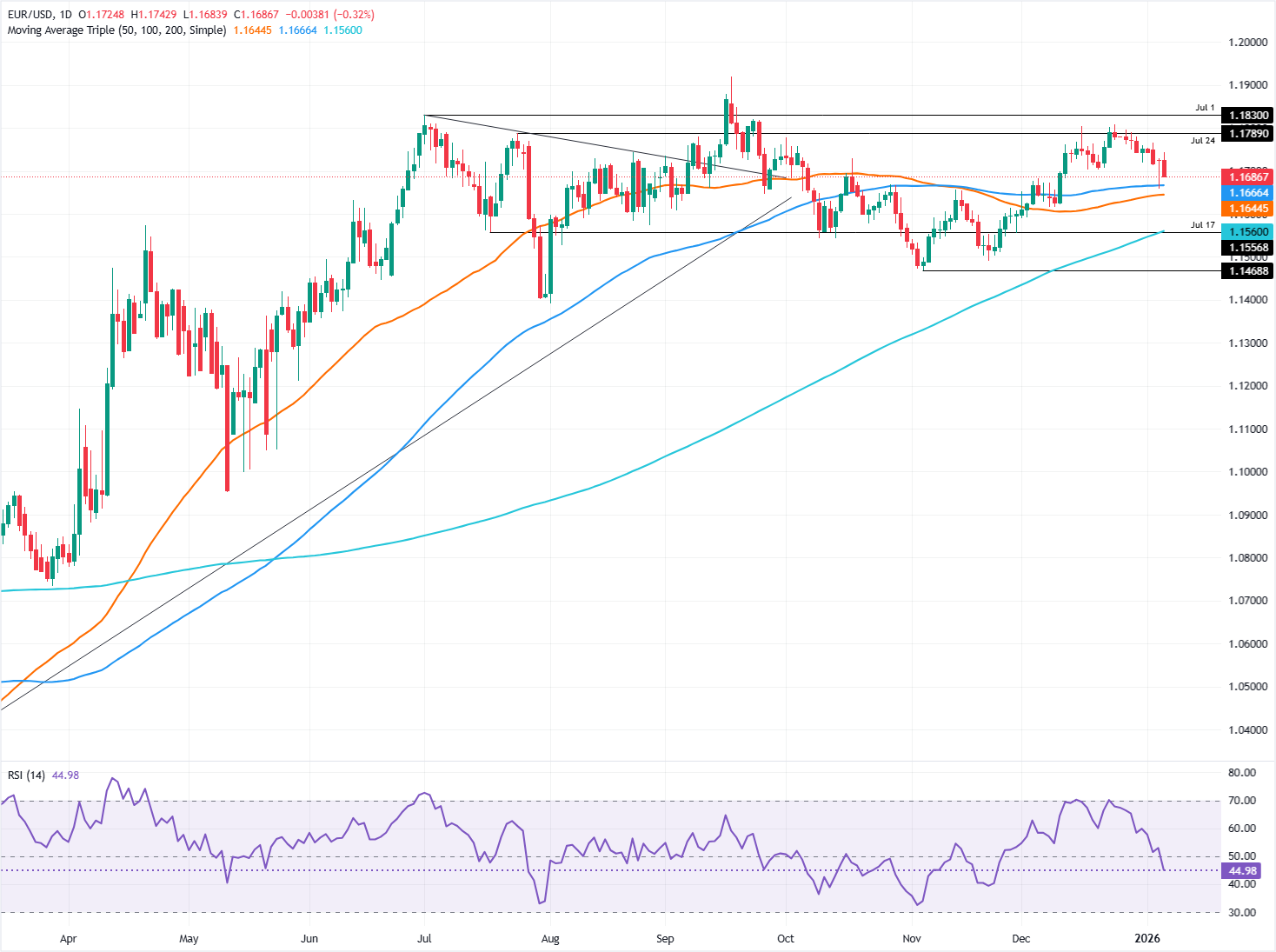
Technical outlook: EUR/USD slumps below 1.1700
Tuesday dip changed the EUR/USD technical picture from neutral to upward biased, to neutral. Failure of printing a daily close above 1.1700 exerts downward pressure on the pair, which is 20-pips shy of hitting the 100-day Simple Moving Average (SMA) at 1.1663.
In that outcome, the EUR/USD next support is the 100-day SMA, followed by the 50- and the 200-day SMAs, each at 1.1639 and 1.1553, respectively.
For a bullish resumption, bulls must clear the 20-day Simple Moving Average (SMA) at 1.1729, ahead of 1.1750, which would clear the path towards 1.1800.
Euro FAQs
The Euro is the currency for the 20 European Union countries that belong to the Eurozone. It is the second most heavily traded currency in the world behind the US Dollar. In 2022, it accounted for 31% of all foreign exchange transactions, with an average daily turnover of over $2.2 trillion a day. EUR/USD is the most heavily traded currency pair in the world, accounting for an estimated 30% off all transactions, followed by EUR/JPY (4%), EUR/GBP (3%) and EUR/AUD (2%).
The European Central Bank (ECB) in Frankfurt, Germany, is the reserve bank for the Eurozone. The ECB sets interest rates and manages monetary policy. The ECB’s primary mandate is to maintain price stability, which means either controlling inflation or stimulating growth. Its primary tool is the raising or lowering of interest rates. Relatively high interest rates – or the expectation of higher rates – will usually benefit the Euro and vice versa. The ECB Governing Council makes monetary policy decisions at meetings held eight times a year. Decisions are made by heads of the Eurozone national banks and six permanent members, including the President of the ECB, Christine Lagarde.
Eurozone inflation data, measured by the Harmonized Index of Consumer Prices (HICP), is an important econometric for the Euro. If inflation rises more than expected, especially if above the ECB’s 2% target, it obliges the ECB to raise interest rates to bring it back under control. Relatively high interest rates compared to its counterparts will usually benefit the Euro, as it makes the region more attractive as a place for global investors to park their money.
Data releases gauge the health of the economy and can impact on the Euro. Indicators such as GDP, Manufacturing and Services PMIs, employment, and consumer sentiment surveys can all influence the direction of the single currency. A strong economy is good for the Euro. Not only does it attract more foreign investment but it may encourage the ECB to put up interest rates, which will directly strengthen the Euro. Otherwise, if economic data is weak, the Euro is likely to fall. Economic data for the four largest economies in the euro area (Germany, France, Italy and Spain) are especially significant, as they account for 75% of the Eurozone’s economy.
Another significant data release for the Euro is the Trade Balance. This indicator measures the difference between what a country earns from its exports and what it spends on imports over a given period. If a country produces highly sought after exports then its currency will gain in value purely from the extra demand created from foreign buyers seeking to purchase these goods. Therefore, a positive net Trade Balance strengthens a currency and vice versa for a negative balance.

Acuity Trading
Acuity Trading 是一家成立于 2013 年、总部位于伦敦的金融科技公司,专注于 AI 驱动的另类数据和情绪分析,用于交易与投资。他们以可视化新闻和情绪工具革新在线交易体验,如今持续以最新的 AI 研究与技术提供可产生阿尔法的另类数据与高度互动的交易工具。
Read More








