

Trade The World
EUR/USD consolidates near three-week highs in risk-off markets
作者 Guillermo Alcala
发布日期: 14 Nov 2025 | 修改日期: 14 Nov 2025


POPULAR ARTICLES

EUR/USD remains practically flat on the daily chart, trading at 1.1630, at a short distance from the three-week highs of 1.1655 hit on Thursday, and on track to close the week nearly 0.6% higher.
- The Euro pulled back from 1.1655 highs against the US Dollar but remains steady above 1.1600,
- Hawkish comments by Fed officials have failed to support the Greenback.
- Eurozone GDP data is expected to confirm that the economy grew at a 0.2% pace in Q3.
EUR/USD remains practically flat on the daily chart, trading at 1.1630, at a short distance from the three-week highs of 1.1655 hit on Thursday, and on track to close the week nearly 0.6% higher. Eurozone Gross Domestic Product has confirmed preliminary expectations, and the Trade Balance widened, but the negative market sentiment has kept the Euro (EUR) on its back foot for most of the European session.
Eurozone GDP revealed that the region's economy grew at a 0.2% pace in the three months to September, while the year-on-year growth has been revised to 1.4% from the previously estimated 1.3% reading. Furthermore, September's trade surplus widened to EUR 19.4 billion, from the upwardly revised 1.9 billion in August.
The Dollar has remained on the back foot during most of the week, despite Federal Reserve (Fed) policymakers' hawkish comments. On Thursday, St. Louis Fed President Alberto Mussalem and Cleveland Fed President Beth Hammack were more concerned about the risks of inflation than about the labour market's momentum, while Minneapolis Fed President Neel Kashkari delivered a more neutral message.
Euro Price Today
The table below shows the percentage change of Euro (EUR) against listed major currencies today. Euro was the strongest against the British Pound.
| USD | EUR | GBP | JPY | CAD | AUD | NZD | CHF | |
|---|---|---|---|---|---|---|---|---|
| USD | 0.00% | 0.24% | -0.19% | 0.03% | 0.24% | -0.38% | -0.44% | |
| EUR | -0.01% | 0.25% | -0.20% | 0.03% | 0.24% | -0.39% | -0.45% | |
| GBP | -0.24% | -0.25% | -0.45% | -0.22% | -0.02% | -0.63% | -0.69% | |
| JPY | 0.19% | 0.20% | 0.45% | 0.25% | 0.45% | -0.18% | -0.23% | |
| CAD | -0.03% | -0.03% | 0.22% | -0.25% | 0.19% | -0.41% | -0.48% | |
| AUD | -0.24% | -0.24% | 0.02% | -0.45% | -0.19% | -0.62% | -0.68% | |
| NZD | 0.38% | 0.39% | 0.63% | 0.18% | 0.41% | 0.62% | -0.06% | |
| CHF | 0.44% | 0.45% | 0.69% | 0.23% | 0.48% | 0.68% | 0.06% |
The heat map shows percentage changes of major currencies against each other. The base currency is picked from the left column, while the quote currency is picked from the top row. For example, if you pick the Euro from the left column and move along the horizontal line to the US Dollar, the percentage change displayed in the box will represent EUR (base)/USD (quote).
Daily digest market movers: Euro remains buoyed on US Dollar weakness
- The Euro has been trading higher this week, supported by US Dollar weakness rather than positive Eurozone data. Investors remain cautious about placing large US Dollar longs amid the economic data blackout, and so far, unfazed by the hawkish comments from Fed officials. The release of a backlog of delayed figures next week will clarify the picture of the US economy and is expected to set the US Dollar's direction.
- On Thursday, Fed's Hammack said that monetary policy is currently barely restrictive, and that interest rates need to be at levels that help to reduce inflation, suggesting that she will be against an interest rate cut in December.
- St. Louis Fed President Alberto Mussalem showed a similar view, pointing to inflation as the central bank's main concern and affirming that the Fed has "limited room to ease without becoming overly accommodative".
- Also on Thursday, Fed's Kashkari pointed to a resilient US economy in an interview at Bloomberg and urged caution with further monetary easing. Regarding December's meeting, Kashkari said that he is still undecided but that he does not have a strong inclination for an interest rate cut.
- In Europe, ECB council member and Governour of the Bank of Latvia affirmed that the impact of US tariffs has not been as bad as initially thought and that interest rates will remain unchanged unless the context changes significantly.
Technical Analysis: Testing support at the reverse trendline, near 1.1610
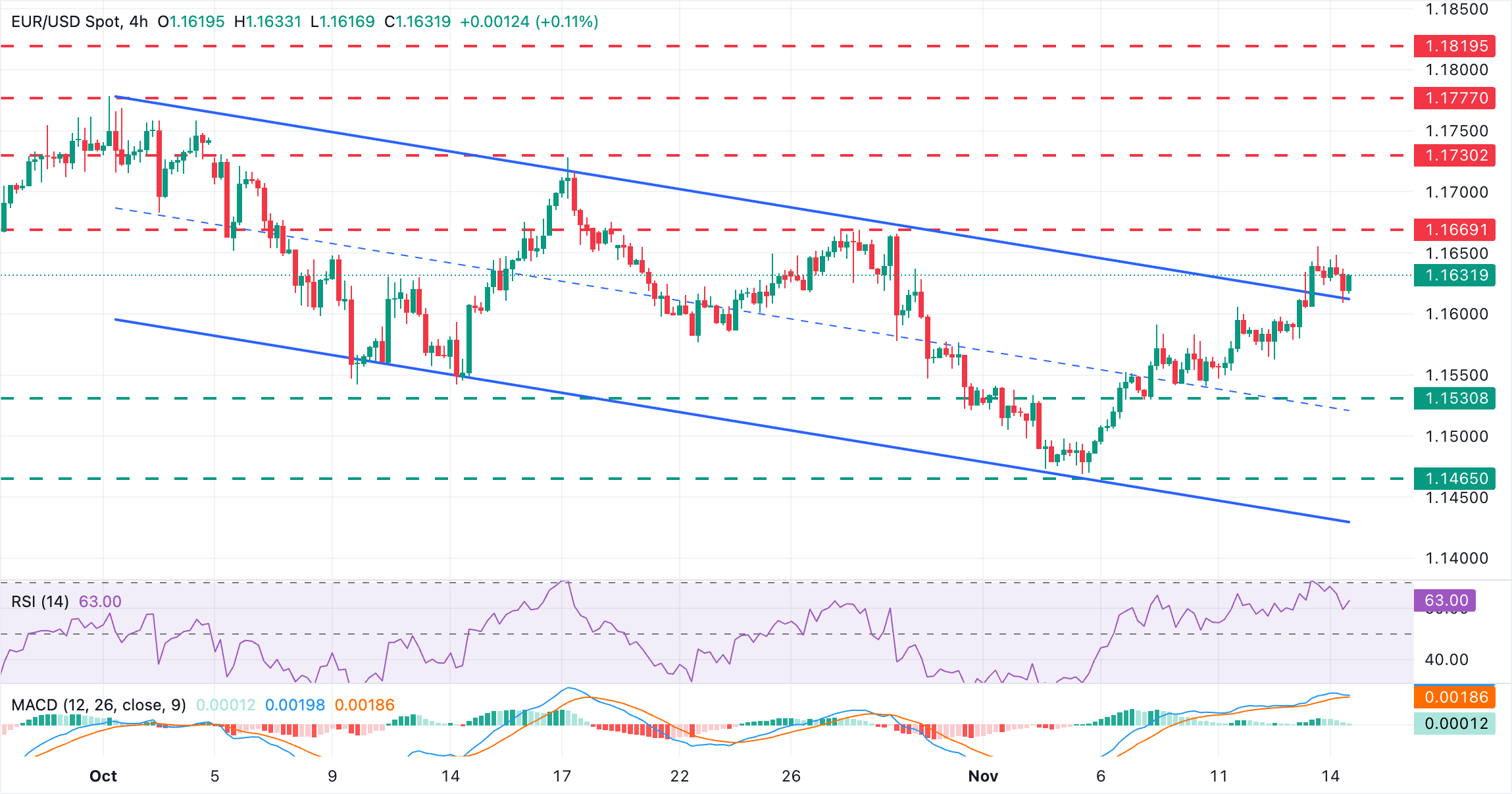
EUR/USD broke the top of a descending channel from early October highs and is consolidating gains on Friday. Technical indicators are positive, but the 4-hour Relative Strength Index (RSI) is nearing overbought conditions after rallying continuously for the last eight days. The Moving Average Convergence Divergence (MACD) in the same timeframe seems likely to cross below the signal line. All in all, signals hinting at some consolidation might be ahead.
Bulls should remain above the channel top, currently around 1.1610, to confirm a trend shift, and keep the October 28 and 29 highs, near 1.1670, in focus. Further up, the target is the October 17 high, near 1.1730. A correction below the mentioned trendline, at 1.1610, on the other hand, is likely to seek support at the November 12 low, in the vicinity of 1.1575, ahead of the 1.1530-1.1540 area (near November 7 and 10 lows).
Risk sentiment FAQs
In the world of financial jargon the two widely used terms “risk-on” and “risk off'' refer to the level of risk that investors are willing to stomach during the period referenced. In a “risk-on” market, investors are optimistic about the future and more willing to buy risky assets. In a “risk-off” market investors start to ‘play it safe’ because they are worried about the future, and therefore buy less risky assets that are more certain of bringing a return, even if it is relatively modest.
Typically, during periods of “risk-on”, stock markets will rise, most commodities – except Gold – will also gain in value, since they benefit from a positive growth outlook. The currencies of nations that are heavy commodity exporters strengthen because of increased demand, and Cryptocurrencies rise. In a “risk-off” market, Bonds go up – especially major government Bonds – Gold shines, and safe-haven currencies such as the Japanese Yen, Swiss Franc and US Dollar all benefit.
The Australian Dollar (AUD), the Canadian Dollar (CAD), the New Zealand Dollar (NZD) and minor FX like the Ruble (RUB) and the South African Rand (ZAR), all tend to rise in markets that are “risk-on”. This is because the economies of these currencies are heavily reliant on commodity exports for growth, and commodities tend to rise in price during risk-on periods. This is because investors foresee greater demand for raw materials in the future due to heightened economic activity.
The major currencies that tend to rise during periods of “risk-off” are the US Dollar (USD), the Japanese Yen (JPY) and the Swiss Franc (CHF). The US Dollar, because it is the world’s reserve currency, and because in times of crisis investors buy US government debt, which is seen as safe because the largest economy in the world is unlikely to default. The Yen, from increased demand for Japanese government bonds, because a high proportion are held by domestic investors who are unlikely to dump them – even in a crisis. The Swiss Franc, because strict Swiss banking laws offer investors enhanced capital protection.

Acuity Trading
Acuity Trading 是一家成立于 2013 年、总部位于伦敦的金融科技公司,专注于 AI 驱动的另类数据和情绪分析,用于交易与投资。他们以可视化新闻和情绪工具革新在线交易体验,如今持续以最新的 AI 研究与技术提供可产生阿尔法的另类数据与高度互动的交易工具。
Read More








