

Trade The World
Gold obliterates records, hits $3,895 on Fed cut frenzy
作者 Christian Borjon Valencia
发布日期: 2 Oct 2025 | 修改日期: 2 Oct 2025


POPULAR ARTICLES

Gold price surges on Wednesday and posts a record high of $3,895, yet it has since retreated somewhat, trading with gains of over 0.30%.
- ADP report shows that private hiring in September plunged, reinforcing bets for a Fed rate cut later this month.
- US government shutdown delays Nonfarm Payrolls release, weighs on markets but support flows into Gold.
- Treasury yields tumble and US Dollar softens, creating a favorable backdrop for bullion’s rally toward fresh record highs.
Gold price surges on Wednesday and posts a record high of $3,895, yet it has since retreated somewhat, trading with gains of over 0.30%. The shutdown of the US government and softer-than-expected employment data reaffirmed investors' stance that the Federal Reserve (Fed) would reduce interest rates at its upcoming meeting.
XAU/USD trades at $3,871 at the time of writing, propelled by falling US Treasury yields and a firm US Dollar.
Bullion holds near $3,871 as weak jobs data and US government shutdown fears boost safe-haven demand
Financial markets remain in a positive mood, despite the shutdown of the US government, which could delay the release of the Friday Nonfarm Payrolls report. Jobs data revealed earlier showed that private hiring plunged in September, according to the ADP National Employment Change report.
Other data showed that manufacturing activity recovered in September, but remained in contractionary territory, as revealed by the Institute for Supply Management (ISM).
In the meantime, the Greenback post modest losses of over 0.11%, a tailwind for Bullion prices.
Expectations that the Federal Reserve would reduce rates at the October 29 meeting remain high, standing at 98% for a 25-basis-point rate cut and a 4% chance of holding rates unchanged.
Daily market movers: Gold price climbs on soft US jobs data
- Bullion prices advance as the Greenback edges down, as shown by the US Dollar Index (DXY). DXY, which tracks the buck’s value against a basket of six currencies, is down 0.11% at 97.68.
- US Treasury yields plunge as the 10-year Treasury note tanks nearly five basis points to 4.106%. US real yields—calculated by subtracting inflation expectations from the nominal yield—, which correlate inversely to Gold prices, are also unchanged at 1.796%.
- ADP revealed that private payrolls shrank by -32,000 in September, following August’s downward revision of -3,000 jobs. Forecasts suggested that companies would add at least 50,000 new employees to their workforce.
- The ISM Manufacturing PMI increased to 49.1 in September from 48.7 in August, though it was the seventh month that the PMI was in contractionary territory, though above estimates of 49.
- Job openings in the US showed the labor market is slowing, yet vacancies rose from 7.21 million to 7.23 million in August. Digging into the data, the hiring rate edged down to 3.2%, the lowest level since June 2024, while layoffs remained at a low level.
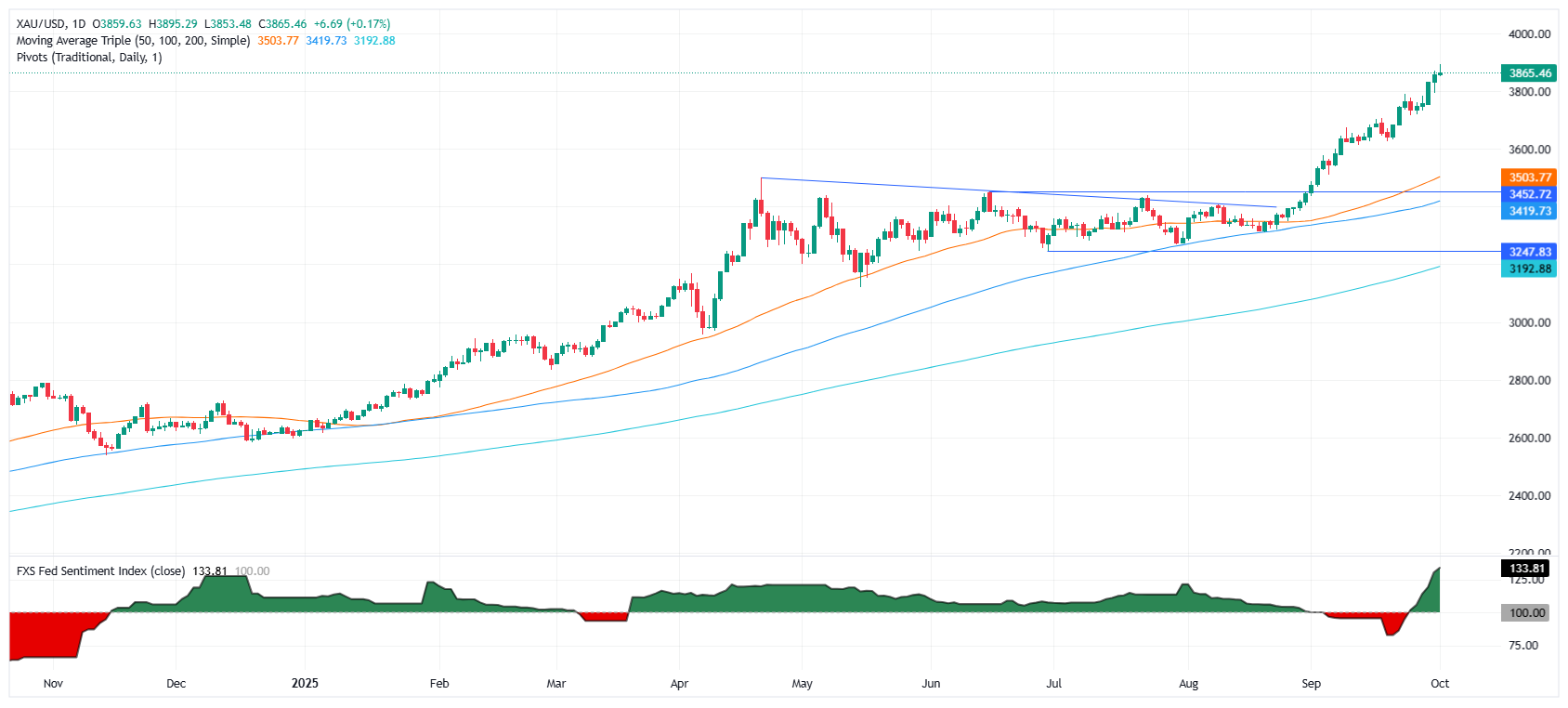
Technical outlook: Gold price poised to challenge $3,900
Gold price is upward biased, despite the formation of a ‘shooting star’ candle, with bearish implications. Nevertheless, fundamentals and risk sentiment favor further upside, though a fall below the September 30 low of $3,793 could sponsor a test of the 20-day Simple Moving Average (SMA) at $3,698.
On the flipside, XAU/USD could challenge the current all-time high at $3,895, ahead of breaching $3,900.
Fed FAQs
Monetary policy in the US is shaped by the Federal Reserve (Fed). The Fed has two mandates: to achieve price stability and foster full employment. Its primary tool to achieve these goals is by adjusting interest rates. When prices are rising too quickly and inflation is above the Fed’s 2% target, it raises interest rates, increasing borrowing costs throughout the economy. This results in a stronger US Dollar (USD) as it makes the US a more attractive place for international investors to park their money. When inflation falls below 2% or the Unemployment Rate is too high, the Fed may lower interest rates to encourage borrowing, which weighs on the Greenback.
The Federal Reserve (Fed) holds eight policy meetings a year, where the Federal Open Market Committee (FOMC) assesses economic conditions and makes monetary policy decisions. The FOMC is attended by twelve Fed officials – the seven members of the Board of Governors, the president of the Federal Reserve Bank of New York, and four of the remaining eleven regional Reserve Bank presidents, who serve one-year terms on a rotating basis.
In extreme situations, the Federal Reserve may resort to a policy named Quantitative Easing (QE). QE is the process by which the Fed substantially increases the flow of credit in a stuck financial system. It is a non-standard policy measure used during crises or when inflation is extremely low. It was the Fed’s weapon of choice during the Great Financial Crisis in 2008. It involves the Fed printing more Dollars and using them to buy high grade bonds from financial institutions. QE usually weakens the US Dollar.
Quantitative tightening (QT) is the reverse process of QE, whereby the Federal Reserve stops buying bonds from financial institutions and does not reinvest the principal from the bonds it holds maturing, to purchase new bonds. It is usually positive for the value of the US Dollar.

Acuity Trading
Acuity Trading 是一家成立于 2013 年、总部位于伦敦的金融科技公司,专注于 AI 驱动的另类数据和情绪分析,用于交易与投资。他们以可视化新闻和情绪工具革新在线交易体验,如今持续以最新的 AI 研究与技术提供可产生阿尔法的另类数据与高度互动的交易工具。
Read More








