

Trade The World
USD/JPY Price Forecast: Uptrend shows fatigue as RSI divergence hints at short-term pullback
作者 Vishal Chaturvedi
发布日期: 1 Nov 2025 | 修改日期: 1 Nov 2025


POPULAR ARTICLES

The Japanese Yen (JPY) steadies against the US Dollar (USD) on Friday, with USD/JPY pausing its two-day winning streak despite the Greenback’s broader strength, as renewed verbal warnings from Japanese officials revive intervention concerns.
- The Japanese Yen steadies as Japan’s new Finance Minister warns of FX intervention risk.
- USD/JPY hovers near 154.00, holding close to an eight-and-a-half-month high.
- RSI divergence on the daily chart hints at possible consolidation before the next move higher.
The Japanese Yen (JPY) steadies against the US Dollar (USD) on Friday, with USD/JPY pausing its two-day winning streak despite the Greenback’s broader strength, as renewed verbal warnings from Japanese officials revive intervention concerns.
Japan’s new Finance Minister Satsuki Katayama said the government is “closely monitoring FX with a high sense of urgency,” a remark that offered the Yen some intraday support after the pair touched fresh multi-month highs on Thursday.
At the time of writing, USD/JPY is trading around 154.00, holding firm near an eight-and-a-half-month high and on track for its biggest monthly gain since June.
Meanwhile, the US Dollar Index (DXY), which measures the Greenback’s value against a basket of six major currencies, is extending its advance for the third straight day, hovering near three-month highs around 99.80, poised for a second consecutive weekly gain, supported by fading expectations of additional Federal Reserve (Fed) interest rate cuts.
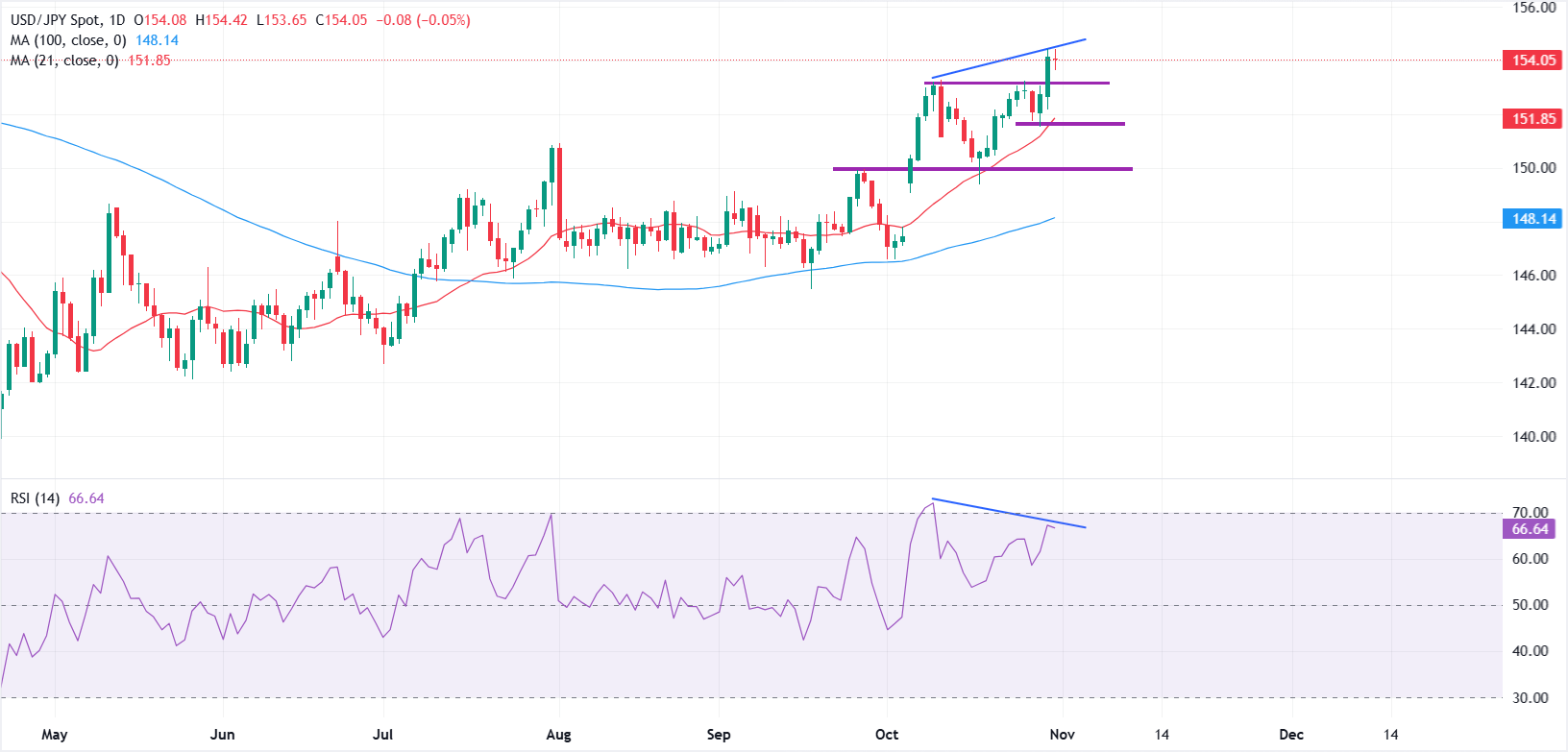
From a technical perspective, USD/JPY remains in a strong uptrend on the daily chart, but signs of exhaustion are emerging. The pair continues to trade well above its 21-day Simple Moving Average (SMA) at 151.85 and the 100-day SMA at 148.14, reflecting a sustained bullish structure.
However, momentum indicators suggest that upside momentum is starting to fade. The 14-day Relative Strength Index (RSI) currently stands around 66.23, showing a mild bearish divergence as prices reached new highs while the RSI failed to confirm the move. This divergence often signals a potential pause or minor correction in the near term.
A brief pullback or consolidation cannot be ruled out before another attempt higher. Immediate resistance is seen at 154.80, the February 12 high, followed by 155.53, the peak from February 4.
On the downside, initial support sits at the 153.00 psychological level. A sustained break below this area could trigger a deeper correction toward the 151.50-152.00 zone, where the 21-day SMA aligns with previous horizontal support. Losing this zone would shift the near-term bias from bullish to neutral or even bearish, exposing the next support around the 150.00 handle and potentially lower levels.
Japanese Yen FAQs
The Japanese Yen (JPY) is one of the world’s most traded currencies. Its value is broadly determined by the performance of the Japanese economy, but more specifically by the Bank of Japan’s policy, the differential between Japanese and US bond yields, or risk sentiment among traders, among other factors.
One of the Bank of Japan’s mandates is currency control, so its moves are key for the Yen. The BoJ has directly intervened in currency markets sometimes, generally to lower the value of the Yen, although it refrains from doing it often due to political concerns of its main trading partners. The BoJ ultra-loose monetary policy between 2013 and 2024 caused the Yen to depreciate against its main currency peers due to an increasing policy divergence between the Bank of Japan and other main central banks. More recently, the gradually unwinding of this ultra-loose policy has given some support to the Yen.
Over the last decade, the BoJ’s stance of sticking to ultra-loose monetary policy has led to a widening policy divergence with other central banks, particularly with the US Federal Reserve. This supported a widening of the differential between the 10-year US and Japanese bonds, which favored the US Dollar against the Japanese Yen. The BoJ decision in 2024 to gradually abandon the ultra-loose policy, coupled with interest-rate cuts in other major central banks, is narrowing this differential.
The Japanese Yen is often seen as a safe-haven investment. This means that in times of market stress, investors are more likely to put their money in the Japanese currency due to its supposed reliability and stability. Turbulent times are likely to strengthen the Yen’s value against other currencies seen as more risky to invest in.

Acuity Trading
Acuity Trading 是一家成立于 2013 年、总部位于伦敦的金融科技公司,专注于 AI 驱动的另类数据和情绪分析,用于交易与投资。他们以可视化新闻和情绪工具革新在线交易体验,如今持续以最新的 AI 研究与技术提供可产生阿尔法的另类数据与高度互动的交易工具。
Read More








