

Ripple adjusts funding strategy as XRP struggles with weak retail demand
作者 John Isige
发布日期: 27 Feb 2026 | 修改日期: 27 Feb 2026


热门文章

Ripple (XRP) declines for the second consecutive day, trading around $1.38 at the time of writing on Friday. The ongoing correction comes on the heels of a bullish reversal from a weekly low of $1.31 on Tuesday, which stalled at $1.49 on Wednesday.
- XRP slides below the $1.40 pivotal level as headwinds trim weekly gains across the crypto market.
- Ripple shifts toward a more distributed funding model to support ecosystem builders across multiple channels.
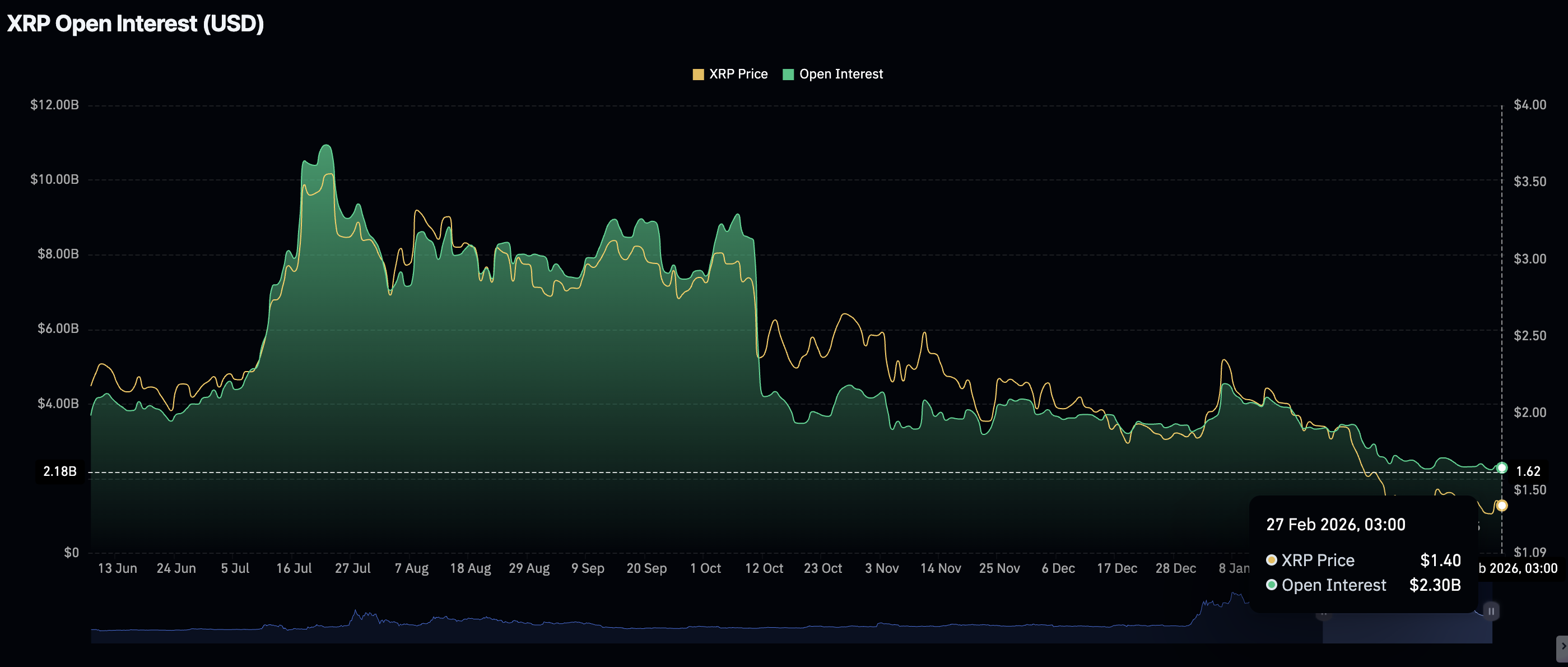
- Retail demand for XRP remains low, with futures Open Interest at its lowest level since January 2025.
Ripple (XRP) declines for the second consecutive day, trading around $1.38 at the time of writing on Friday. The ongoing correction comes on the heels of a bullish reversal from a weekly low of $1.31 on Tuesday, which stalled at $1.49 on Wednesday.
Ripple announces changes for builder funding in 2026
Ripple is shifting toward a new funding model that gives ecosystem builders access to support across multiple channels. The issuer of the XRP token and the RLUSD stablecoin said in a statement released on Thursday that starting in 2026, builders will access funding through a distributed model.
The new model creates an environment where independent organisations, venture partners, regional hubs, and community-led initiatives support builders at scale.
Ripple appears to be preparing to launch both new and expanded initiatives in 2026, such as the FinTech Builder Program, designed to support startups building institutional-grade financial products on the XRP Ledger (XRPL). The products span stablecoin payments, credit infrastructure, tokenization, and regulated financial services.
Retail demand wanes as XRP falters
Retail investor interest in XRP has persistently declined, as evidenced by a decline in derivatives activity. The downtrend in futures Open Interest (OI) to $2.30 billion on Friday, from $2.35 billion the previous day, is a concern for the derivatives market. The OI is at its lowest level since January 2025.
In contrast, OI hit a record $10.94 billion in July, coinciding with XRP reaching $3.66, its current all-time high. A steadily declining OI suggests that investors are unwilling to lean into risk and would rather close positions than open new ones.
XRP technical outlook: XRP faces renewed downside pressure
XRP trades around $1.38 with the near-term bias mildly bearish. The price holds well below the 50, 100, and 200-day Exponential Moving Averages (EMAs), which are clustered between $1.62 and $2.06. All three moving averages are sloping lower, keeping the broader trend under pressure despite the recent bounce from a weekly low at $1.31.
The Moving Average Convergence Divergence (MACD) indicator holds above its signal line on the daily chart, while the green histogram bars are contracting, suggesting a modest bullish influence within a larger downtrend.
Still, the Relative Strength Index (RSI) around 40 remains below the neutral 50 line on the same chart, indicating oversold conditions and reinforcing downside momentum toward support at $1.31.
-1772196496097-1772196496104.png)
Initial resistance emerges at $1.54, aligning with the February 6 high, while the 50-day EMA lines up to cap rebounds at $1.62. A break above this supply cluster could open the door to a larger breakout targeting the 100-day EMA at $1.83 and later the 200-day EMA at $2.06.
Cryptocurrency prices FAQs
Token launches influence demand and adoption among market participants. Listings on crypto exchanges deepen the liquidity for an asset and add new participants to an asset’s network. This is typically bullish for a digital asset.
A hack is an event in which an attacker captures a large volume of the asset from a DeFi bridge or hot wallet of an exchange or any other crypto platform via exploits, bugs or other methods. The exploiter then transfers these tokens out of the exchange platforms to ultimately sell or swap the assets for other cryptocurrencies or stablecoins. Such events often involve an en masse panic triggering a sell-off in the affected assets.
Macroeconomic events like the US Federal Reserve’s decision on interest rates influence crypto assets mainly through the direct impact they have on the US Dollar. An increase in interest rate typically negatively influences Bitcoin and altcoin prices, and vice versa. If the US Dollar index declines, risk assets and associated leverage for trading gets cheaper, in turn driving crypto prices higher.
Halvings are typically considered bullish events as they slash the block reward in half for miners, constricting the supply of the asset. At consistent demand if the supply reduces, the asset’s price climbs.
(The technical analysis of this story was written with the help of an AI tool.)

Acuity Trading 是一家成立于 2013 年、总部位于伦敦的金融科技公司,专注于 AI 驱动的另类数据和情绪分析,用于交易与投资。他们以可视化新闻和情绪工具革新在线交易体验,如今持续以最新的 AI 研究与技术提供可产生阿尔法的另类数据与高度互动的交易工具。
阅读更多








