

Banxico seen holding rates at 7% amid war-driven inflation risks
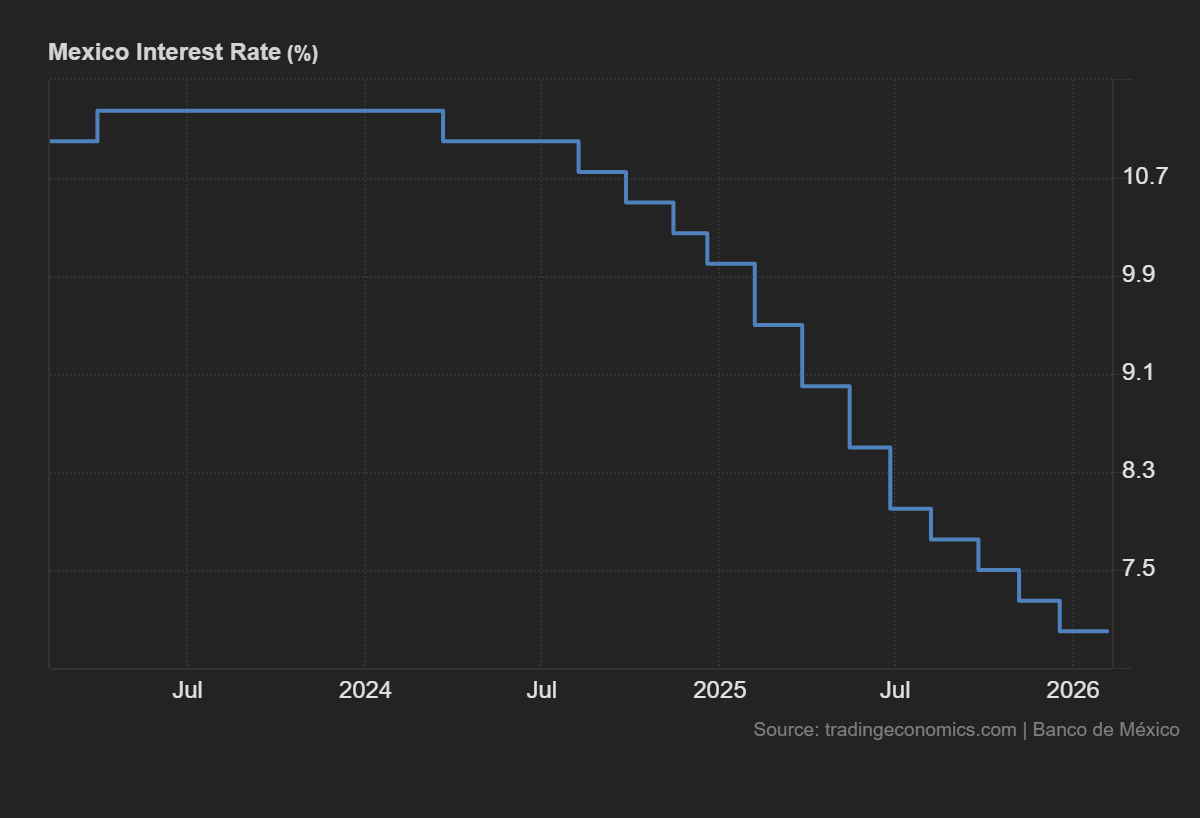
A Reuters poll revealed that the Bank of Mexico — also known as Banxico for its Spanish acronym — is expected to keep interest rates steady at 7% at the March 26 meeting amid concerns about the Middle East war.
If Banxico keeps rates unchanged, it would be the second time the central bank has opted for a wait-and-see approach, after reducing rates 12 times since the easing cycle began.
The survey revealed that 16 of 28 economists expect Mexico's main reference rate to remain unchanged, while a minority of participants — including analysts at Goldman Sachs and JPMorgan — project a resumption of Banxico's easing cycle, even though the central bank's governing council raised inflation expectations.
Eleven of the respondents expect a 25-basis points reduction to 6.25%, including the already mentioned Bank of America and Barclays, alongside one local analyst who projects a 25 basis points rate hike to 7.25%.
Banxico FAQs
The Bank of Mexico, also known as Banxico, is the country’s central bank. Its mission is to preserve the value of Mexico’s currency, the Mexican Peso (MXN), and to set the monetary policy. To this end, its main objective is to maintain low and stable inflation within target levels – at or close to its target of 3%, the midpoint in a tolerance band of between 2% and 4%.
The main tool of the Banxico to guide monetary policy is by setting interest rates. When inflation is above target, the bank will attempt to tame it by raising rates, making it more expensive for households and businesses to borrow money and thus cooling the economy. Higher interest rates are generally positive for the Mexican Peso (MXN) as they lead to higher yields, making the country a more attractive place for investors. On the contrary, lower interest rates tend to weaken MXN. The rate differential with the USD, or how the Banxico is expected to set interest rates compared with the US Federal Reserve (Fed), is a key factor.
Banxico meets eight times a year, and its monetary policy is greatly influenced by decisions of the US Federal Reserve (Fed). Therefore, the central bank’s decision-making committee usually gathers a week after the Fed. In doing so, Banxico reacts and sometimes anticipates monetary policy measures set by the Federal Reserve. For example, after the Covid-19 pandemic, before the Fed raised rates, Banxico did it first in an attempt to diminish the chances of a substantial depreciation of the Mexican Peso (MXN) and to prevent capital outflows that could destabilize the country.














