

Dow Jones Industrial Average futures sit out the rally as July hike bets creep higher
- The Dow lagged badly while the S&P 500 and Nasdaq Composite printed fresh all-time highs, with technology doing all the heavy lifting.
- Index futures drifted steadily lower through the overnight and premarket sessions, leaving momentum pinned deep in oversold territory.
- Rate-cut hopes have quietly evaporated, with traders now pricing a genuine chance of a July hike ahead of Thursday's key inflation print.
The Dow Jones Industrial Average (DJIA) is the odd one out following a long weekend, and that should bother anyone leaning into this rally. While the S&P 500 and Nasdaq Composite punched to fresh record intraday highs on Tuesday, hauled up by a frenzied bid for memory chips, the Dow Jones Industrial Average (DJIA) closed down roughly 0.3%, and its futures kept leaking lower across the holiday-thinned overnight and premarket sessions. US markets were shut Monday for Memorial Day, so this was the week's first real read on sentiment, and the price-weighted Dow is quietly refusing to buy what the rest of the tape is selling, namely that a shaky US-Iran ceasefire is as good as a peace deal.

Tech euphoria the Dow can't share
The melt-up has a single engine, and the Dow barely owns a piece of it. Micron (MU) ripped 17% and vaulted past $1 trillion in market value as analysts tripped over themselves to upgrade memory names, with fellow chipmakers Seagate (STX) and Western Digital (WDC) riding the same wave. That is exactly the kind of high-beta, capex-fueled enthusiasm that lifts the Nasdaq and the S&P 500 while doing almost nothing for an index stacked with industrials, financials, and old-economy heavyweights. The Dow's underperformance is not noise, it is the composition of the index telling you where the conviction actually sits, and where it does not.
The futures aren't buying it
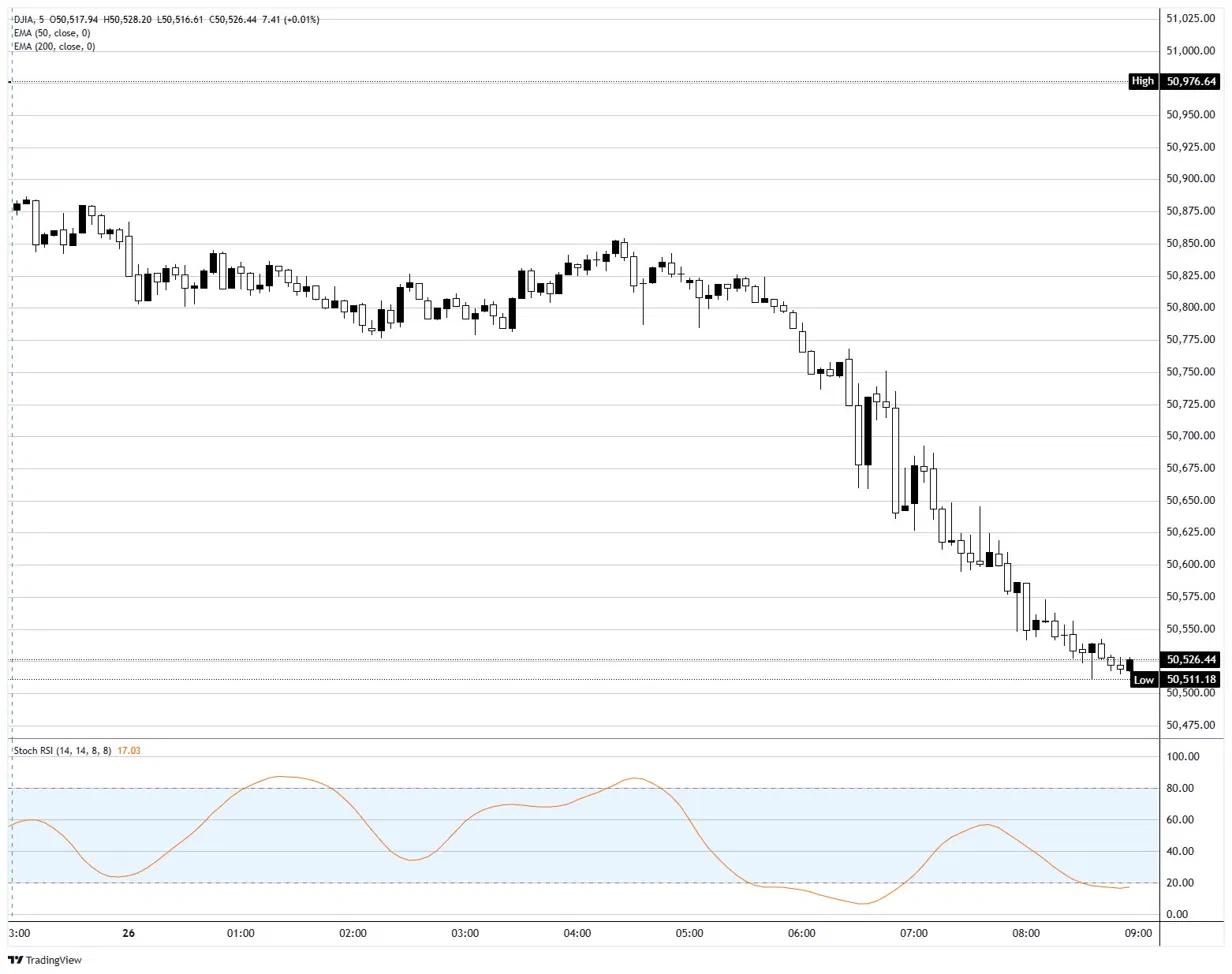
Price action overnight backs up the skepticism. After chopping sideways near the 50,800 area early in the session, Dow futures broke down cleanly and ground toward the 50,500 region by the premarket, slipping off highs near 51,000. There was no panic to it, just a steady one-directional leak that left Stochastic RSI buried near the floor of its range, deeply oversold. That kind of read can spring a relief bounce, but a market this heavy rarely finds buyers until it stops printing lower highs. Until futures reclaim the 50,800 shelf, the path of least resistance points lower, with the round 50,000 handle the obvious magnet if 50,500 gives way.
Oil is doing the talking
The piece the equity crowd keeps glossing over is Crude Oil. US strikes in southern Iran early Tuesday, framed as self-defense during the ceasefire, did little to calm the energy market. West Texas Intermediate (WTI) slipped around 2% toward $93 a barrel even as Brent pushed roughly 4% higher to near $100, the kind of split that screams waterborne supply risk rather than a market convinced the fighting is over. With Brent back at triple digits and Oil still trading well above its early-year levels, the disinflation story that powered last week's gains is on thin ice. The Dow, with its heavier tilt toward economically sensitive names, tends to feel that squeeze faster than a tech-led index does.
Thursday's PCE is the only number that matters
This is where the rally's optimism runs into the data. A month ago the market saw essentially no chance of the Federal Reserve (Fed) hiking in July. Now, per the CME Group's FedWatch tool, traders are pricing around a 13% chance of exactly that. Easing bets have not just faded, they have flipped direction, and with crude firm and price pressures looking increasingly entrenched, Thursday's Personal Consumption Expenditures Price Index (PCE) release at 12:30 GMT is the week's pivot point. Core PCE is seen ticking up to 3.3% YoY with the headline rate expected to accelerate toward 3.8%, and a hot print would hand the hawks the ammunition the futures market is already bracing for.
For now the bias stays lower while the Dow trades below the 50,800 reclaim level, with 50,500 the line in the sand and 50,000 the next downside target. A break back above 50,800 would neutralize the bearish tilt and put the highs near 51,000 back in play, but that is a tall order with PCE looming and the rest of the market already priced for perfection. The S&P 500 and Nasdaq can keep chasing records on chip euphoria. The Dow, and the rate-hike odds creeping up beneath it, are flashing a different signal, and one of them is going to be wrong.
Dow Jones 5-minute chart
Dow Jones FAQs
The Dow Jones Industrial Average, one of the oldest stock market indices in the world, is compiled of the 30 most traded stocks in the US. The index is price-weighted rather than weighted by capitalization. It is calculated by summing the prices of the constituent stocks and dividing them by a factor, currently 0.152. The index was founded by Charles Dow, who also founded the Wall Street Journal. In later years it has been criticized for not being broadly representative enough because it only tracks 30 conglomerates, unlike broader indices such as the S&P 500.
Many different factors drive the Dow Jones Industrial Average (DJIA). The aggregate performance of the component companies revealed in quarterly company earnings reports is the main one. US and global macroeconomic data also contributes as it impacts on investor sentiment. The level of interest rates, set by the Federal Reserve (Fed), also influences the DJIA as it affects the cost of credit, on which many corporations are heavily reliant. Therefore, inflation can be a major driver as well as other metrics which impact the Fed decisions.
Dow Theory is a method for identifying the primary trend of the stock market developed by Charles Dow. A key step is to compare the direction of the Dow Jones Industrial Average (DJIA) and the Dow Jones Transportation Average (DJTA) and only follow trends where both are moving in the same direction. Volume is a confirmatory criteria. The theory uses elements of peak and trough analysis. Dow’s theory posits three trend phases: accumulation, when smart money starts buying or selling; public participation, when the wider public joins in; and distribution, when the smart money exits.
There are a number of ways to trade the DJIA. One is to use ETFs which allow investors to trade the DJIA as a single security, rather than having to buy shares in all 30 constituent companies. A leading example is the SPDR Dow Jones Industrial Average ETF (DIA). DJIA futures contracts enable traders to speculate on the future value of the index and Options provide the right, but not the obligation, to buy or sell the index at a predetermined price in the future. Mutual funds enable investors to buy a share of a diversified portfolio of DJIA stocks thus providing exposure to the overall index.














