

EUR/USD edges down below 1.1720 lows but holds most of Thursday’s gains
- EUR/USD retreats from 1.1740, but remains steady above 1.1700.
- The Euro bounced up on Thursday amid hot Eurozone inflation and a hawkish hold by the ECB.
- Trading volumes are thin on Friday, due to the May 1 labor holiday.
The Euro (EUR) is trading moderately lower against the US Dollar (USD) on Friday, retreating to 1.1719 at the time of writing, down from highs above 1.1740 on Thursday. The pair, however, maintains most of the previous day’s gains, with market volumes thinned on the May 1 labor holiday.
The pair regained lost ground on Thursday, as investors prioritised the hot Eurozone inflation figures over the weakening Gross Domestic Product (GDP) figures, which were released simultaneously.

Later on, the European Central Bank (ECB) kept its benchmark interest rate steady at 2%, as expected. ECB President Christine Lagarde, however, held a distinctly hawkish stance that convinced traders. She dismissed fears of stagflation and affirmed that a rise in interest rates was discussed at the meeting, keeping options open for a June hike.
In the US session, Wall Street rallied to fresh record highs, fuelled by upbeat quarterly earnings from US companies. The equities' rush is offsetting fears about the consequences of high Oil prices, fueling a risk appetite that keeps demand for the safe-haven US Dollar subdued, at least for now.
Meanwhile, the situation in the Middle East remains stalled. The US and Iran exchange threats while the Strait of Hormuz enters its third month of blockade with no credible plan to reopen it. Oil prices are above the key $100, with Brent Oil at $113.94 at the time of writing, a very painful level for Eurozone Crude-importing economies, which will, highly likely, weigh on the Euro in the long run.
Technical Analysis: Looking for direction around 1.1700
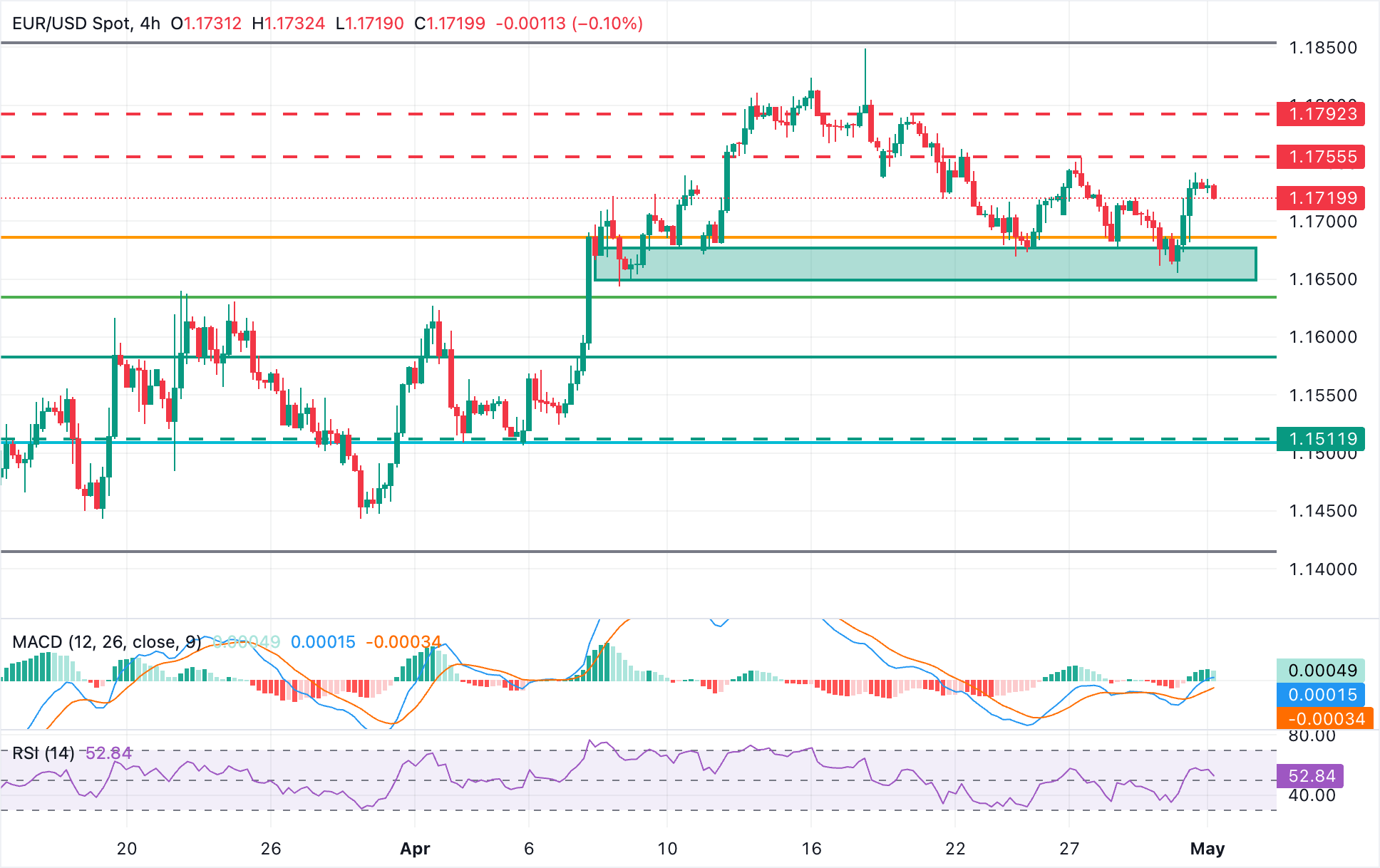
fears of stagflation
From a technical perspective, the EUR/USD remains trapped within a broadly 100-pip range, with support above 1.1650 holding bears and upside attempts limited below 1.1750.
Technical indicators on 4-hour chart are positive, yet showing weak momentum. The Relative Strength Index (RSI) is modestly positive, while the Moving Average Convergence Divergence (MACD) remains above zero, but with a small, flattening green histogram, suggesting that the bullish momentum is frail.
On the topside, April 27 high, in the area of 1.1750 is holding bulls, closing the path towards the April 20 high near 1.1790 and April's peak, right below 1.1850.
Bears, on the other hand, are struggling to extend dips below a cluster of supports between 1.1675 and the April 8 intraday low, near 1.1645. A confirmation below here would clear the way to the 61.8% Fibonacci retracement of the early April rally, at 1.1580, and the April 2 and 3 low, near 1.1500.
(The technical analysis of this story was written with the help of an AI tool.)
Euro FAQs
The Euro is the currency for the 20 European Union countries that belong to the Eurozone. It is the second most heavily traded currency in the world behind the US Dollar. In 2022, it accounted for 31% of all foreign exchange transactions, with an average daily turnover of over $2.2 trillion a day. EUR/USD is the most heavily traded currency pair in the world, accounting for an estimated 30% off all transactions, followed by EUR/JPY (4%), EUR/GBP (3%) and EUR/AUD (2%).
The European Central Bank (ECB) in Frankfurt, Germany, is the reserve bank for the Eurozone. The ECB sets interest rates and manages monetary policy. The ECB’s primary mandate is to maintain price stability, which means either controlling inflation or stimulating growth. Its primary tool is the raising or lowering of interest rates. Relatively high interest rates – or the expectation of higher rates – will usually benefit the Euro and vice versa. The ECB Governing Council makes monetary policy decisions at meetings held eight times a year. Decisions are made by heads of the Eurozone national banks and six permanent members, including the President of the ECB, Christine Lagarde.
Eurozone inflation data, measured by the Harmonized Index of Consumer Prices (HICP), is an important econometric for the Euro. If inflation rises more than expected, especially if above the ECB’s 2% target, it obliges the ECB to raise interest rates to bring it back under control. Relatively high interest rates compared to its counterparts will usually benefit the Euro, as it makes the region more attractive as a place for global investors to park their money.
Data releases gauge the health of the economy and can impact on the Euro. Indicators such as GDP, Manufacturing and Services PMIs, employment, and consumer sentiment surveys can all influence the direction of the single currency. A strong economy is good for the Euro. Not only does it attract more foreign investment but it may encourage the ECB to put up interest rates, which will directly strengthen the Euro. Otherwise, if economic data is weak, the Euro is likely to fall. Economic data for the four largest economies in the euro area (Germany, France, Italy and Spain) are especially significant, as they account for 75% of the Eurozone’s economy.
Another significant data release for the Euro is the Trade Balance. This indicator measures the difference between what a country earns from its exports and what it spends on imports over a given period. If a country produces highly sought after exports then its currency will gain in value purely from the extra demand created from foreign buyers seeking to purchase these goods. Therefore, a positive net Trade Balance strengthens a currency and vice versa for a negative balance.














