

EUR/USD Price Forecast: 200-period EMA to act as key barrier amid Middle East conflicts
- EUR/USD rises to near 1.1570 as ECB’s Lagarde warns of interest rate hikes amid escalating inflation expectations.
- Iran rejects the US ceasefire proposal and wants its own conditions to be fulfilled first before truce talks.
- Tehran wants its authorial recognition on the Strait of Hormuz.
The EUR/USD pair trades slightly higher around 1.1570 during the late Asian trading session on Thursday. The major currency pair edges higher as the US Dollar (USD) trades subduedly, while the broader outlook of the latter remains firm in the wake of Iran’s refusal to the United States (US) President Donald Trump’s ceasefire plan.
During the press time, the US Dollar Index (DXY), which tracks the Greenback’s value against six major currencies, struggles to extend Wednesday’s upside move above 99.70.

According to an Iranian state TV, Tehran would “end the war when it decides to do so and when its own conditions are met”, and until then would continue fighting across the region, The Guardian reported.
Tehran’s conditions include guarantees of no attacks on Iran, allowance to pursue missile program, reparations of war, and toll system on the Strait of Hormuz.
Meanwhile, the Euro (EUR) trades broadly higher as European Central Bank (ECB) President Christine Lagarde has opened the door for interest rate hikes, if inflation proves to be more than temporary. “If the shock gives rise to a large though not-too-persistent overshoot of our target, some measured adjustment of policy could be warranted,” Lagarde said on Wednesday.
Euro Price Today
The table below shows the percentage change of Euro (EUR) against listed major currencies today. Euro was the strongest against the Canadian Dollar.
| USD | EUR | GBP | JPY | CAD | AUD | NZD | CHF | |
|---|---|---|---|---|---|---|---|---|
| USD | -0.09% | 0.00% | -0.02% | 0.07% | -0.09% | -0.00% | -0.01% | |
| EUR | 0.09% | 0.09% | 0.06% | 0.16% | -0.00% | 0.09% | 0.08% | |
| GBP | -0.00% | -0.09% | -0.02% | 0.07% | -0.09% | -0.01% | -0.01% | |
| JPY | 0.02% | -0.06% | 0.02% | 0.09% | -0.07% | -0.00% | 0.01% | |
| CAD | -0.07% | -0.16% | -0.07% | -0.09% | -0.15% | -0.07% | -0.09% | |
| AUD | 0.09% | 0.00% | 0.09% | 0.07% | 0.15% | 0.09% | 0.10% | |
| NZD | 0.00% | -0.09% | 0.00% | 0.00% | 0.07% | -0.09% | -0.01% | |
| CHF | 0.00% | -0.08% | 0.00% | -0.01% | 0.09% | -0.10% | 0.00% |
The heat map shows percentage changes of major currencies against each other. The base currency is picked from the left column, while the quote currency is picked from the top row. For example, if you pick the Euro from the left column and move along the horizontal line to the US Dollar, the percentage change displayed in the box will represent EUR (base)/USD (quote).
EUR/USD technical analysis
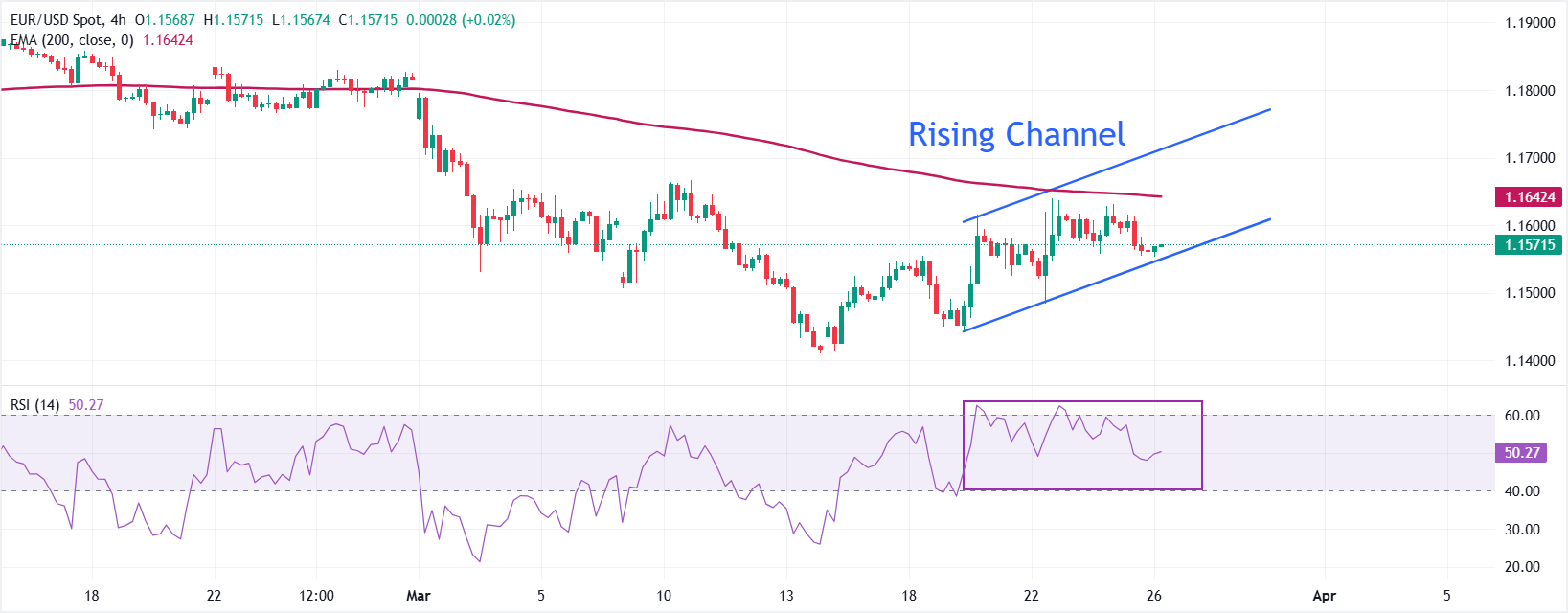
EUR/USD is up 0.1% to near 1.1570 during the press time. The near-term bias is mildly bullish as price trades in a Rising Channel pattern. However, its placement below the gently declining 200-period Exponential Moving Average (EMA) around 1.1642 tempers upside conviction and frames the move as a grind higher within a broader corrective context.
The 14-day Relative Strength Index (RSI) around 50 shows balanced momentum, suggesting the current recovery lacks strong directional pressure but continues to lean upward while the channel support holds.
Initial support is located at the channel bottom near 1.1550, with a break below exposing a deeper pullback toward the prior reaction area around 1.1485. On the topside, the major resistance lies at the 200-period EMA at 1.1642, which acts as a pivotal barrier for any extension of gains within the channel. A sustained move above 1.1642 would open the way toward the channel top above 1.1700, while failure to clear 1.1615 would keep the pair confined to a consolidative climb along the lower half of the ascending structure.
(The technical analysis of this story was written with the help of an AI tool.)
ECB FAQs
The European Central Bank (ECB) in Frankfurt, Germany, is the reserve bank for the Eurozone. The ECB sets interest rates and manages monetary policy for the region. The ECB primary mandate is to maintain price stability, which means keeping inflation at around 2%. Its primary tool for achieving this is by raising or lowering interest rates. Relatively high interest rates will usually result in a stronger Euro and vice versa. The ECB Governing Council makes monetary policy decisions at meetings held eight times a year. Decisions are made by heads of the Eurozone national banks and six permanent members, including the President of the ECB, Christine Lagarde.
In extreme situations, the European Central Bank can enact a policy tool called Quantitative Easing. QE is the process by which the ECB prints Euros and uses them to buy assets – usually government or corporate bonds – from banks and other financial institutions. QE usually results in a weaker Euro. QE is a last resort when simply lowering interest rates is unlikely to achieve the objective of price stability. The ECB used it during the Great Financial Crisis in 2009-11, in 2015 when inflation remained stubbornly low, as well as during the covid pandemic.
Quantitative tightening (QT) is the reverse of QE. It is undertaken after QE when an economic recovery is underway and inflation starts rising. Whilst in QE the European Central Bank (ECB) purchases government and corporate bonds from financial institutions to provide them with liquidity, in QT the ECB stops buying more bonds, and stops reinvesting the principal maturing on the bonds it already holds. It is usually positive (or bullish) for the Euro.














