

EUR/USD Price Forecast: Jumps to near four-year high at 1.1920
作者 Sagar Dua
发布日期: 26 Jan 2026 | 修改日期: 26 Jan 2026


热门文章

The EUR/USD pair is up 0.36% to near 1.1900 during the Asian trading session on Monday. The major currency pair strengthens as the US Dollar (USD) extends last week’s decline amid caution ahead of the Federal Reserve's (Fed) monetary policy announcement on Wednesday.
- EUR/USD gains sharply to near 1.1900 at the start of the week amid a weakened US Dollar.
- Resolved US-EU disputes failed to uplift the US Dollar.
- The Fed is almost certain to hold interest rates steady on Wednesday.
The EUR/USD pair is up 0.36% to near 1.1900 during the Asian trading session on Monday. The major currency pair strengthens as the US Dollar (USD) extends last week’s decline amid caution ahead of the Federal Reserve's (Fed) monetary policy announcement on Wednesday.
As of writing, the US Dollar Index (DXY), which tracks the Greenback’s value against six major currencies, trades 0.4% lower to near 97.00, the lowest level seen in four months.
The US Dollar faces severe selling pressure as concerns over the United States’ (US) long-term trade relations with its trading partners persists despite recent geopolitics and trade tensions between Washington and several European Union (EU) members being resolved.
On Wednesday, the Fed will leave interest rates unchanged in the range of 3.50%-3.75%, according to the CME FedWatch tool. This will be the Fed's first pause after three consecutive interest rate cuts. The Fed reduced borrowing rates by 75 basis points (bps) in late 2025 to support a weak job market.
This week, the major trigger for the Euro (EUR) will be the preliminary Q4 Eurozone Gross Domestic Product (GDP) and the German Harmonized Index of Consumer Prices (HICP) data for January.
EUR/USD technical analysis
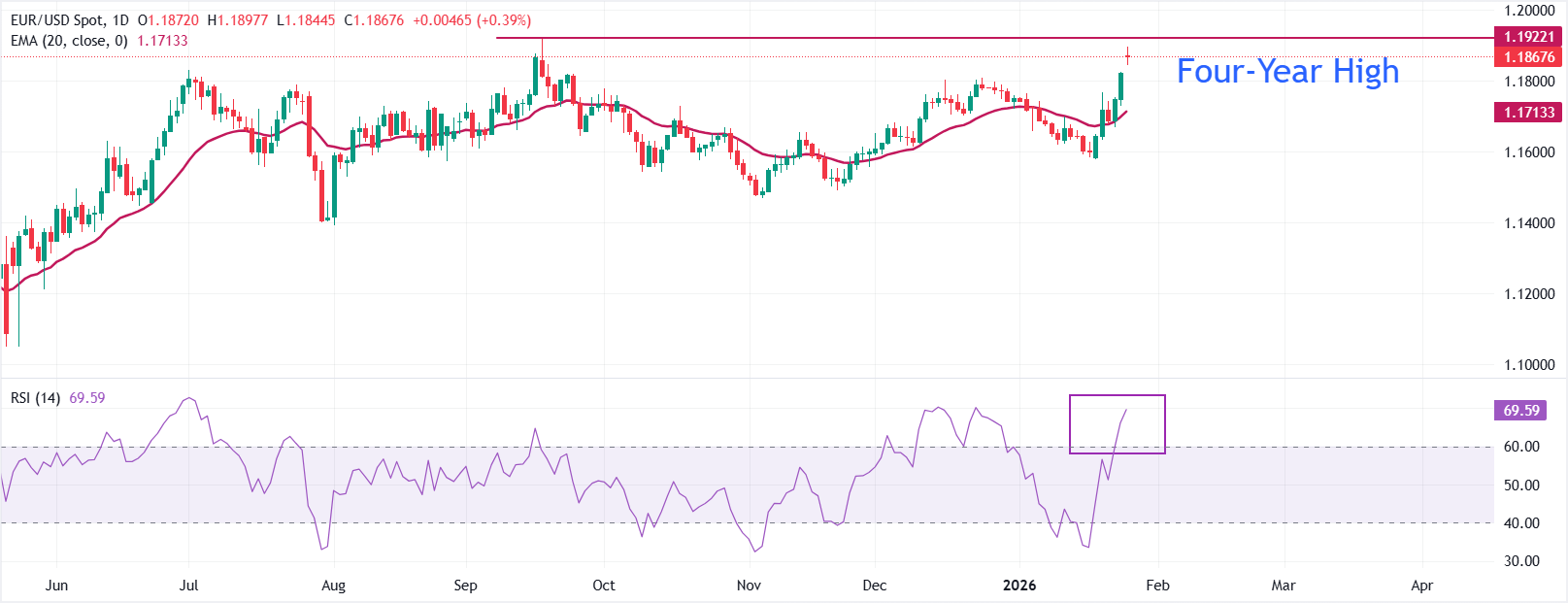
EUR/USD trades higher at around 1.1866 as of writing. Price holds above the 20-day Exponential Moving Average (EMA) at 1.1713, maintaining a bullish short-term bias. The 20-day EMA slopes higher, confirming an improving trend structure.
The 14-day Relative Strength Index (RSI) at 69.49 sits near overbought, signaling firm momentum.
Given momentum running hot, the price is expected to revisit its over four-year high of 1.1919 soon. The asset could discover more upside if it manages to deliver a daily close above the same. On the downside, the 20-day EMA will remain a major support zone for the pair.
(The technical analysis of this story was written with the help of an AI tool.)
Fed FAQs
Monetary policy in the US is shaped by the Federal Reserve (Fed). The Fed has two mandates: to achieve price stability and foster full employment. Its primary tool to achieve these goals is by adjusting interest rates. When prices are rising too quickly and inflation is above the Fed’s 2% target, it raises interest rates, increasing borrowing costs throughout the economy. This results in a stronger US Dollar (USD) as it makes the US a more attractive place for international investors to park their money. When inflation falls below 2% or the Unemployment Rate is too high, the Fed may lower interest rates to encourage borrowing, which weighs on the Greenback.
The Federal Reserve (Fed) holds eight policy meetings a year, where the Federal Open Market Committee (FOMC) assesses economic conditions and makes monetary policy decisions. The FOMC is attended by twelve Fed officials – the seven members of the Board of Governors, the president of the Federal Reserve Bank of New York, and four of the remaining eleven regional Reserve Bank presidents, who serve one-year terms on a rotating basis.
In extreme situations, the Federal Reserve may resort to a policy named Quantitative Easing (QE). QE is the process by which the Fed substantially increases the flow of credit in a stuck financial system. It is a non-standard policy measure used during crises or when inflation is extremely low. It was the Fed’s weapon of choice during the Great Financial Crisis in 2008. It involves the Fed printing more Dollars and using them to buy high grade bonds from financial institutions. QE usually weakens the US Dollar.
Quantitative tightening (QT) is the reverse process of QE, whereby the Federal Reserve stops buying bonds from financial institutions and does not reinvest the principal from the bonds it holds maturing, to purchase new bonds. It is usually positive for the value of the US Dollar.

超过一百万用户依赖 FXStreet 获取实时市场数据、图表工具、专家洞见和外汇新闻。其全面的经济日历和教育网络研讨会帮助交易者保持信息领先、做出审慎决策。FXStreet 拥有约 60 人的团队,分布在巴塞罗那总部及全球各地区。
阅读更多








