

EUR/USD reversal approaches 1.1500 amid higher Oil prices, risk-off markets
- EUR/USD hits session lows below 1.1500 following a knee-jerk reaction at 1.1627.
- Expectations of a protracted Iran war and higher Oil prices are hammering the Euro on Thursday.
- Technical indicators show growing bearish momentum with support at 1.1440 on the bears' focus.
The Euro declines more than 0.5% against the safe-haven US Dollar on Thursday, extending its reversal from Wednesday’s highs at 1.1625 to session lows just below 1.1520 so far. Fading hopes of a swift end to the Iran war have reactivated risk-off trades, supporting the Greenback and boosting Oil prices, to the detriment of the crude-importing Eurozone economies.
US President Donald Trump failed to provide any specific deadline for the Iran war in a televised message on Wednesday, as everybody was expecting. Instead, he reiterated the bellicose rhetoric and repeated his calls on allies to “build up the courage” to secure the Strait of Hormuz. The risk appetite witnessed over the previous two days vanished, equities dropped, and Oil and the US Dollar soared.
Technical Analysis: Bears aim for the 1.1440 area
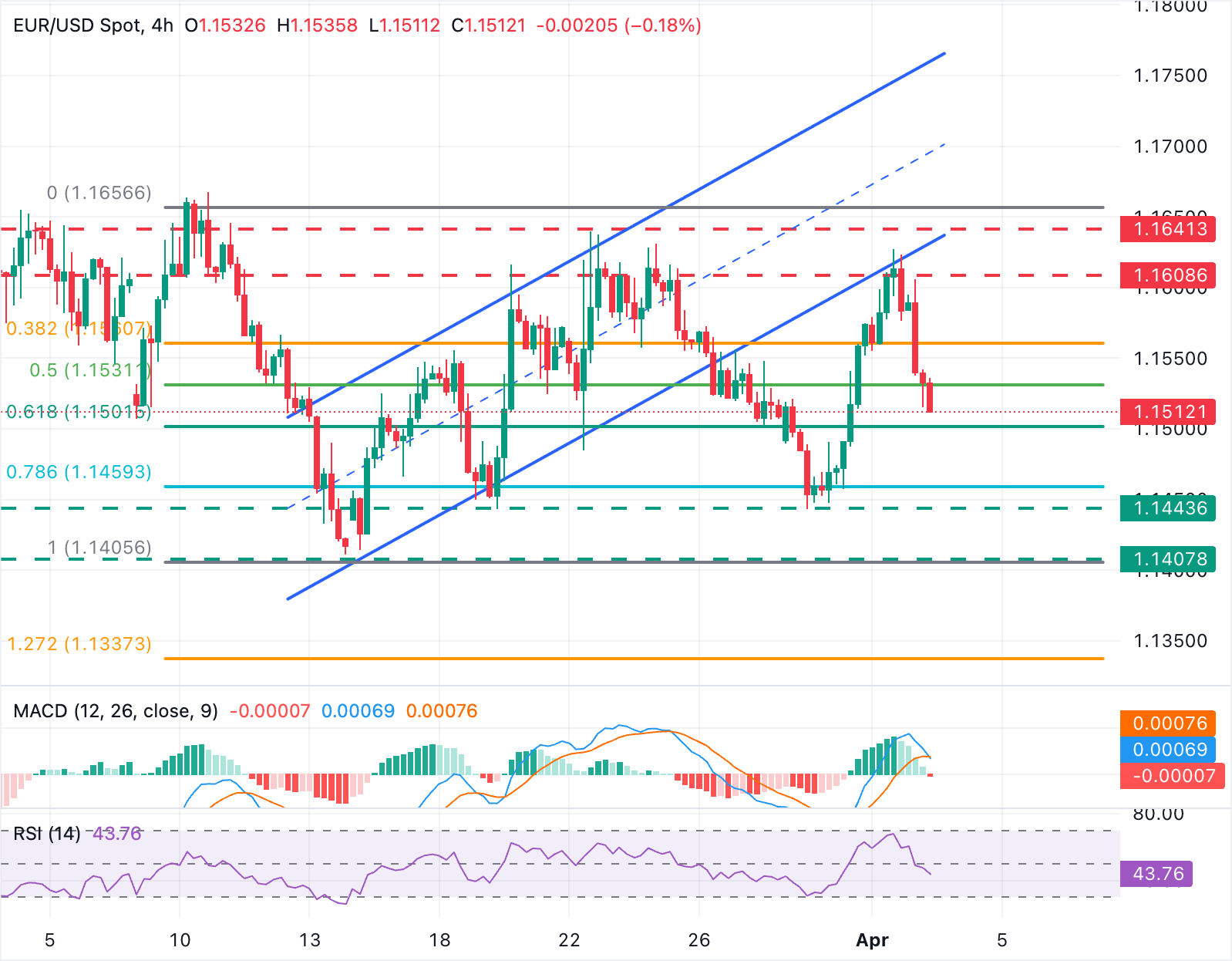
EUR/USD recovery was capped on Wednesday at the reverse trendline of the broken bullish channel, right below 1.1630, which confirms the broader bearish trend.
Technical indicators are also turning negative, with the Moving Average Convergence Divergence (MACD) about to close below the signal line, suggesting fading upside momentum, and the Relative Strength Index (RSI) below the 50 line that divides the bullish from the bearish territory.
The knee-jerk reaction featured by the Euro has increased pressure towards the March 19 and 31 lows, around 1.1440 ahead of the March 13 low at 1.1411. Further down, thje 127.2% Fibonacci extension of the early March sell-off lies at 1.1327. On the upside, Immediate resistance emerges at the 1.1606, session high ahead of the mentioned reverse trendline, now at 1.1630, and the March 23 high, near 1.1640.
(The technical analysis of this story was written with the help of an AI tool.)
Euro FAQs
The Euro is the currency for the 20 European Union countries that belong to the Eurozone. It is the second most heavily traded currency in the world behind the US Dollar. In 2022, it accounted for 31% of all foreign exchange transactions, with an average daily turnover of over $2.2 trillion a day. EUR/USD is the most heavily traded currency pair in the world, accounting for an estimated 30% off all transactions, followed by EUR/JPY (4%), EUR/GBP (3%) and EUR/AUD (2%).
The European Central Bank (ECB) in Frankfurt, Germany, is the reserve bank for the Eurozone. The ECB sets interest rates and manages monetary policy. The ECB’s primary mandate is to maintain price stability, which means either controlling inflation or stimulating growth. Its primary tool is the raising or lowering of interest rates. Relatively high interest rates – or the expectation of higher rates – will usually benefit the Euro and vice versa. The ECB Governing Council makes monetary policy decisions at meetings held eight times a year. Decisions are made by heads of the Eurozone national banks and six permanent members, including the President of the ECB, Christine Lagarde.
Eurozone inflation data, measured by the Harmonized Index of Consumer Prices (HICP), is an important econometric for the Euro. If inflation rises more than expected, especially if above the ECB’s 2% target, it obliges the ECB to raise interest rates to bring it back under control. Relatively high interest rates compared to its counterparts will usually benefit the Euro, as it makes the region more attractive as a place for global investors to park their money.
Data releases gauge the health of the economy and can impact on the Euro. Indicators such as GDP, Manufacturing and Services PMIs, employment, and consumer sentiment surveys can all influence the direction of the single currency. A strong economy is good for the Euro. Not only does it attract more foreign investment but it may encourage the ECB to put up interest rates, which will directly strengthen the Euro. Otherwise, if economic data is weak, the Euro is likely to fall. Economic data for the four largest economies in the euro area (Germany, France, Italy and Spain) are especially significant, as they account for 75% of the Eurozone’s economy.
Another significant data release for the Euro is the Trade Balance. This indicator measures the difference between what a country earns from its exports and what it spends on imports over a given period. If a country produces highly sought after exports then its currency will gain in value purely from the extra demand created from foreign buyers seeking to purchase these goods. Therefore, a positive net Trade Balance strengthens a currency and vice versa for a negative balance.














