

EUR/USD: Supreme Court tariff ruling and Fed speaker lineup drive midweek volatility
- US President Trump plans to raise temporary tariffs to 15% after the Supreme Court struck down broader emergency tariffs, keeping trade policy uncertainty elevated.
- Eurozone Purchasing Managers Index data showed private-sector activity expanding at its fastest pace since November, while German business morale hit a six-month high.
- Euro area inflation figures from Germany, France, and Spain are due later this week.
The Euro (EUR) is trading near the 1.1775 level on Tuesday after recovering from a one-month low last week. The US Dollar (USD) found renewed support from Federal Reserve (Fed) minutes that showed policymakers split on the interest rate outlook, with markets pricing virtually no chance of a cut in March and around 80% probability of a hold in April.

Fed Chair Jerome Powell's term expires in May, adding another layer of uncertainty to the policy path. On the Euro side, the European Central Bank (ECB) is effectively on hold with inflation near its 2% target, and ECB President Christine Lagarde confirmed she will serve out her full term. US Consumer Confidence data and several Fed speeches on Tuesday, along with delayed US jobs and inflation reports later this week, will shape near-term direction.
Fibers drifts around key averages as Stochastic approaches oversold
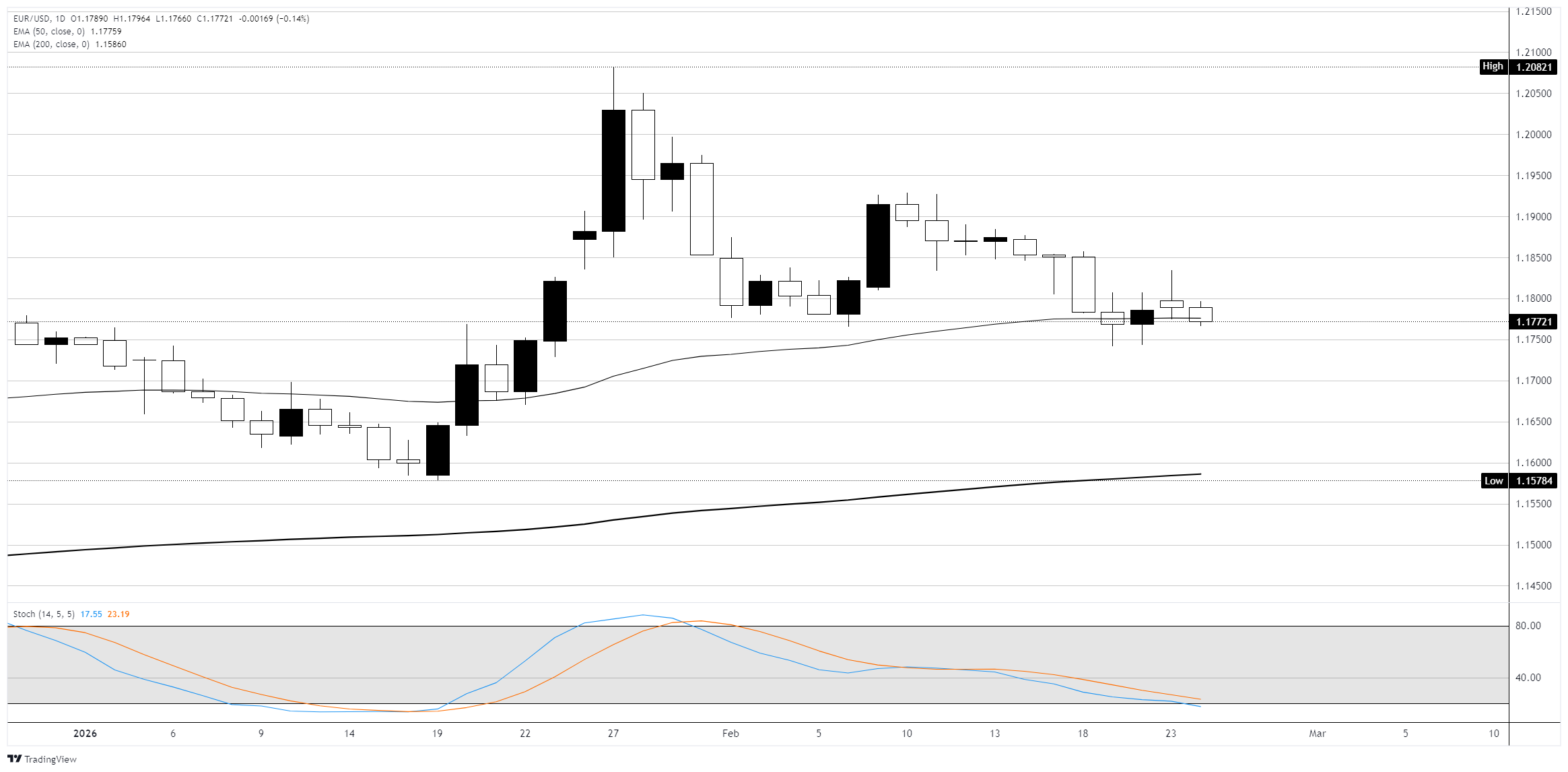
On the daily chart, EUR/USD edges lower by 0.12% on Tuesday, settling near the 50-day Exponential Moving Average (EMA) near 1.1775 following a muted European trading session. The pair has pulled back steadily from the January high near 1.2080, giving up roughly 300 pips across a month-long decline defined by a sequence of lower highs and lower lows. Price is holding well above the rising 200-day EMA at 1.1585, which continues to confirm the broader bullish structure from the early-January swing low near 1.1580. The Stochastic Oscillator has crossed bearish and is approaching the oversold zone, suggesting downside momentum may be nearing exhaustion. A cluster of small-bodied candles over recent sessions near the 50 EMA points to indecision at this level. Immediate support sits at the 1.1750 area, with the psychological 1.1700 handle below; a sustained break lower would expose the 1.1578 swing low. A bounce from the 50 EMA and reclaim of 1.1830 would be needed to shift near-term bias back toward the 1.1900 to 1.1950 resistance zone.
EUR/USD daily chart
(This story was corrected on February 24 at 16:35 to say that EUR/USD edges lower on Tuesday, not Monday.)
Euro FAQs
The Euro is the currency for the 20 European Union countries that belong to the Eurozone. It is the second most heavily traded currency in the world behind the US Dollar. In 2022, it accounted for 31% of all foreign exchange transactions, with an average daily turnover of over $2.2 trillion a day. EUR/USD is the most heavily traded currency pair in the world, accounting for an estimated 30% off all transactions, followed by EUR/JPY (4%), EUR/GBP (3%) and EUR/AUD (2%).
The European Central Bank (ECB) in Frankfurt, Germany, is the reserve bank for the Eurozone. The ECB sets interest rates and manages monetary policy. The ECB’s primary mandate is to maintain price stability, which means either controlling inflation or stimulating growth. Its primary tool is the raising or lowering of interest rates. Relatively high interest rates – or the expectation of higher rates – will usually benefit the Euro and vice versa. The ECB Governing Council makes monetary policy decisions at meetings held eight times a year. Decisions are made by heads of the Eurozone national banks and six permanent members, including the President of the ECB, Christine Lagarde.
Eurozone inflation data, measured by the Harmonized Index of Consumer Prices (HICP), is an important econometric for the Euro. If inflation rises more than expected, especially if above the ECB’s 2% target, it obliges the ECB to raise interest rates to bring it back under control. Relatively high interest rates compared to its counterparts will usually benefit the Euro, as it makes the region more attractive as a place for global investors to park their money.
Data releases gauge the health of the economy and can impact on the Euro. Indicators such as GDP, Manufacturing and Services PMIs, employment, and consumer sentiment surveys can all influence the direction of the single currency. A strong economy is good for the Euro. Not only does it attract more foreign investment but it may encourage the ECB to put up interest rates, which will directly strengthen the Euro. Otherwise, if economic data is weak, the Euro is likely to fall. Economic data for the four largest economies in the euro area (Germany, France, Italy and Spain) are especially significant, as they account for 75% of the Eurozone’s economy.
Another significant data release for the Euro is the Trade Balance. This indicator measures the difference between what a country earns from its exports and what it spends on imports over a given period. If a country produces highly sought after exports then its currency will gain in value purely from the extra demand created from foreign buyers seeking to purchase these goods. Therefore, a positive net Trade Balance strengthens a currency and vice versa for a negative balance.














