

Euro depreciates further as the US–Iran ceasefire teeters
- EUR/USD extends losses for the third consecutive day and consolidates below 1.1700.
- Investors' fears of the resumption of hostilities between the US and Iran have crushed risk appetite.
- The pair approaches a key support area below 1.1675.
The Euro (EUR) extends losses against the US Dollar (USD) for the third consecutive day, as investors' concerns about the resumption of hostilities between the US and Iran have crushed risk appetite. The pair trades around 1.1680 at the time of writing and approaches a key resistance area between 1.1645 and 1.1675.
US President Donald Trump’s decision to free vessels stranded in the Strait of Hormuz stirred the hornet's nest on Monday. At least one ship has been reported crossing the waterway, scorted by US military, but several others have reported fires and explosions, and Iranian missiles hit an Oil port in the United Arab Emirates (UAE) that hosts a military base.

These skirmishes are keeping investors on edge about a full resumption of the conflict, while Oil prices remain well above the $100 level. The US benchmark West Texas Intermediate (WTI) trades at $101.40 at the time of writing, and the Brent Oil at $111.58, approaching four-year highs at $114.30. These prices put Eurozone Crude-importing economies under significant pressure and pose a strong weight on the Euro.
Later in the day, the European Central Bank President Christine Lagarde will speak in Frankfurt and might give further details about the central bank’s monetary tightening calendar. In the US, the S&P Global and, a few hours later, the ISM Services Purchasing Managers’ Indexes (PMIs) will be the main focus on Tuesday ahead of April’s jobs reports due later this week.
Technical Analysis: A retest of the 1.1645-1.1675 support area is on the cards
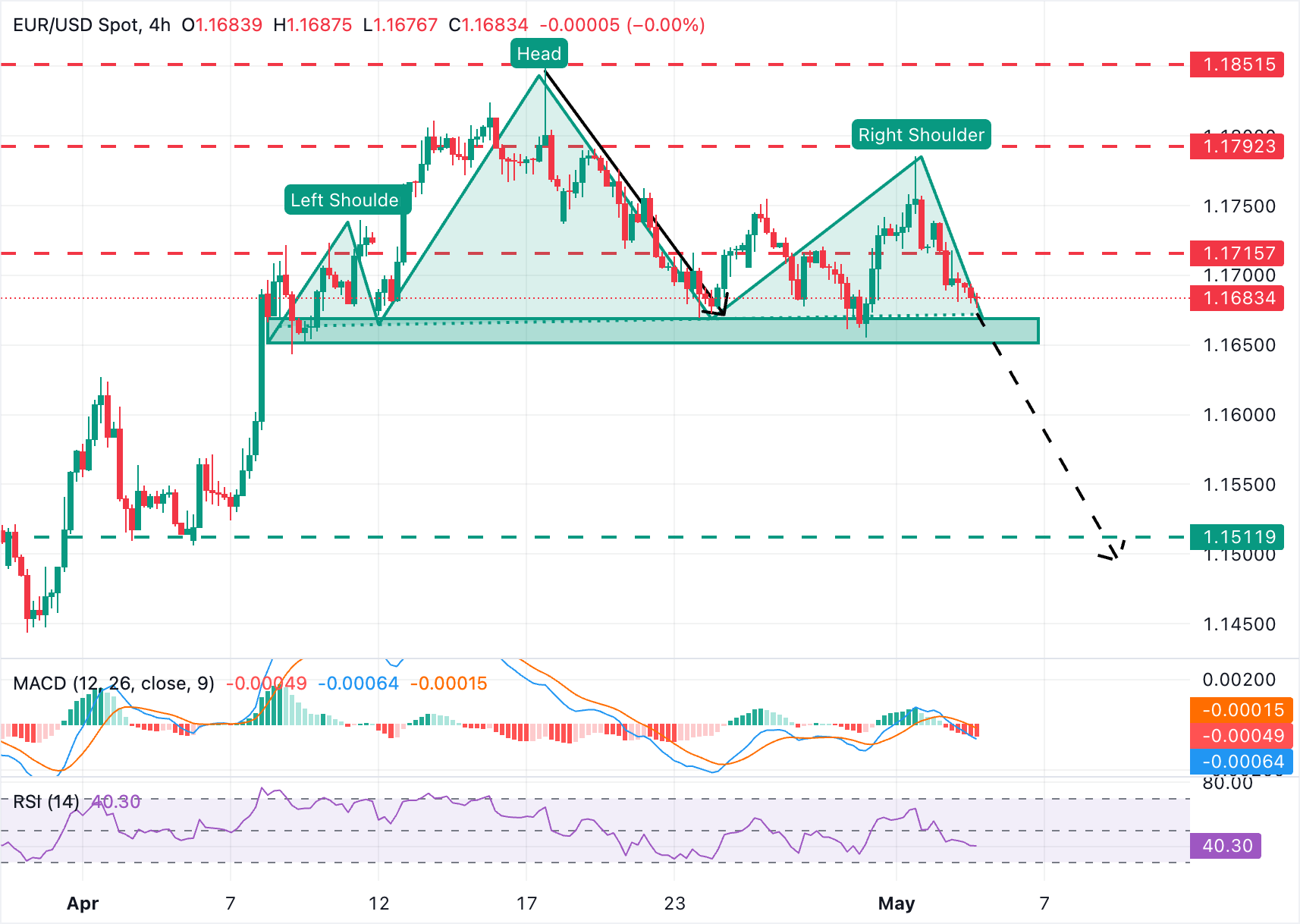
EUR/USD is showing a growing bearish momentum, with price action nearing the support area between 1.1645 and 1.1675, which has held downside attempts several times in April.
Momentum indicators are deepening within bearish territory. The 4-hour Relative Strength Index (RSI) dives to around 40, while the Moving Average Convergence Divergence (MACD) drifts into negative territory with a mildly bearish tone, suggesting that upside attempts may continue to struggle.
The mentioned support area above 1.1645, however, is likely to pose a significant challenge for bears. A clear break below that area would confirm a bearish Head & Shoulders pattern, with a measured target just below April lows in the 1.1500 area.
On the upside, Friday's low, at 1.1715, might act as resistance ahead of the April 20 and May 1 highs in the area between 1.1785 and 1.1795, and the April 17 high, near 1.1850.
(The technical analysis of this story was written with the help of an AI tool.)
Risk sentiment FAQs
In the world of financial jargon the two widely used terms “risk-on” and “risk off'' refer to the level of risk that investors are willing to stomach during the period referenced. In a “risk-on” market, investors are optimistic about the future and more willing to buy risky assets. In a “risk-off” market investors start to ‘play it safe’ because they are worried about the future, and therefore buy less risky assets that are more certain of bringing a return, even if it is relatively modest.
Typically, during periods of “risk-on”, stock markets will rise, most commodities – except Gold – will also gain in value, since they benefit from a positive growth outlook. The currencies of nations that are heavy commodity exporters strengthen because of increased demand, and Cryptocurrencies rise. In a “risk-off” market, Bonds go up – especially major government Bonds – Gold shines, and safe-haven currencies such as the Japanese Yen, Swiss Franc and US Dollar all benefit.
The Australian Dollar (AUD), the Canadian Dollar (CAD), the New Zealand Dollar (NZD) and minor FX like the Ruble (RUB) and the South African Rand (ZAR), all tend to rise in markets that are “risk-on”. This is because the economies of these currencies are heavily reliant on commodity exports for growth, and commodities tend to rise in price during risk-on periods. This is because investors foresee greater demand for raw materials in the future due to heightened economic activity.
The major currencies that tend to rise during periods of “risk-off” are the US Dollar (USD), the Japanese Yen (JPY) and the Swiss Franc (CHF). The US Dollar, because it is the world’s reserve currency, and because in times of crisis investors buy US government debt, which is seen as safe because the largest economy in the world is unlikely to default. The Yen, from increased demand for Japanese government bonds, because a high proportion are held by domestic investors who are unlikely to dump them – even in a crisis. The Swiss Franc, because strict Swiss banking laws offer investors enhanced capital protection.














