

Euro falls back as US Dollar recovers early losses
- The Euro gives back a majority of its early gains against the US Dollar as the latter bounces back.
- Renewed Middle East hostilities have improved the US Dollar’s safe-haven demand.
- Traders raise hawkish ECB bets as renewed US-Iran tensions boost oil prices.
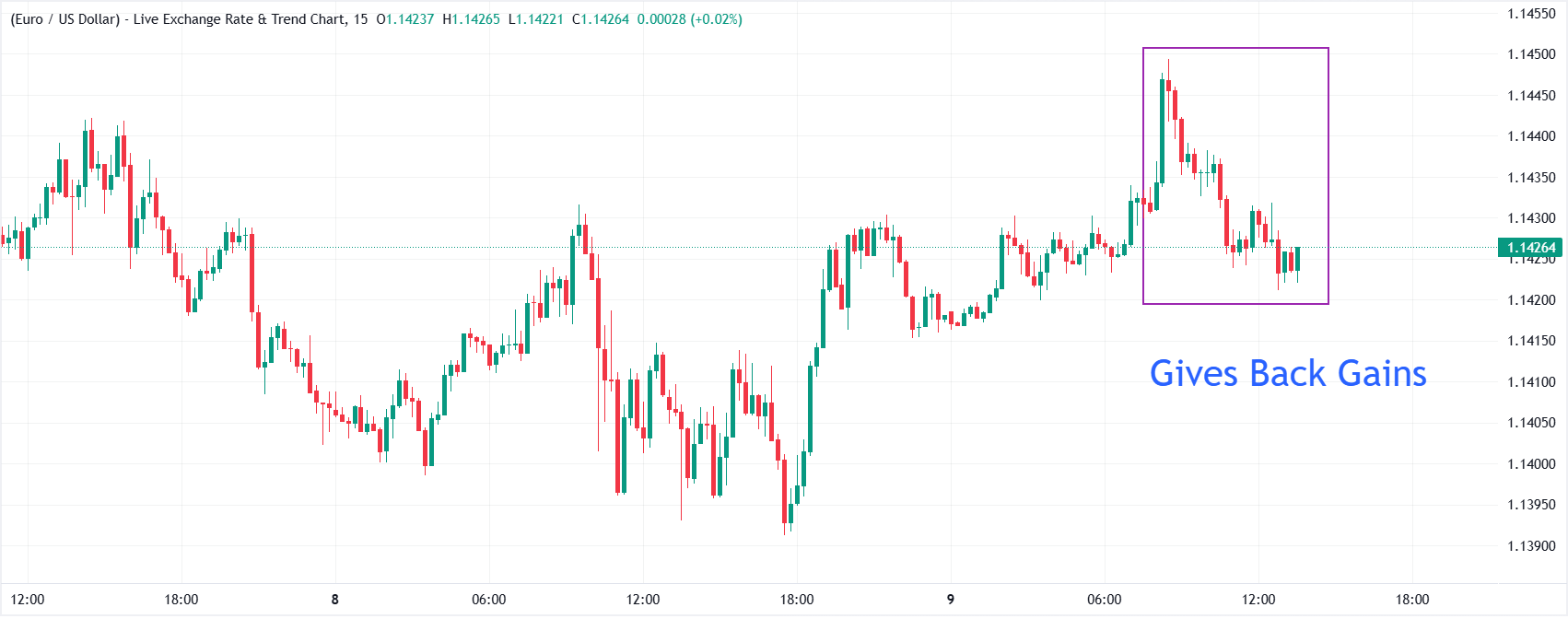
The Euro (EUR) retreats to near 1.1425 against the US Dollar (USD) during the European trading session on Thursday. The major currency pair falls back as the US Dollar claws back a majority of its early losses, with the appeal of safe-haven assets improving in the wake of renewed geopolitical risks.
As of writing, the US Dollar Index (DXY), which gauges the Greenback’s value against six major currencies, trades marginally lower around 101.00 after rebounding from the day’s low of 100.80.

The exchange of attacks between the United States (US) and Iran, following confirmation from President Donald Trump that the Memorandum of Understanding (MoU) with Iran is over, has lifted the safe-haven demand.
The US military forces have also attacked Iranian infrastructure, which suggests that tensions could remain prolonged.
Higher oil prices due to diminished traffic near the Strait of Hormuz have de-anchored inflation expectations again, a scenario that could discourage Federal Reserve (Fed) officials further from reducing interest rates this year.
The Federal Open Market Committee (FOMC) Minutes of the June policy meeting, released on Wednesday, also showed that policymakers continue to see “inflation as the dominant risk”, and several officials still believe further tightening could become necessary.
Meanwhile, traders have raised hawkish European Central Bank (ECB) as oil prices have increased significantly after the US-Iran went back to square.
According to a Reuters report, traders have priced in another 30 basis points (bps) increase in policy rates this year. In June, the ECB raised its key rates by 25 bps.
US Dollar FAQs
The US Dollar (USD) is the official currency of the United States of America, and the ‘de facto’ currency of a significant number of other countries where it is found in circulation alongside local notes. It is the most heavily traded currency in the world, accounting for over 88% of all global foreign exchange turnover, or an average of $6.6 trillion in transactions per day, according to data from 2022. Following the second world war, the USD took over from the British Pound as the world’s reserve currency. For most of its history, the US Dollar was backed by Gold, until the Bretton Woods Agreement in 1971 when the Gold Standard went away.
The most important single factor impacting on the value of the US Dollar is monetary policy, which is shaped by the Federal Reserve (Fed). The Fed has two mandates: to achieve price stability (control inflation) and foster full employment. Its primary tool to achieve these two goals is by adjusting interest rates. When prices are rising too quickly and inflation is above the Fed’s 2% target, the Fed will raise rates, which helps the USD value. When inflation falls below 2% or the Unemployment Rate is too high, the Fed may lower interest rates, which weighs on the Greenback.
In extreme situations, the Federal Reserve can also print more Dollars and enact quantitative easing (QE). QE is the process by which the Fed substantially increases the flow of credit in a stuck financial system. It is a non-standard policy measure used when credit has dried up because banks will not lend to each other (out of the fear of counterparty default). It is a last resort when simply lowering interest rates is unlikely to achieve the necessary result. It was the Fed’s weapon of choice to combat the credit crunch that occurred during the Great Financial Crisis in 2008. It involves the Fed printing more Dollars and using them to buy US government bonds predominantly from financial institutions. QE usually leads to a weaker US Dollar.
Quantitative tightening (QT) is the reverse process whereby the Federal Reserve stops buying bonds from financial institutions and does not reinvest the principal from the bonds it holds maturing in new purchases. It is usually positive for the US Dollar.














