

GBP/USD runs out of gas after BoE hawkish hold ahead of Friday data deluge
- The BoE held Bank Rate at 3.75% in an 8-1 hawkish split, with Huw Pill alone calling for a 25 basis point hike.
- Friday's ISM Manufacturing PMI is forecast at 53, with the Prices Paid sub-index seen at 80 amid oil-fed cost pressure.
- Next Friday's US Non-Farm Payrolls anchors a US data-dominated week, with the UK calendar largely silent.
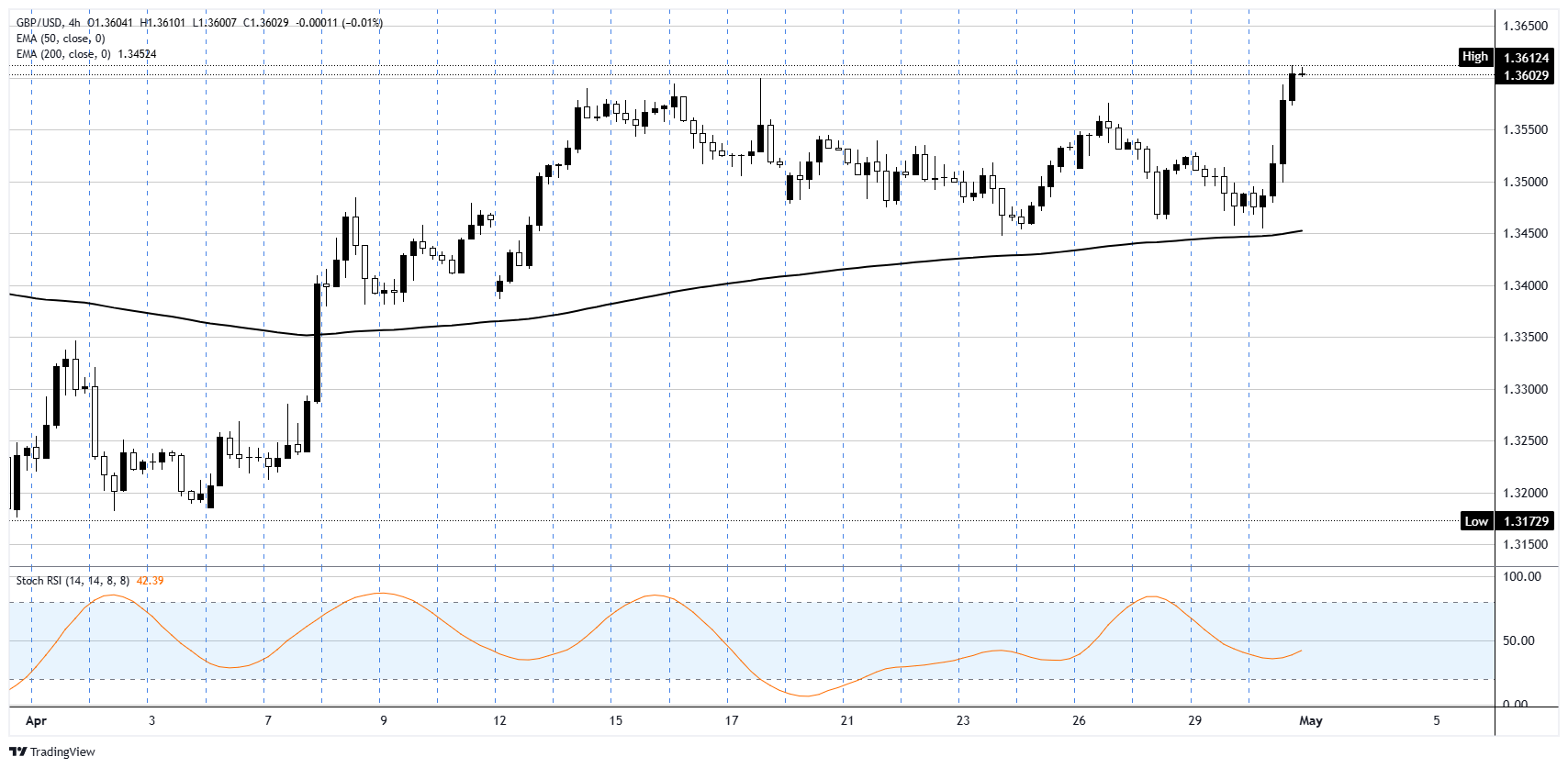
GBP/USD rallied 0.96% on Thursday, settling near 1.3600 after a choppy session that saw cable test the 1.3455 area in the European morning before catching a sharp bid through the New York afternoon. The daily candle left a long lower wick from the morning low, with price stalling close to the 1.3600 round figure into the late session.

The Bank of England (BoE) left its main Bank Rate at 3.75% in an 8-1 vote, with chief economist Huw Pill the lone dissenter pushing for a 25 basis point hike. Governor Andrew Bailey leaned into second-round inflation risks during the press conference, signaling that the Monetary Policy Committee (MPC) is prepared to act pre-emptively if energy-driven price pressure begins feeding into wages. On the US side, the Personal Consumption Expenditures (PCE) Price Index rose 3.5% YoY in March, in line with forecasts, while preliminary Q1 Gross Domestic Product (GDP) growth printed at 2% against the 2.3% consensus, a softer undertone that weighed on the Dollar through the New York afternoon.
Friday's session brings the Institute for Supply Management Manufacturing Purchasing Managers Index (ISM Manufacturing PMI), with consensus at 53 and the Prices Paid sub-index forecast at 80, a level that would point to sticky cost pressure if confirmed. BoE chief economist Huw Pill also speaks during the European morning and could lean more hawkishly than Bailey did on Thursday, given his vote for a hike. Beyond Friday, the UK calendar is effectively empty next week, with a bank holiday on Monday and no top-tier domestic releases. The US slate is the inverse, headlined by ISM Services PMI on Tuesday, the ADP Employment Change print on Wednesday, and culminating in next Friday's Non-Farm Payrolls (NFP) report, which is likely to set the near-term direction for cable.
GBP/USD, 4-hour chart
Pound Sterling FAQs
The Pound Sterling (GBP) is the oldest currency in the world (886 AD) and the official currency of the United Kingdom. It is the fourth most traded unit for foreign exchange (FX) in the world, accounting for 12% of all transactions, averaging $630 billion a day, according to 2022 data. Its key trading pairs are GBP/USD, also known as ‘Cable’, which accounts for 11% of FX, GBP/JPY, or the ‘Dragon’ as it is known by traders (3%), and EUR/GBP (2%). The Pound Sterling is issued by the Bank of England (BoE).
The single most important factor influencing the value of the Pound Sterling is monetary policy decided by the Bank of England. The BoE bases its decisions on whether it has achieved its primary goal of “price stability” – a steady inflation rate of around 2%. Its primary tool for achieving this is the adjustment of interest rates. When inflation is too high, the BoE will try to rein it in by raising interest rates, making it more expensive for people and businesses to access credit. This is generally positive for GBP, as higher interest rates make the UK a more attractive place for global investors to park their money. When inflation falls too low it is a sign economic growth is slowing. In this scenario, the BoE will consider lowering interest rates to cheapen credit so businesses will borrow more to invest in growth-generating projects.
Data releases gauge the health of the economy and can impact the value of the Pound Sterling. Indicators such as GDP, Manufacturing and Services PMIs, and employment can all influence the direction of the GBP. A strong economy is good for Sterling. Not only does it attract more foreign investment but it may encourage the BoE to put up interest rates, which will directly strengthen GBP. Otherwise, if economic data is weak, the Pound Sterling is likely to fall.
Another significant data release for the Pound Sterling is the Trade Balance. This indicator measures the difference between what a country earns from its exports and what it spends on imports over a given period. If a country produces highly sought-after exports, its currency will benefit purely from the extra demand created from foreign buyers seeking to purchase these goods. Therefore, a positive net Trade Balance strengthens a currency and vice versa for a negative balance.














