

Gold breaks above $4,400 as geopolitical tensions and Fed outlook lift demand
作者 Vishal Chaturvedi
发布日期: 22 Dec 2025 | 修改日期: 22 Dec 2025


热门文章

Gold (XAU/USD) surges to fresh record highs on Monday, as escalating geopolitical tensions bolster safe-haven demand. At the time of writing, XAU/USD is trading around $4,424, up about 2% on the day, after breaking above the October 20 peak near $4,381.
- Gold jumps to fresh record highs as escalating geopolitical tensions lift safe-haven demand.
- Dovish Fed expectations and a softer US Dollar continue to underpin the broader bullish bias
- Technically, XAU/USD maintains a bullish bias above rising moving averages despite an overbought RSI.
Gold (XAU/USD) surges to fresh record highs on Monday, as escalating geopolitical tensions bolster safe-haven demand. At the time of writing, XAU/USD is trading around $4,424, up about 2% on the day, after breaking above the October 20 peak near $4,381.
The precious metal is on track for its strongest annual performance since 1979, with prices up nearly 67% year to date. The rally has been fuelled by a dovish Federal Reserve (Fed) stance, broadly weaker US Dollar (USD), sustained central-bank buying and record inflows into Gold-backed ETFs.
Looking ahead, markets continue to anticipate further monetary policy easing by the Fed into 2026, as recent data indicate cooling inflationary pressure and a softer US labor market. A lower interest-rate environment typically supports non-yielding assets such as Gold.
As markets drift toward the year-end and liquidity thins with major data releases largely drying up, Gold may consolidate in the near term or see mild profit-taking after the recent surge before attempting another push into uncharted territory.
However, a handful of US economic releases on Tuesday may still provide short-term direction, with attention on the ADP Employment Change four-week average, the delayed preliminary Q3 Gross Domestic Product (GDP) report, Durable Goods Orders, Industrial Production, and Consumer Confidence.
Market movers: Rising geopolitical tensions and Fed signals keep markets cautious
- On the geopolitical front, renewed Iran-Israel tensions are reinforcing risk-off sentiment. Reports suggest Iran may use large-scale military drills as a potential cover for offensive operations. Israeli officials have also warned that Tehran may be reconstituting nuclear enrichment facilities previously targeted by US strikes in June. Meanwhile, Israeli Prime Minister Benjamin Netanyahu is expected to brief US President Donald Trump on possible options to strike Iran’s missile program again.
- Tensions between the US and Venezuela have also escalated sharply. US forces have intercepted and pursued another oil tanker near Venezuelan waters after seizing two tankers last week. The latest action follows an order by President Donald Trump to impose a blockade on sanctioned Oil tankers entering and leaving Venezuela.
- US-led Ukraine peace talks showed mixed progress over the weekend amid ongoing conflict. US, European, Ukrainian, and Russian envoys held discussions in Miami, with US special envoy Steve Witkoff describing the talks as “productive and constructive,” particularly around the development of a 20-point peace plan and potential security guarantees for Kyiv. Still, no major breakthrough emerged, as Moscow continues to hold firm on territorial demands.
- On the monetary policy front, markets are currently pricing in two Fed rate cuts in 2026. However, Fed officials remain divided on the need for additional monetary easing following cumulative cuts of 75 basis points (bps) this year. Cleveland Fed President Beth Hammack, a future 2026 FOMC voter, signaled in a Wall Street Journal interview that she sees no need to adjust interest rates for several months ahead, arguing that inflation remains a key concern even after recent easing moves and suggesting the central bank could hold the policy rate in its current 3.50%-3.75% range into the spring.
- A softer US Dollar is providing additional tailwind by making the metal cheaper for overseas buyers. The US Dollar Index (DXY), which tracks the Greenback's value against a basket of six major currencies, trades around 98.46, easing after climbing to a one-week high on Friday.
Technical analysis: XAU/USD holds bullish bias despite overbought RSI
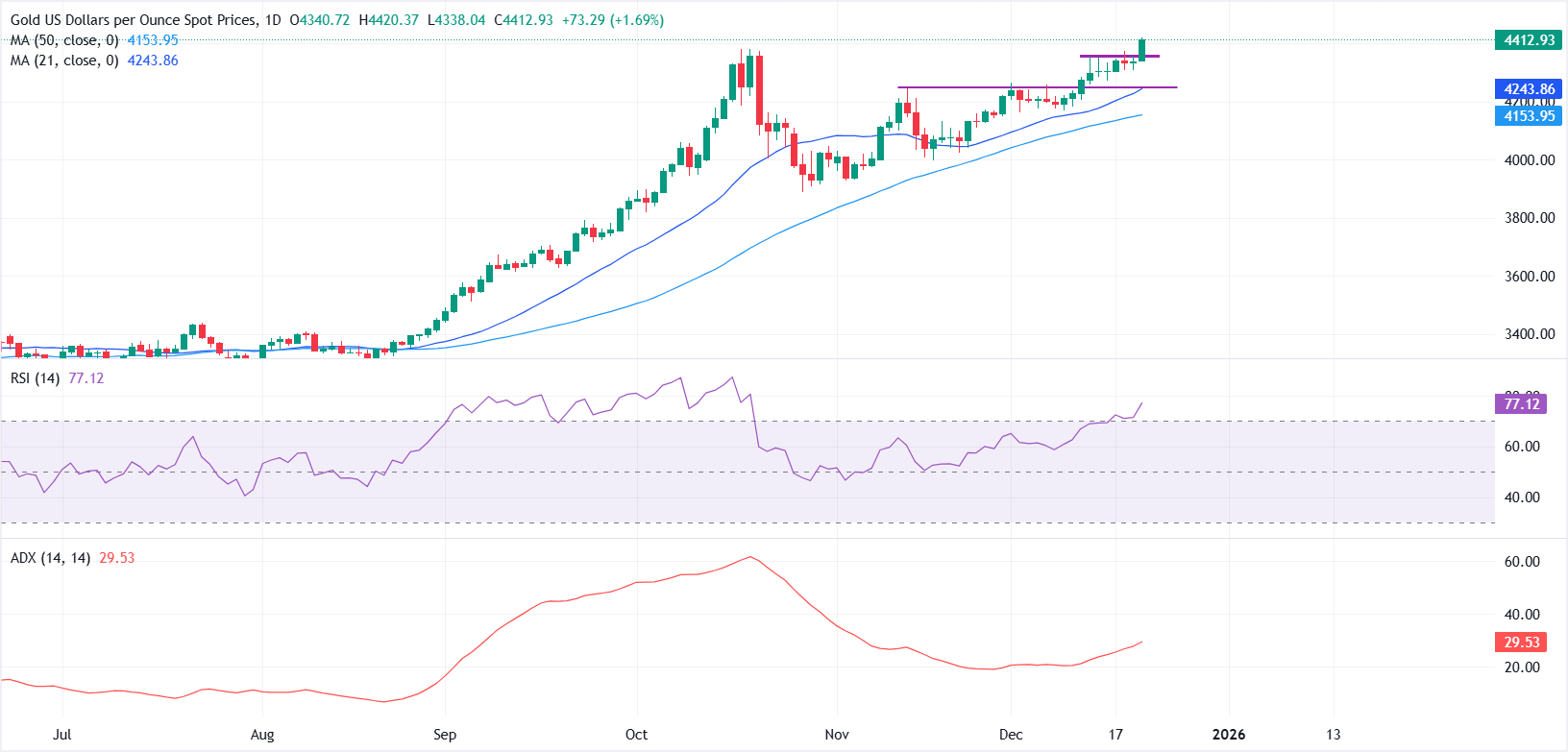
XAU/USD resumes its broader uptrend, climbing back into uncharted territory after navigating a healthy period of correction and consolidation, defying earlier concerns about an overstretched rally.
On the daily chart, Gold continues to trade comfortably above its 21-day Simple Moving Average (SMA) near $4,244 and the 50-day SMA around $4,154, both of which slope higher and reinforce the bullish bias. As long as prices hold above these dynamic supports, dips are likely to attract buyers.
The Relative Strength Index (RSI) stands near 77, firmly in overbought territory, suggesting strong upside momentum, though also signalling scope for short-term consolidation or shallow pullbacks. Meanwhile, the Average Directional Index (ADX) rises to 29.53, reinforcing the bullish backdrop.
(This story was corrected on December 22 at 14:40 GMT to say in the first paragraph that Gold's price peak near $4,381 was on October 20, not 21)
Gold FAQs
Gold has played a key role in human’s history as it has been widely used as a store of value and medium of exchange. Currently, apart from its shine and usage for jewelry, the precious metal is widely seen as a safe-haven asset, meaning that it is considered a good investment during turbulent times. Gold is also widely seen as a hedge against inflation and against depreciating currencies as it doesn’t rely on any specific issuer or government.
Central banks are the biggest Gold holders. In their aim to support their currencies in turbulent times, central banks tend to diversify their reserves and buy Gold to improve the perceived strength of the economy and the currency. High Gold reserves can be a source of trust for a country’s solvency. Central banks added 1,136 tonnes of Gold worth around $70 billion to their reserves in 2022, according to data from the World Gold Council. This is the highest yearly purchase since records began. Central banks from emerging economies such as China, India and Turkey are quickly increasing their Gold reserves.
Gold has an inverse correlation with the US Dollar and US Treasuries, which are both major reserve and safe-haven assets. When the Dollar depreciates, Gold tends to rise, enabling investors and central banks to diversify their assets in turbulent times. Gold is also inversely correlated with risk assets. A rally in the stock market tends to weaken Gold price, while sell-offs in riskier markets tend to favor the precious metal.
The price can move due to a wide range of factors. Geopolitical instability or fears of a deep recession can quickly make Gold price escalate due to its safe-haven status. As a yield-less asset, Gold tends to rise with lower interest rates, while higher cost of money usually weighs down on the yellow metal. Still, most moves depend on how the US Dollar (USD) behaves as the asset is priced in dollars (XAU/USD). A strong Dollar tends to keep the price of Gold controlled, whereas a weaker Dollar is likely to push Gold prices up.

超过一百万用户依赖 FXStreet 获取实时市场数据、图表工具、专家洞见和外汇新闻。其全面的经济日历和教育网络研讨会帮助交易者保持信息领先、做出审慎决策。FXStreet 拥有约 60 人的团队,分布在巴塞罗那总部及全球各地区。
阅读更多








