

Gold steadies near $4,000 as traders await US labor data, Fed Chair speech
- Gold consolidates near the $4,000 mark as hawkish Fed bets support the US Dollar and Treasury yields.
- Traders await key US labor data and Fed Chair Kevin Warsh's speech in Portugal.
- Technical indicators point to persistent downside momentum despite oversold conditions.
Gold (XAU/USD) consolidates losses on Wednesday as a firmer US Dollar (USD) and hawkish Federal Reserve (Fed) expectations keep buyers on the sidelines. At the time of writing, XAU/USD is trading around $4,000, not far from the seven-month low of $3,941 touched on Tuesday.
Gold's glitter has faded over the past few months, posting its steepest quarterly decline since 2013 on Tuesday. The precious metal is now trading around 28% below its all-time high near $5,600 set in January.

The correction follows a powerful two-year rally, including a 67% gain in 2025, driven by strong central bank buying, robust ETF inflows, geopolitical tensions and Federal Reserve (Fed) interest rate cuts.
However, in 2026, the bull run appears to have stalled, with the primary driver of the sell-off being a sharp shift in interest rate expectations. Earlier this year, traders were pricing in at least two Fed rate cuts. However, the US-Iran war triggered an energy-driven inflation shock, pushing US inflation to more than double the Fed's 2% target.
That forced traders to reassess the Fed's monetary policy outlook, leading markets to increasingly price in the possibility of a rate hike later this year, boosting the US Dollar and Treasury yields.
As a non-yielding asset, Gold tends to perform well in a low-interest-rate environment because lower borrowing costs reduce the opportunity cost of holding the precious metal. Traders are currently pricing in a 67% probability of a rate hike at the September meeting, according to the CME FedWatch Tool.
Traders now await the ADP Employment Change report and Fed Chair Kevin Warsh's speech on a panel in Sintra, Portugal, later on Wednesday, followed by Thursday's Nonfarm Payrolls (NFP) report, for fresh clues on the monetary policy outlook.
Meanwhile, weak physical demand from India, one of the world's largest Gold consumers, is also weighing on prices. According to the India Bullion & Jewellers Association (IBJA), Indian households sold nearly 50 tonnes of old Gold during the April-June quarter, a 43% increase from a year earlier, as consumers locked in profits at elevated prices. Demand has also been pressured by the Indian government's decision to raise the customs duty on Gold from 6% to 15% in May.
On the geopolitical front, progress toward a final US-Iran peace agreement remains slow. Although US and Iranian envoys have arrived in Doha, Qatar, no direct talks between the two sides are scheduled.
Technical Analysis: XAU/USD risks deeper losses below $4,000 support
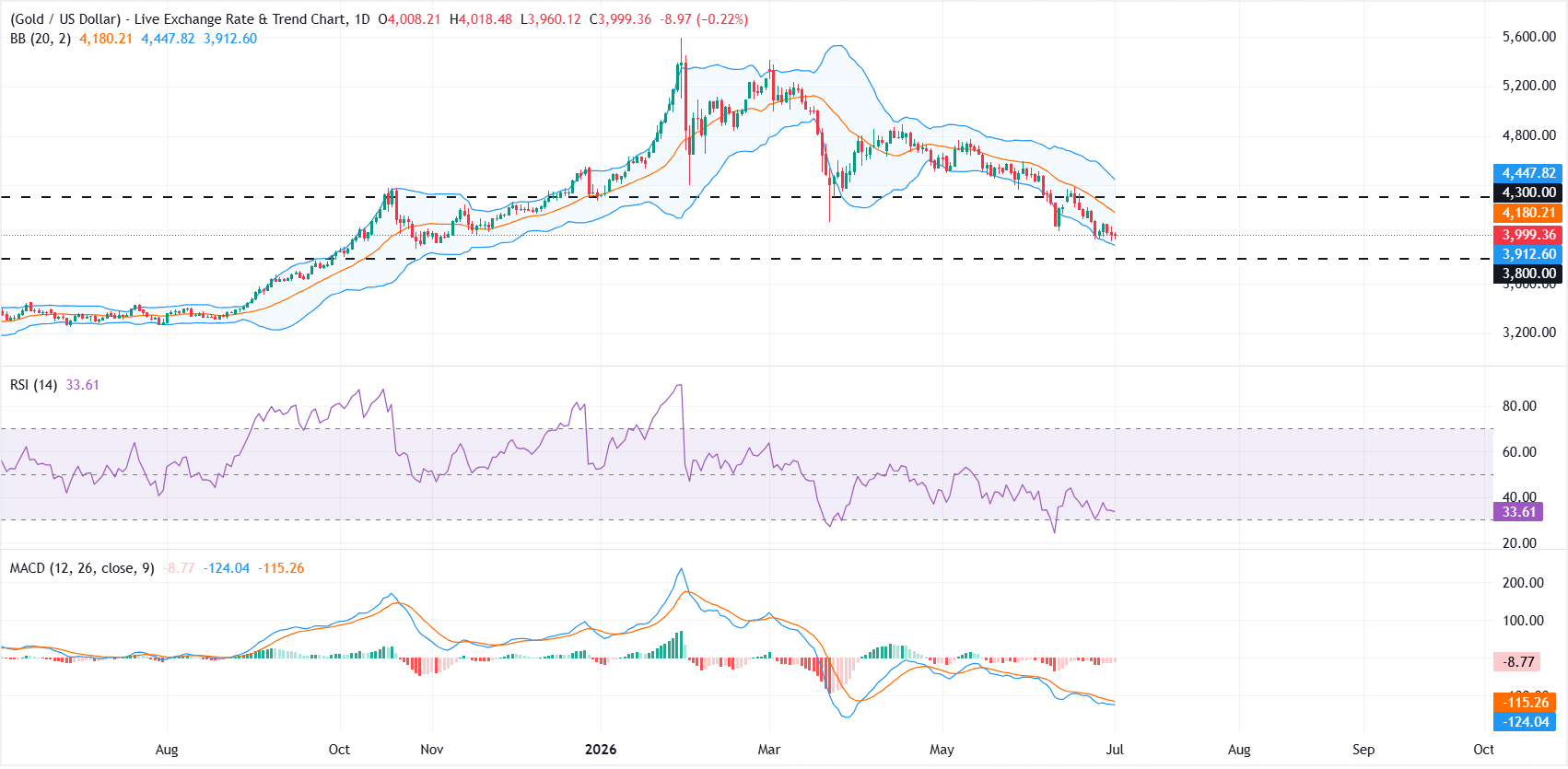
On the daily chart, XAU/USD keeps a bearish near-term tone as it holds below the 20-period Bollinger Simple Moving Average (SMA) clustered around $4,180.
Price is hovering just above the lower Bollinger band support at roughly $3,911, with the Relative Strength Index (RSI) hovering in the low 30s and Moving Average Convergence Divergence (MACD) lines remaining in negative territory, which together suggest downside momentum is still dominant despite an oversold backdrop.
On the topside, initial resistance emerges at the 20-period Bollinger SMA around $4,180, followed by the horizontal cap near $4,300 and the upper band closer to $4,450, a broader supply zone that would need to be reclaimed to ease bearish pressure.
On the downside, immediate focus stays on the lower Bollinger band support near $3,911, with a break there exposing the next key horizontal floor at $3,800, where buyers would be expected to defend the broader bullish cycle.
(The technical analysis of this story was written with the help of an AI tool.)
Gold FAQs
Gold has played a key role in human’s history as it has been widely used as a store of value and medium of exchange. Currently, apart from its shine and usage for jewelry, the precious metal is widely seen as a safe-haven asset, meaning that it is considered a good investment during turbulent times. Gold is also widely seen as a hedge against inflation and against depreciating currencies as it doesn’t rely on any specific issuer or government.
Central banks are the biggest Gold holders. In their aim to support their currencies in turbulent times, central banks tend to diversify their reserves and buy Gold to improve the perceived strength of the economy and the currency. High Gold reserves can be a source of trust for a country’s solvency. Central banks added 1,136 tonnes of Gold worth around $70 billion to their reserves in 2022, according to data from the World Gold Council. This is the highest yearly purchase since records began. Central banks from emerging economies such as China, India and Turkey are quickly increasing their Gold reserves.
Gold has an inverse correlation with the US Dollar and US Treasuries, which are both major reserve and safe-haven assets. When the Dollar depreciates, Gold tends to rise, enabling investors and central banks to diversify their assets in turbulent times. Gold is also inversely correlated with risk assets. A rally in the stock market tends to weaken Gold price, while sell-offs in riskier markets tend to favor the precious metal.
The price can move due to a wide range of factors. Geopolitical instability or fears of a deep recession can quickly make Gold price escalate due to its safe-haven status. As a yield-less asset, Gold tends to rise with lower interest rates, while higher cost of money usually weighs down on the yellow metal. Still, most moves depend on how the US Dollar (USD) behaves as the asset is priced in dollars (XAU/USD). A strong Dollar tends to keep the price of Gold controlled, whereas a weaker Dollar is likely to push Gold prices up.













