

The Australian Dollar keeps knocking on a door nobody opens
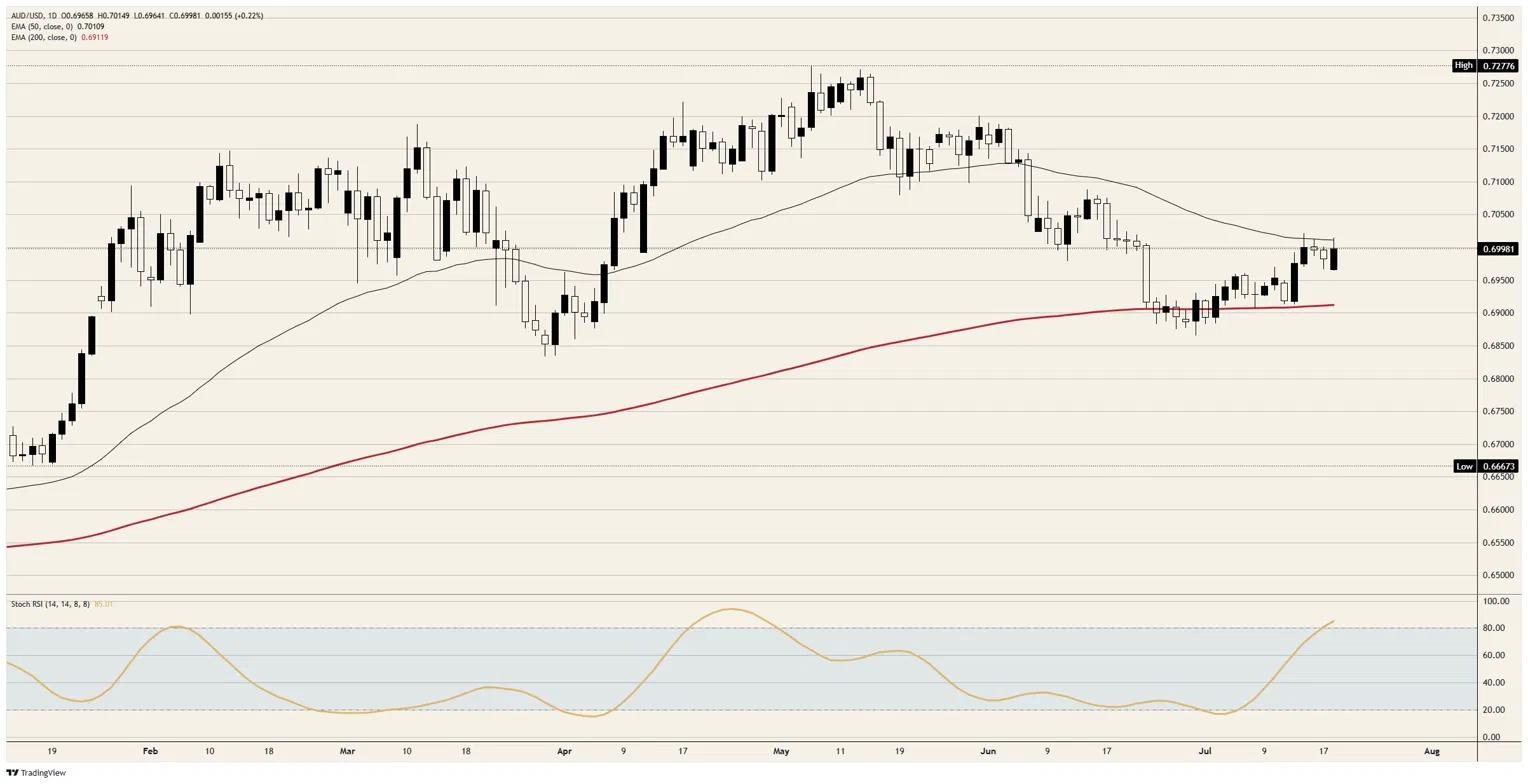
- AUD/USD churns just below the 0.7000 handle after a second intraday rejection above it, still capped by the 50-day EMA.
- Thursday's June jobs report is the gatekeeper for an August rate hike that surveyed economists split on almost down the middle.
- China left its benchmark lending rate unchanged on Monday, withholding fresh stimulus a week after a soft growth print.
AUD/USD trades up around 0.2% on Monday and still cannot hold the figure that matters, climbing from near 0.6950 in early dealing, poking above the 0.7000 handle twice through the London and New York sessions, and getting sold back below it both times. The second rejection stalled directly beneath the 50-day Exponential Moving Average (EMA), which hovers just above the round number and has capped the entire July recovery.

The wedge is now precisely drawn, with the 50-day EMA pressing down from just above 0.7000 and the rising 200-day EMA offering support near 0.6900, and the pair has spent two weeks grinding between the two. The daily Stochastic Relative Strength Index sits in the mid-80s, which says the easy portion of the rebound off the early-July base is spent. What breaks the deadlock is not on the chart. It sits on Thursday's calendar.
Thursday owns the week
The Reserve Bank of Australia (RBA) has hiked three times this year to a 4.35% cash rate and held in June with the tightening door explicitly open, its minutes flagging broad labour cost strains and a trimmed-mean gauge that accelerated to 3.6% even as headline inflation eased. The next decision lands on 11 August, and a slim majority of surveyed economists still expects at least one more hike this year, with most of that camp pointing directly at that meeting.
Thursday's June employment report at 01:30 GMT is the first of two gates before then, with the June-quarter inflation report to follow ahead of the decision. Consensus looks for hiring to cool sharply to 15K after May's 40.3K blowout, with unemployment steady at 4.4% and participation at 66.7%. A hot print keeps the August hike alive and hands the Aussie the rate story it needs to break the 50-day EMA. A soft one arms the on-hold camp and points the wedge lower.
China is not helping
The People's Bank of China (PBoC) left its benchmark loan prime rate at 3% on Monday, declining to add stimulus a week after second-quarter Gross Domestic Product printed 4.3% YoY against a 4.5% consensus, the softest quarterly result since 2022. The miss was built on domestic weakness, with fixed-asset and property investment falling hard even as retail sales and industrial output beat. For a currency that runs on Iron Ore cargoes to Chinese mills, a demand slowdown that Beijing declines to chase with easing is a slow leak rather than a shock.
The export mix does supply one genuine cushion, because with Gulf energy flows still badly disrupted by the Hormuz campaign, Australian liquefied natural gas and coal are moving at war premiums that Iron Ore alone would never deliver. That terms-of-trade math keeps a floor under the Aussie that pure China beta would already have broken.
The war bid nobody trusts
Risk appetite stays propped almost single-handedly by Trump's continued hints at talks with Tehran, even as Central Command announced a fresh round of strikes beginning 20:00 GMT Monday, the campaign's tenth consecutive night, and the President vowed on Truth Social that Iran pays many times over for every American killed. The strikes roll on while Washington professes openness, and markets keep choosing to price the openness.
The Aussie sits squarely inside that contradiction as the G10's cleanest China proxy and one of its favourite risk barometers, long the war premium in its export book and short the global demand a wider war would destroy. A currency built to trade both channels at once has instead chosen neither, which is exactly what the chart shows.
The week ahead
Thursday carries the entire domestic load, with the June employment report at 01:30 GMT followed by the July flash Purchasing Managers Index (PMI) round at 23:00 GMT, where the composite starts from 50.4 and manufacturing from 51.5. The jobs print is the release with rate implications, and positioning into it should define the early-week drift.
Friday hands the baton to the United States, where the flash PMI round at 13:45 GMT is the only red-band American release before the Federal Reserve's decision the following Wednesday. The Fed sits in its pre-meeting blackout until then, which leaves Gulf headlines as the Dollar's marginal input all week.
Technical levels to watch
Resistance: The 0.7000 handle and the 50-day EMA just above it form a single ceiling that has rejected every advance this month. Beyond that package, 0.7050 and the 0.7100 area cap the June congestion, with the May peak just below 0.7300 out of the conversation until the rate story changes.
Support: Monday's base near 0.6950 is the first floor, backed by the rising 200-day EMA and the early-July base together in the 0.6900 area. A break of that zone exposes 0.6850 and unwinds the entire July recovery.
Bias: Bearish below the 50-day EMA. Repeated rejections at the same ceiling with daily momentum already in the mid-80s argue the next move runs toward the 200-day EMA near 0.6900 unless Thursday's jobs report forces the issue. A daily close above 0.7050 invalidates the fade and turns the wedge into a launchpad toward 0.7100.
AUD/USD daily chart
Australian Dollar FAQs
One of the most significant factors for the Australian Dollar (AUD) is the level of interest rates set by the Reserve Bank of Australia (RBA). Because Australia is a resource-rich country another key driver is the price of its biggest export, Iron Ore. The health of the Chinese economy, its largest trading partner, is a factor, as well as inflation in Australia, its growth rate and Trade Balance. Market sentiment – whether investors are taking on more risky assets (risk-on) or seeking safe-havens (risk-off) – is also a factor, with risk-on positive for AUD.
The Reserve Bank of Australia (RBA) influences the Australian Dollar (AUD) by setting the level of interest rates that Australian banks can lend to each other. This influences the level of interest rates in the economy as a whole. The main goal of the RBA is to maintain a stable inflation rate of 2-3% by adjusting interest rates up or down. Relatively high interest rates compared to other major central banks support the AUD, and the opposite for relatively low. The RBA can also use quantitative easing and tightening to influence credit conditions, with the former AUD-negative and the latter AUD-positive.
China is Australia’s largest trading partner so the health of the Chinese economy is a major influence on the value of the Australian Dollar (AUD). When the Chinese economy is doing well it purchases more raw materials, goods and services from Australia, lifting demand for the AUD, and pushing up its value. The opposite is the case when the Chinese economy is not growing as fast as expected. Positive or negative surprises in Chinese growth data, therefore, often have a direct impact on the Australian Dollar and its pairs.
Iron Ore is Australia’s largest export, accounting for $118 billion a year according to data from 2021, with China as its primary destination. The price of Iron Ore, therefore, can be a driver of the Australian Dollar. Generally, if the price of Iron Ore rises, AUD also goes up, as aggregate demand for the currency increases. The opposite is the case if the price of Iron Ore falls. Higher Iron Ore prices also tend to result in a greater likelihood of a positive Trade Balance for Australia, which is also positive of the AUD.
The Trade Balance, which is the difference between what a country earns from its exports versus what it pays for its imports, is another factor that can influence the value of the Australian Dollar. If Australia produces highly sought after exports, then its currency will gain in value purely from the surplus demand created from foreign buyers seeking to purchase its exports versus what it spends to purchase imports. Therefore, a positive net Trade Balance strengthens the AUD, with the opposite effect if the Trade Balance is negative.














