

USD/JPY Price Forecast: Bulls move in as pair bounces toward 158.00
- USD/JPY rebounds as RSI recovery hints at buyer interest.
- Break above 158.00 exposes 158.71 and 159.00 resistance levels.
- Failure at 158.00 keeps focus on 157.00 support zone.
USD/JPY recovers some ground and rallies towards a daily four-day high near 157.80 as traders digest comments from US Treasury Secretary Scott Bessent on undesirable volatility in the FX space, prompting a Yen buy. At the time of writing, the pair is up by over 0.30%.
USD/JPY Price Forecast: Technical outlook
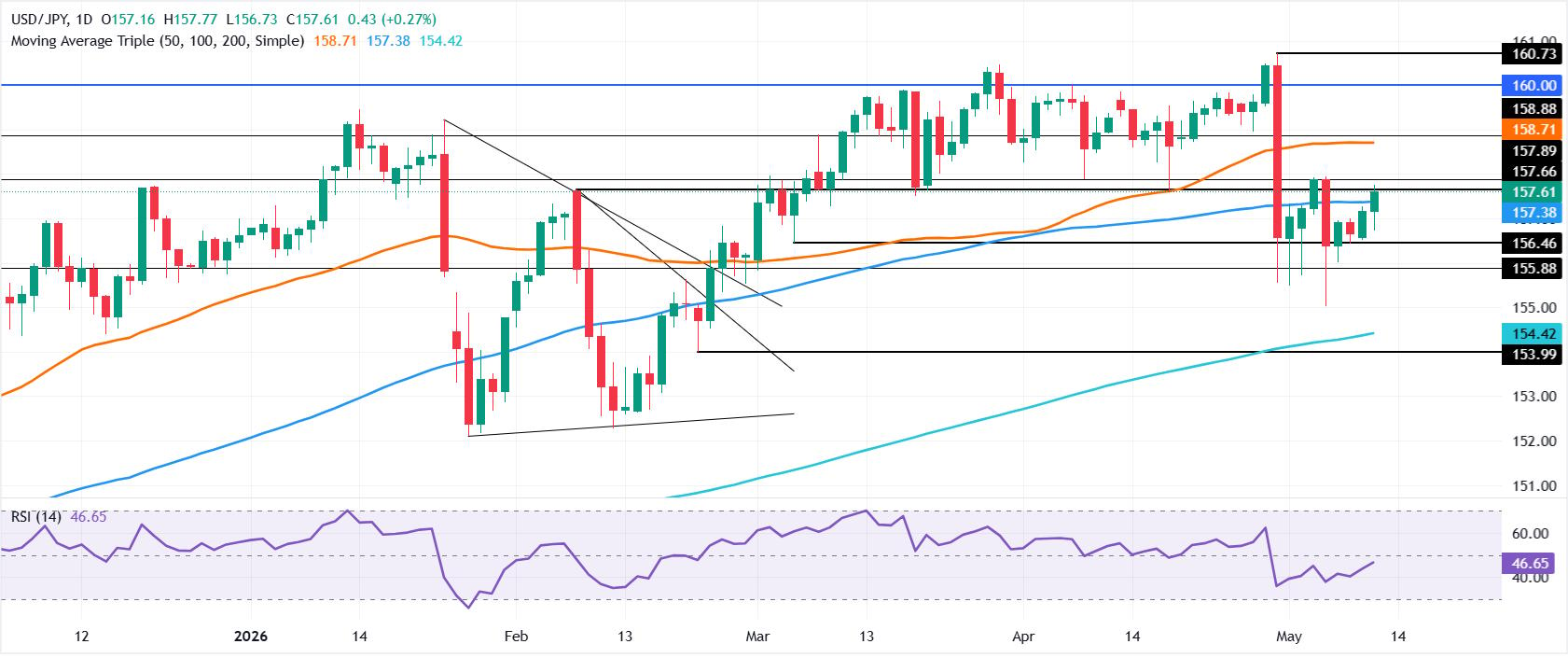
The USD/JPY technical picture shows the pair is neutral to downwardly biased following the BoJ’s April 30 intervention in the FX space, which has prevented buyers from testing the 158.00 figure.

The Relative Strength Index (RSI) is bearish but is trending upward, indicating that buyers are moving in.
For a bullish continuation, USD/JPY must clear 158.00. This could exacerbate a move towards the 50-day Simple Moving Average (SMA) at 158.71, ahead of the 159.00 figure. At around this level and 160.00, Japanese authorities could begin verbal jawboning about the exchange rate or intervene in the markets.
Downwards, the first support level is 157.00. A breach of the latter will expose the May 11 daily low of 156.51, followed by the May 7 daily low of 156.02.
USD/JPY Price Chart – Daily
Japanese Yen FAQs
The Japanese Yen (JPY) is one of the world’s most traded currencies. Its value is broadly determined by the performance of the Japanese economy, but more specifically by the Bank of Japan’s policy, the differential between Japanese and US bond yields, or risk sentiment among traders, among other factors.
One of the Bank of Japan’s mandates is currency control, so its moves are key for the Yen. The BoJ has directly intervened in currency markets sometimes, generally to lower the value of the Yen, although it refrains from doing it often due to political concerns of its main trading partners. The BoJ ultra-loose monetary policy between 2013 and 2024 caused the Yen to depreciate against its main currency peers due to an increasing policy divergence between the Bank of Japan and other main central banks. More recently, the gradually unwinding of this ultra-loose policy has given some support to the Yen.
Over the last decade, the BoJ’s stance of sticking to ultra-loose monetary policy has led to a widening policy divergence with other central banks, particularly with the US Federal Reserve. This supported a widening of the differential between the 10-year US and Japanese bonds, which favored the US Dollar against the Japanese Yen. The BoJ decision in 2024 to gradually abandon the ultra-loose policy, coupled with interest-rate cuts in other major central banks, is narrowing this differential.
The Japanese Yen is often seen as a safe-haven investment. This means that in times of market stress, investors are more likely to put their money in the Japanese currency due to its supposed reliability and stability. Turbulent times are likely to strengthen the Yen’s value against other currencies seen as more risky to invest in.














