

When are the German/ Eurozone flash HCOB PMIs and how could they affect EUR/USD?
German/ Eurozone flash PMIs Overview
The preliminary German and Eurozone flash HCOB Purchasing Managers’ Index (PMI) data for March is due for release today at 08:30 and 09:00 GMT, respectively.
Amongst the Euro area economies, the German and the composite Eurozone PMI reports hold more relevance, in terms of their impact on the European currency and the related markets as well.
The flash Composite PMI for Germany is expected to come in lower due to a slowdown in both manufacturing and the service sector activity. In February, the Composite PMI came in at 53.2.
Germany’s Manufacturing PMI is expected to have swung to contraction again after returning to growth for a month in February. A figure below 50.0 is considered a contraction in the business activity. The Manufacturing PMI is seen arriving lower at 49.8 from the previous reading of 50.9. Flash Services PMI is estimated to have dropped to 52.5 from 53.5 in February.

The forecast for the Eurozone flash Composite PMI also shows that the overall private sector output expanded at a moderate pace in March due to a decline in the manufacturing sector output and a slowdown in the services sector output growth.
The Composite PMI is expected to come in at 51.1, lower than 51.9 in February. The Services PMI is seen at 51.0, down from the previous reading of 51.9. Like the German Manufacturing PMI, the manufacturing activity in the old continent is estimated to have returned to the declining trajectory. The Manufacturing PMI is seen arriving lower at 49.5 against the prior release of 50.8.
How could German/ Eurozone flash PMIs affect EUR/USD?
Signs of continuous strength in the overall business sector activity from the German/ Eurozone flash PMI prints would be favorable for the Euro (EUR), while weak numbers would act as a drag on the shared currency. However, developments regarding the war in the Middle East are expected to be the key driver of the EUR/USD pair.
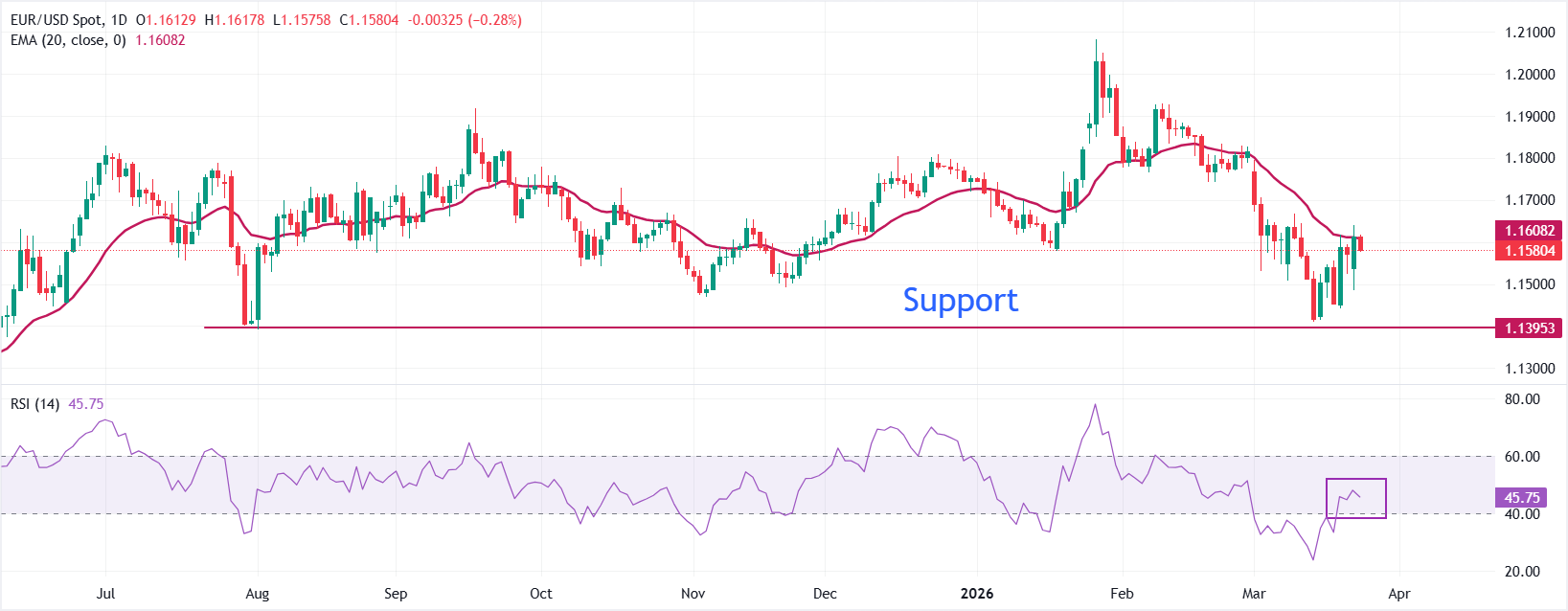
EUR/USD trades 0.22% lower to near 1.1580 in the early European session. The pair stays pressured below the 20-day Exponential Moving Average (EMA) near 1.16, which keeps the near-term bias mildly bearish despite the recent stabilization off the lows. Price action has carved out a sequence of lower daily closes over recent weeks, and the failed attempts to reclaim the 20-day EMA reinforce a downside-oriented structure.
The 14-day Relative Strength Index (RSI) at 45 remains below the 50 midline, signaling persistent, though not extreme, bearish momentum.
Initial resistance emerges at 1.1610, where the 20-day EMA converges with recent daily highs, and a break above this area would be needed to ease immediate downside pressure. Further resistance stands at the March 10 high of 1.1667. On the downside, immediate support aligns at 1.1510, guarding the recent cluster of lows, with a break exposing an over seven-month low of around 1.1390 as the next bearish target.
(The technical analysis of this story was written with the help of an AI tool.)
Economic Indicator
HCOB Composite PMI
The Composite Purchasing Managers’ Index (PMI), released on a monthly basis by S&P Global and Hamburg Commercial Bank (HCOB), is a leading indicator gauging private-business activity in the Eurozone for both the manufacturing and services sectors. The data is derived from surveys to senior executives. Each response is weighted according to the size of the company and its contribution to total manufacturing or services output accounted for by the sub-sector to which that company belongs. Survey responses reflect the change, if any, in the current month compared to the previous month and can anticipate changing trends in official data series such as Gross Domestic Product (GDP), industrial production, employment and inflation. The index varies between 0 and 100, with levels of 50.0 signaling no change over the previous month. A reading above 50 indicates that the private economy is generally expanding, a bullish sign for the Euro (EUR). Meanwhile, a reading below 50 signals that activity is generally declining, which is seen as bearish for EUR.
Read more.Next release: Tue Mar 24, 2026 09:00 (Prel)
Frequency: Monthly
Consensus: 51.1
Previous: 51.9
Source: S&P Global














