

XYZ launches licensed S&P 500 perpetual contract on Hyperliquid with 24/7 trading
- S&P Dow Jones Indices has licensed the S&P 500 to XYZ, enabling the launch of the first officially licensed perpetual derivative tied to the index.
- The product allows non-US investors to gain leveraged exposure to the S&P 500 via Hyperliquid’s decentralised platform.
- Hyperliquid holds steady above $40.00, supported by a robust technical structure.
The world’s leading global index provider, S&P Dow Jones Indices, has licensed the S&P 500 to Trade[XYZ] (XYZ) in a move to offer a licensed perpetual derivative contract based on the index on the decentralized cryptocurrency exchange, Hyperliquid.
S&P 500 perpetual contract launches on Hyperliquid
Hyperliquid has positioned itself as a leading provider of real-world asset (RWA) markets tapping perpetual derivatives contracts. Support for the S&P 500 enables investors outside the United States (US) to access leveraged exposure to the S&P 500 for the first time on a decentralised trading blockchain platform, stated S&P Global in a press release on Wednesday.

The collaboration is of immense significance for global investors as it extends the S&P 500's liquidity ecosystem on-chain, with over $1 trillion traded daily. Investors can now trade the deep liquidity of the digitally native product 24/7.
Perpetual derivatives are financial instruments that enable eligible investors to seek leveraged exposure, with either long or short positions on an underlying asset, without expiry limitations.
Hyperliquid’s decentralised exchange offers a transparent, high-performance on-chain trading environment, powered directly by institutional-quality S&P DJI index data. XYZ is the largest real-world asset market on Hyperliquid. Since October, XYZ markets have processed over $100 billion in volume, with an annualised rate averaging $600 billion.
Cameron Drinkwater, Chief Product & Operations Officer at S&P Dow Jones Indices, said that the company believes “digitally-native investors should demand the institutional-quality standards that define our indices, and we are thrilled to work with Trade[XYZ] to do so.”
S&P Dow Jones Indices has been expanding its offerings across decentralized initiatives, including the S&P Digital Markets 50 index. Its mission is to bring most of the world’s most essential markets on-chain and views the S&P 500 as a natural starting point.
Hyperliquid steadies defying broader volatility
Hyperliquid (HYPE) is trading above $40.00 at the time of writing on Wednesday. The native decentralised exchange token appears to be defying broader crypto market volatility, which has seen Bitcoin (BTC) correct from a daily high of $74,672 to trade slightly above $71,000.
Momentum indicators support a short-term bullish outlook, with the Moving Average Convergence Divergence (MACD) remaining above the signal line on the daily chart. Related green histogram bars are expanding, which could prompt traders to lean into risk.
The Relative Strength Index (RSI) at 71 on the same chart shows overbought conditions, but if it rises further, Hyperliquid could extend its uptrend to $45.00. A sustained break above that level would expose HYPE to the next key hurdle around $48.00.
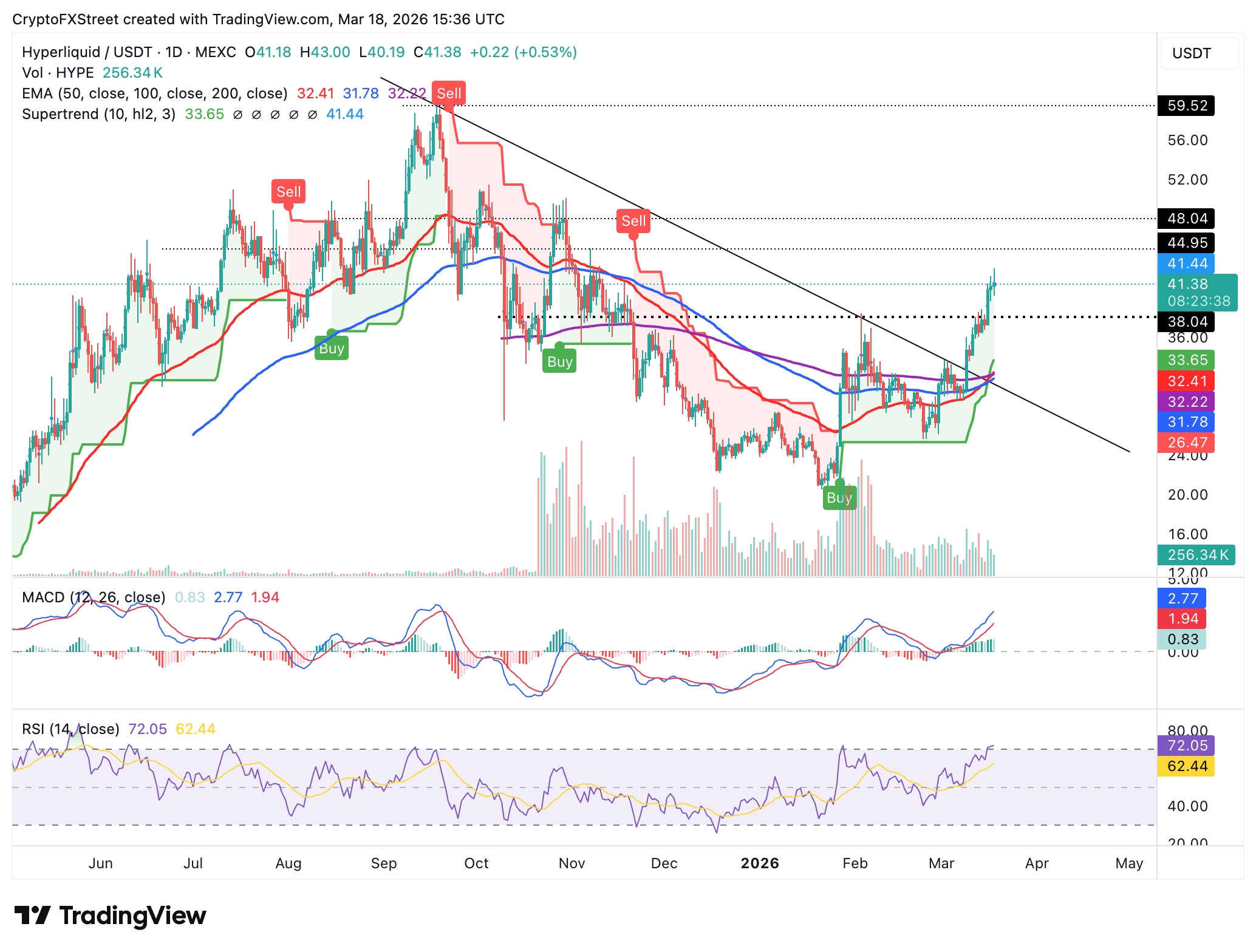
Still, a reversal of the RSI from overbought conditions could mark the beginning of a correction below the daily low at $40.19. Below this level, Hyperliquid would seek support roughly at $38.00.
Cryptocurrency prices FAQs
Token launches influence demand and adoption among market participants. Listings on crypto exchanges deepen the liquidity for an asset and add new participants to an asset’s network. This is typically bullish for a digital asset.
A hack is an event in which an attacker captures a large volume of the asset from a DeFi bridge or hot wallet of an exchange or any other crypto platform via exploits, bugs or other methods. The exploiter then transfers these tokens out of the exchange platforms to ultimately sell or swap the assets for other cryptocurrencies or stablecoins. Such events often involve an en masse panic triggering a sell-off in the affected assets.
Macroeconomic events like the US Federal Reserve’s decision on interest rates influence crypto assets mainly through the direct impact they have on the US Dollar. An increase in interest rate typically negatively influences Bitcoin and altcoin prices, and vice versa. If the US Dollar index declines, risk assets and associated leverage for trading gets cheaper, in turn driving crypto prices higher.
Halvings are typically considered bullish events as they slash the block reward in half for miners, constricting the supply of the asset. At consistent demand if the supply reduces, the asset’s price climbs.














