

Trade The World
EUR/GBP Price Forecast: Bulls might find resistance above 0.8720
作者 Guillermo Alcala
发布日期: 17 Oct 2025 | 修改日期: 17 Oct 2025


POPULAR ARTICLES

The Euro received a boost from French PM Sébastien Lecornu’s victory in two no-confidence votes on Thursday. The pair bounced up from 0.8665 and retraced Wednesday’s losses, aiming for the top of the recent range, in the area of 0.8720-0.8730.
- The Euro appreciates against the Pound, but it might find resistance above 0.8020.
- Easing concerns about France's politics and hawkish comments by ECB officials have boosted the Euro.
- From a wider perspective, the EUR/GBP keeps trading in a choppy manner around 0.8700.,
The Euro received a boost from French PM Sébastien Lecornu’s victory in two no-confidence votes on Thursday. The pair bounced up from 0.8665 and retraced Wednesday’s losses, aiming for the top of the recent range, in the area of 0.8720-0.8730.
Easing concerns about France’s political crisis and some hawkish comments by ECB officials Wunsch and Kochel provided some support to the Euro ahead of the release of the Eurozone HICP due later on Friday.
Technical analysis: Still looking for direction around 0.8700
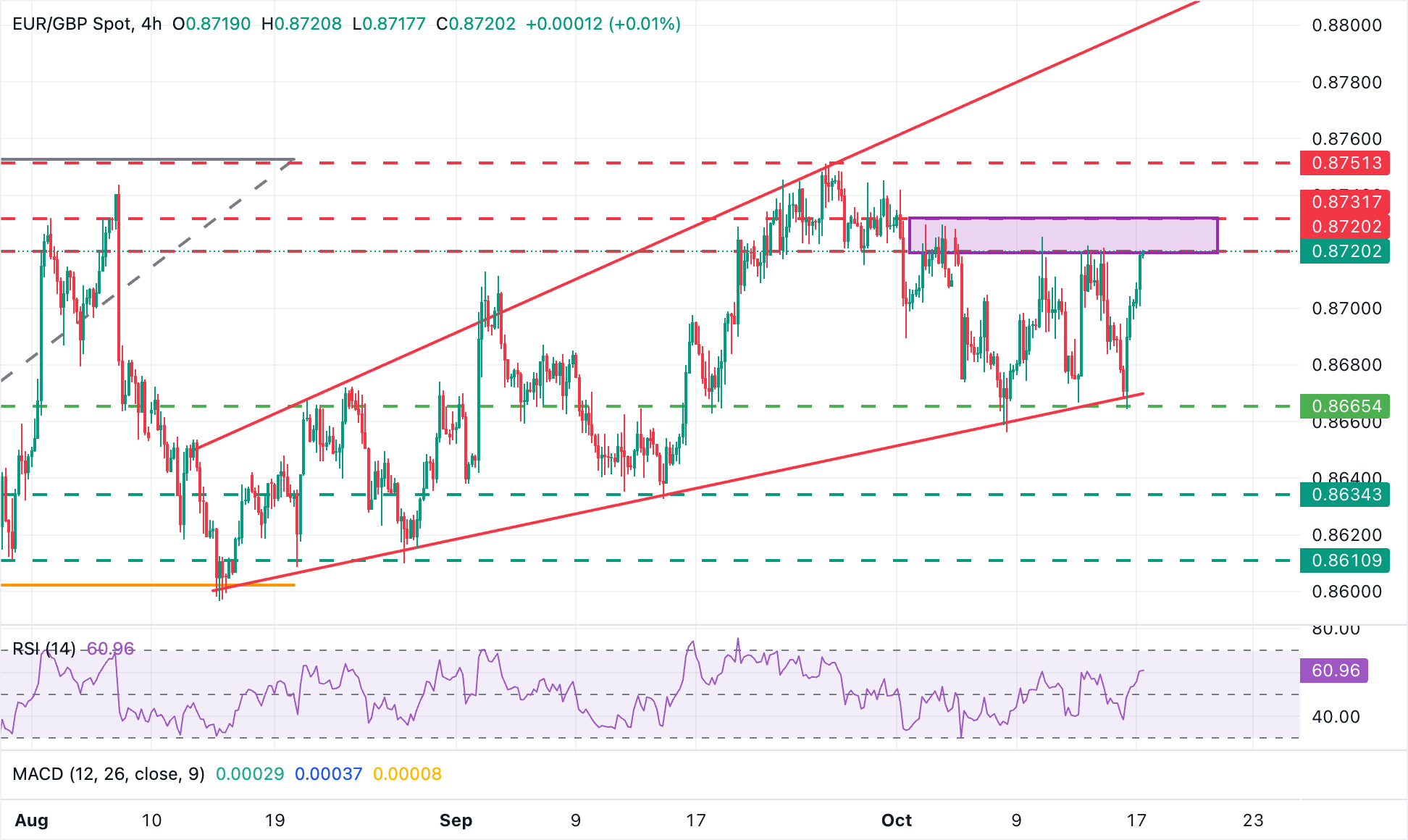
The EUR/GBP has been trading in a choppy and volatile manner during the last three weeks and remains trapped within a broadly 60-pip range around 0.8700 after retreating from the 0.8750 area in late September.
The broader trend remains positive, but the resistance area between 0.8720 and 0.8730 has limited upside attempts several times over the last three weeks and is highly likely to challenge bulls again.
A clearance of that area exposes the year-to-date high, at 0.8750, further up, the trendline resistance is near 0.8795. Supports are at 0.8660 (October 14, 16 lows) and below here, September 11 and 15 lows at 0.8635, and the August 10 low at the 0.8610 area.
ECB FAQs
The European Central Bank (ECB) in Frankfurt, Germany, is the reserve bank for the Eurozone. The ECB sets interest rates and manages monetary policy for the region. The ECB primary mandate is to maintain price stability, which means keeping inflation at around 2%. Its primary tool for achieving this is by raising or lowering interest rates. Relatively high interest rates will usually result in a stronger Euro and vice versa. The ECB Governing Council makes monetary policy decisions at meetings held eight times a year. Decisions are made by heads of the Eurozone national banks and six permanent members, including the President of the ECB, Christine Lagarde.
In extreme situations, the European Central Bank can enact a policy tool called Quantitative Easing. QE is the process by which the ECB prints Euros and uses them to buy assets – usually government or corporate bonds – from banks and other financial institutions. QE usually results in a weaker Euro. QE is a last resort when simply lowering interest rates is unlikely to achieve the objective of price stability. The ECB used it during the Great Financial Crisis in 2009-11, in 2015 when inflation remained stubbornly low, as well as during the covid pandemic.
Quantitative tightening (QT) is the reverse of QE. It is undertaken after QE when an economic recovery is underway and inflation starts rising. Whilst in QE the European Central Bank (ECB) purchases government and corporate bonds from financial institutions to provide them with liquidity, in QT the ECB stops buying more bonds, and stops reinvesting the principal maturing on the bonds it already holds. It is usually positive (or bullish) for the Euro.

FXStreet
超过一百万用户依赖 FXStreet 获取实时市场数据、图表工具、专家洞见和外汇新闻。其全面的经济日历和教育网络研讨会帮助交易者保持信息领先、做出审慎决策。FXStreet 拥有约 60 人的团队,分布在巴塞罗那总部及全球各地区。
Read More








