

Trade The World
Gold set for weekly loss as strong US data, trade optimism hits safe-haven demand
作者 Christian Borjon Valencia
发布日期: 26 Jul 2025 | 修改日期: 26 Jul 2025


POPULAR ARTICLES

Gold price (XAU/USD) is poised to end the week on a lower note as economic data from the United States (US) and progress in trade deals with the latter weighed on safe-haven demand, driving the yellow metal lower.
- Gold pressured by robust US labor data and progress on US–EU trade deal.
- US Dollar rebound and trade optimism curb safe-haven demand, sending XAU/USD to $3,325 low.
- Traders eye Fed decision, US Q2 GDP, Core PCE, and NFP data in coming week.
Gold price (XAU/USD) is poised to end the week on a lower note as economic data from the United States (US) and progress in trade deals with the latter weighed on safe-haven demand, driving the yellow metal lower. Additionally, the Greenback recovered some ground despite falling US Treasury yields. At the time of writing, the XAU/USD trades at $3,336, down almost 1%.
Next week, the Federal Reserve (Fed) is expected to hold rates unchanged at the 4.25%-4.50% range for the fifth time this year. Data released during the month justified the Fed’s case to maintain the current policy stance after Initial Jobless Claims dipped for the fourth consecutive week, highlighting the strength of the jobs market. Meanwhile, Durable Goods Orders plunged on Friday, sparked by a drop in aircraft orders.
Upbeat trade news has emerged since Monday, following the US and Japan's agreement. News that a deal could be replicated with the European Union (EU) ahead of the August 1 deadline pushed the non-yielding metal below $3,400 and toward a weekly low of $3,325.
Bullion is also down as the US Dollar bounced off an almost two-week low, making Gold more expensive for foreign buyers.
Recent news revealed that Trump’s visit to the Fed was not an event that moved the markets, although it appears that he has changed his view regarding Powell.
Next week, the US economic docket will feature on July 30, the Fed’s decision, Gross Domestic Product (GDP) preliminary figures for Q2, the release of Core Personal Consumption Expenditures (PCE), along with Nonfarm Payroll figures.
Daily digest market movers: US yields fall alongside Gold prices
- Gold dips even though US Treasury yields tumble, with the 10-year Treasury note falling three basis points to 4.386%. Consequently, US real yields, which are calculated by subtracting inflation expectations from the nominal interest rate, decreased by 1.5 basis points to 1.936%.
- The US Dollar Index (DXY), which tracks the buck’s performance against a basket of six currencies, is up 0.17% at 97.68.
- On Thursday, better-than-expected Initial Jobless Claims pointed to continued labor market strength, even as S&P Global reported a contraction in manufacturing activity. US Durable Goods Orders declined in June, mainly driven by a sharp drop in aircraft demand. Headline orders fell 9.6% MoM, following a 16.5% surge in May. While the decline was significant, it was smaller than the -10.8% contraction forecast by analysts. Transportation equipment led the downturn, plunging 22.4% in June.
- However, Core Durable Goods Orders — which exclude transportation — rose by 0.2%, pointing to some underlying strength in business investment.
- In US trade developments, President Donald Trump announced that most trade deals are now finalized, with forthcoming letters expected to outline tariff rates ranging from 10% to 15%. When questioned about the likelihood of an agreement with the European Union, Trump stated there is a “50-50” chance of reaching a deal.
- Interest rate probability indicates that the Fed will maintain its current rates, with odds standing at 96% for a hold and 4% for a 25-basis-point rate cut at the July 30 meeting.
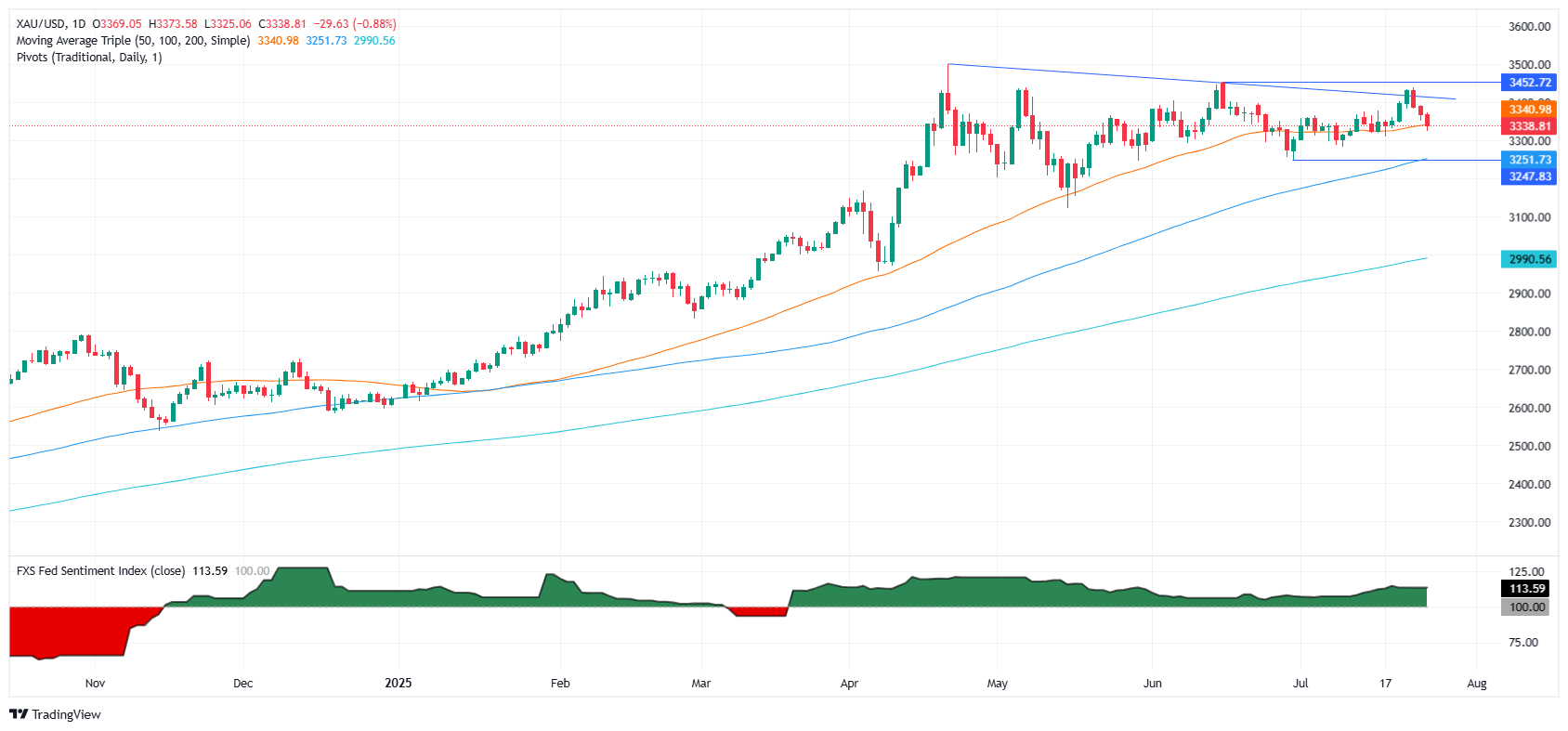
XAU/USD technical outlook: Gold price tests support at the confluence of 20-day and 50-day SMAs
Gold logged a third straight bearish session, with sellers driving prices below $3,350, which opened the door to test the $3,320 area. Around this area lies the 20-day and 50-day Simple Moving Averages (SMAs)at $3,342 and $3,332, respectively. It is worth noting that the Relative Strength Index (RSI) has turned bearish; however, according to market structure, Bullion’s upside remains intact.
However, if the spot price tumbles below the confluence of the 100-daySMA and the June 30 low at $3,238 and $3,246, respectively. A breakout above $3,400 could pave the way for a retest of the five-week high at $3,438, followed by the June 16 peak at $3,452 and ultimately the all-time high of $3,500.
Gold FAQs
Gold has played a key role in human’s history as it has been widely used as a store of value and medium of exchange. Currently, apart from its shine and usage for jewelry, the precious metal is widely seen as a safe-haven asset, meaning that it is considered a good investment during turbulent times. Gold is also widely seen as a hedge against inflation and against depreciating currencies as it doesn’t rely on any specific issuer or government.
Central banks are the biggest Gold holders. In their aim to support their currencies in turbulent times, central banks tend to diversify their reserves and buy Gold to improve the perceived strength of the economy and the currency. High Gold reserves can be a source of trust for a country’s solvency. Central banks added 1,136 tonnes of Gold worth around $70 billion to their reserves in 2022, according to data from the World Gold Council. This is the highest yearly purchase since records began. Central banks from emerging economies such as China, India and Turkey are quickly increasing their Gold reserves.
Gold has an inverse correlation with the US Dollar and US Treasuries, which are both major reserve and safe-haven assets. When the Dollar depreciates, Gold tends to rise, enabling investors and central banks to diversify their assets in turbulent times. Gold is also inversely correlated with risk assets. A rally in the stock market tends to weaken Gold price, while sell-offs in riskier markets tend to favor the precious metal.
The price can move due to a wide range of factors. Geopolitical instability or fears of a deep recession can quickly make Gold price escalate due to its safe-haven status. As a yield-less asset, Gold tends to rise with lower interest rates, while higher cost of money usually weighs down on the yellow metal. Still, most moves depend on how the US Dollar (USD) behaves as the asset is priced in dollars (XAU/USD). A strong Dollar tends to keep the price of Gold controlled, whereas a weaker Dollar is likely to push Gold prices up.

FXStreet
超过一百万用户依赖 FXStreet 获取实时市场数据、图表工具、专家洞见和外汇新闻。其全面的经济日历和教育网络研讨会帮助交易者保持信息领先、做出审慎决策。FXStreet 拥有约 60 人的团队,分布在巴塞罗那总部及全球各地区。
Read More








