

Trade The World
Silver Price Forecast: Bulls defend $38.00 as triangle support holds, momentum remains fragile
作者 Vishal Chaturvedi
发布日期: 27 Aug 2025 | 修改日期: 27 Aug 2025


POPULAR ARTICLES

Silver (XAG/USD) trades slightly lower on Wednesday, having trimmed earlier losses after finding support near the $38.00 handle. The metal came under pressure earlier in the session as a stronger US Dollar (USD) capped upside momentum.
- Silver trims intraday losses as buyers defend support near the $38.00 handle.
- XAG/USD retests the upper boundary of the broken symmetrical triangle and edges higher, keeping short-term hopes of a bullish continuation alive.
- Momentum signals remain mixed, with the RSI recovering slightly, but the MACD still indicates a weakening bias below the signal line.
Silver (XAG/USD) trades slightly lower on Wednesday, having trimmed earlier losses after finding support near the $38.00 handle. The metal came under pressure earlier in the session as a stronger US Dollar (USD) capped upside momentum. The decline came despite political turbulence in Washington, with US President Donald Trump’s push to remove Federal Reserve (Fed) Governor Lisa Cook, stirring fresh concerns over central bank independence.
At the time of writing, XAG/USD is trading near $38.50, having trimmed some of its intraday losses after bouncing from a low of $38.08. The renewed demand for the Greenback and firmer US Treasury yields are weighing on precious metals. However, the downside in Silver remains cushioned amid lingering uncertainty over the Fed’s independence and growing expectations for a rate cut, following Fed Chair Jerome Powell’s dovish tilt at the Jackson Hole Symposium.
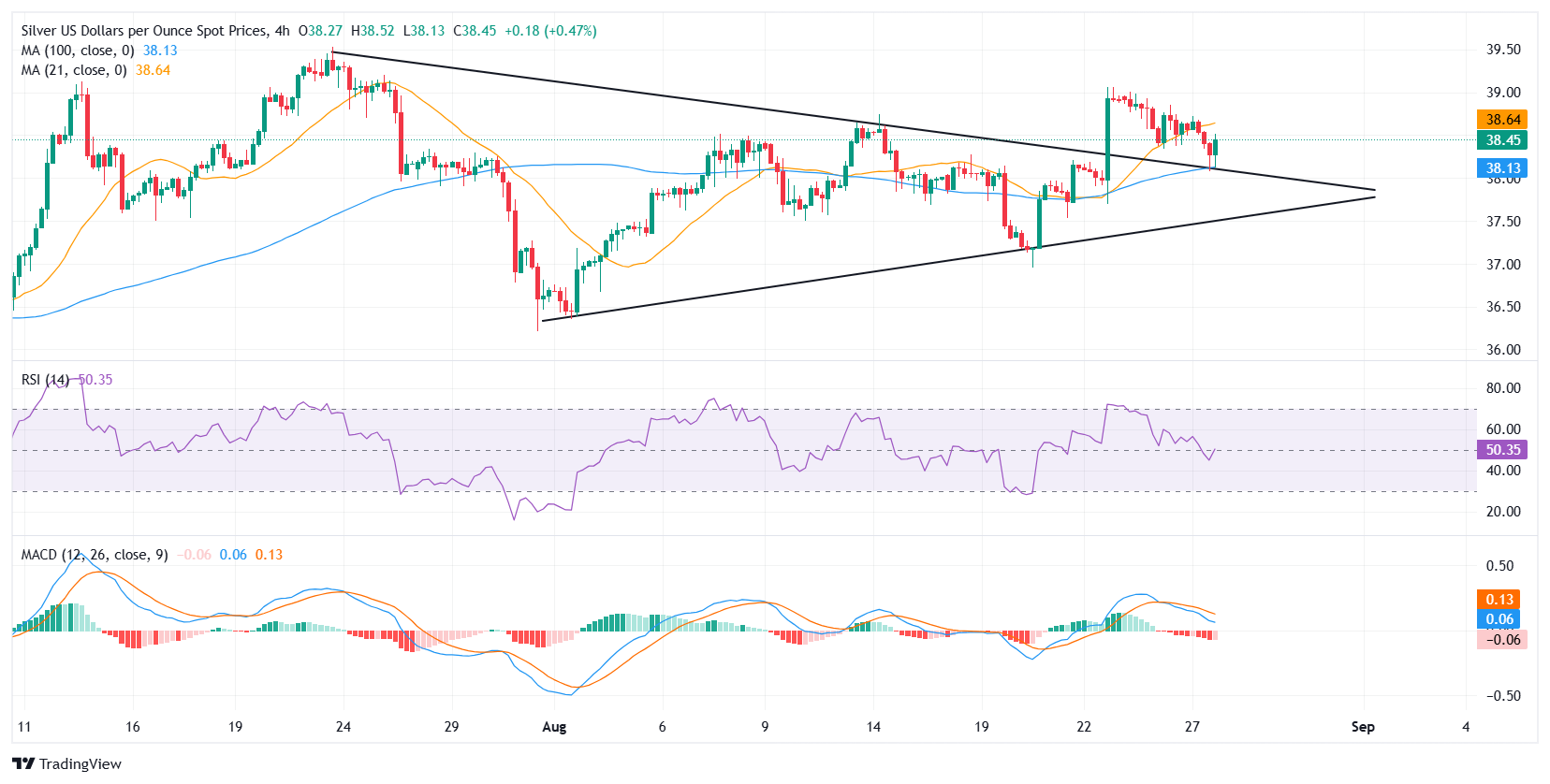
From a technical perspective, Silver is back under pressure after failing to extend its breakout above the symmetrical triangle formation seen on the 4-hour chart. The pullback has dragged XAG/USD back toward the triangle’s upper boundary, now acting as a key support zone alongside the 100-period Simple Moving Average (SMA), currently located near $38.13. A decisive break below this confluence support would likely invalidate the recent bullish breakout and shift short-term momentum back in favor of the bears.
The Relative Strength Index (RSI) is hovering around the neutral 50 mark, suggesting a lack of clear directional strength.. At the same time, the Moving Average Convergence Divergence (MACD) is showing waning bullish momentum. The MACD line (blue) has crossed below the signal line (orange), indicating a bearish crossover, while the histogram has turned negative.
Looking ahead, immediate resistance is seen at $38.63, marked by the 21-period EMA, followed by $39.06 — Friday’s high. A sustained break above this zone is needed to revive bullish momentum and expose the next upside target at the multi-year peak of $39.53. On the flip side, critical support is located at the $38.13-$38.00 zone, which combines the 100-period SMA with the upper boundary of the former triangle. A clean break below this area would signal a failed breakout and open the door for a deeper pullback toward the $37.50 pivot, with $37.00 remaining the next key downside level if selling pressure accelerates.
Silver FAQs
Silver is a precious metal highly traded among investors. It has been historically used as a store of value and a medium of exchange. Although less popular than Gold, traders may turn to Silver to diversify their investment portfolio, for its intrinsic value or as a potential hedge during high-inflation periods. Investors can buy physical Silver, in coins or in bars, or trade it through vehicles such as Exchange Traded Funds, which track its price on international markets.
Silver prices can move due to a wide range of factors. Geopolitical instability or fears of a deep recession can make Silver price escalate due to its safe-haven status, although to a lesser extent than Gold's. As a yieldless asset, Silver tends to rise with lower interest rates. Its moves also depend on how the US Dollar (USD) behaves as the asset is priced in dollars (XAG/USD). A strong Dollar tends to keep the price of Silver at bay, whereas a weaker Dollar is likely to propel prices up. Other factors such as investment demand, mining supply – Silver is much more abundant than Gold – and recycling rates can also affect prices.
Silver is widely used in industry, particularly in sectors such as electronics or solar energy, as it has one of the highest electric conductivity of all metals – more than Copper and Gold. A surge in demand can increase prices, while a decline tends to lower them. Dynamics in the US, Chinese and Indian economies can also contribute to price swings: for the US and particularly China, their big industrial sectors use Silver in various processes; in India, consumers’ demand for the precious metal for jewellery also plays a key role in setting prices.
Silver prices tend to follow Gold's moves. When Gold prices rise, Silver typically follows suit, as their status as safe-haven assets is similar. The Gold/Silver ratio, which shows the number of ounces of Silver needed to equal the value of one ounce of Gold, may help to determine the relative valuation between both metals. Some investors may consider a high ratio as an indicator that Silver is undervalued, or Gold is overvalued. On the contrary, a low ratio might suggest that Gold is undervalued relative to Silver.

FXStreet
超过一百万用户依赖 FXStreet 获取实时市场数据、图表工具、专家洞见和外汇新闻。其全面的经济日历和教育网络研讨会帮助交易者保持信息领先、做出审慎决策。FXStreet 拥有约 60 人的团队,分布在巴塞罗那总部及全球各地区。
Read More








