

WTI edges higher even as EIA data signals weaker demand
作者 Vishal Chaturvedi
发布日期: 4 Dec 2025 | 修改日期: 4 Dec 2025


热门文章

West Texas Intermediate (WTI) edges higher on Wednesday after a brief dip as traders digest the latest US Energy Information Administration (EIA) crude inventory report. At the time of writing, WTI is trading near $59.10, up nearly 1.00% on the day.
- WTI edges higher as traders digest a softer-demand EIA crude inventory report.
- Geopolitical tensions remain elevated after US-Russia talks showed no progress on Ukraine.
- WTI remains capped by a descending trendline and the 21-day SMA.
West Texas Intermediate (WTI) edges higher on Wednesday after a brief dip as traders digest the latest US Energy Information Administration (EIA) crude inventory report. At the time of writing, WTI is trading near $59.10, up nearly 1.00% on the day.
The weekly EIA report offered a softer demand signal, showing a 574K barrel build in crude inventories against expectations for a 1.9 million-barrel draw, while gasoline and distillate stocks also rose sharply.
Geopolitical tensions also remain elevated following high-level talks between the United States and Russia that failed to deliver meaningful progress toward ending the Ukraine war, while persistent concerns about global oversupply continue to shape the broader outlook to the downside.
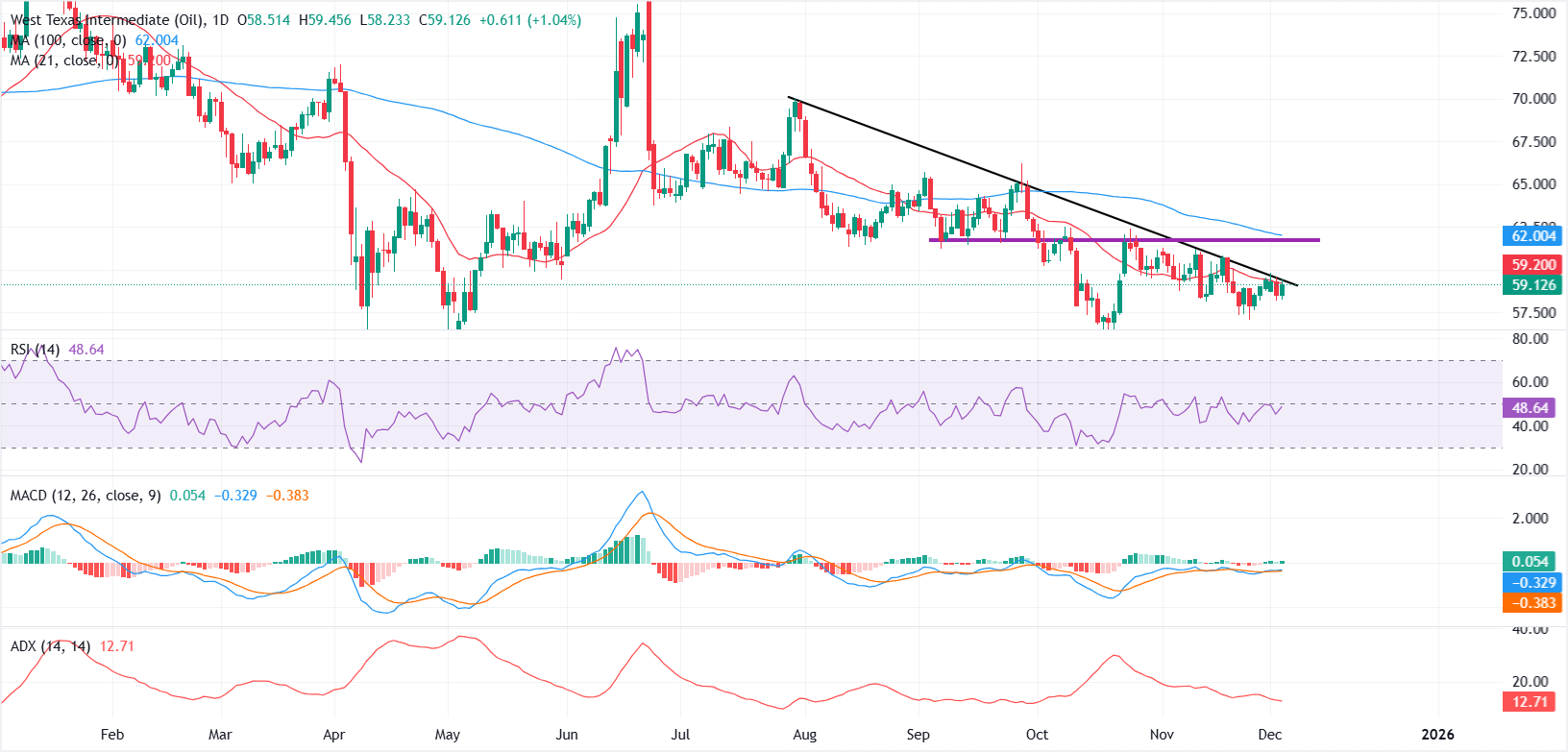
From a technical standpoint, on the daily chart, WTI continues to trade below a downward-sloping trendline, signalling that bears remain in control. The 21-day Simple Moving Average (SMA) acts as immediate resistance, coinciding with the descending trendline around $59.50.
A clear break above this area would expose the next resistance zone, with the $60.50-$62.00 region forming a strong barrier reinforced by the 100-day SMA. A decisive move above this region would be required to ease the broader bearish pressure.
On the downside, initial support lies near $58.00, followed by the November lows around $57.00, a break of which could open the door to deeper losses.
Momentum indicators paint a mixed but mildly constructive near-term picture. The Moving Average Convergence Divergence (MACD) has edged slightly above the signal line near the zero mark, with a modest positive histogram that points to fading bearish pressure.
The Relative Strength Index (RSI), around 48, reflects neutral momentum as it drifts toward the 50 midline. Meanwhile, the Average Directional Index (ADX) at 12.7 underscores the absence of a strong trend.
WTI Oil FAQs
WTI Oil is a type of Crude Oil sold on international markets. The WTI stands for West Texas Intermediate, one of three major types including Brent and Dubai Crude. WTI is also referred to as “light” and “sweet” because of its relatively low gravity and sulfur content respectively. It is considered a high quality Oil that is easily refined. It is sourced in the United States and distributed via the Cushing hub, which is considered “The Pipeline Crossroads of the World”. It is a benchmark for the Oil market and WTI price is frequently quoted in the media.
Like all assets, supply and demand are the key drivers of WTI Oil price. As such, global growth can be a driver of increased demand and vice versa for weak global growth. Political instability, wars, and sanctions can disrupt supply and impact prices. The decisions of OPEC, a group of major Oil-producing countries, is another key driver of price. The value of the US Dollar influences the price of WTI Crude Oil, since Oil is predominantly traded in US Dollars, thus a weaker US Dollar can make Oil more affordable and vice versa.
The weekly Oil inventory reports published by the American Petroleum Institute (API) and the Energy Information Agency (EIA) impact the price of WTI Oil. Changes in inventories reflect fluctuating supply and demand. If the data shows a drop in inventories it can indicate increased demand, pushing up Oil price. Higher inventories can reflect increased supply, pushing down prices. API’s report is published every Tuesday and EIA’s the day after. Their results are usually similar, falling within 1% of each other 75% of the time. The EIA data is considered more reliable, since it is a government agency.
OPEC (Organization of the Petroleum Exporting Countries) is a group of 12 Oil-producing nations who collectively decide production quotas for member countries at twice-yearly meetings. Their decisions often impact WTI Oil prices. When OPEC decides to lower quotas, it can tighten supply, pushing up Oil prices. When OPEC increases production, it has the opposite effect. OPEC+ refers to an expanded group that includes ten extra non-OPEC members, the most notable of which is Russia.

超过一百万用户依赖 FXStreet 获取实时市场数据、图表工具、专家洞见和外汇新闻。其全面的经济日历和教育网络研讨会帮助交易者保持信息领先、做出审慎决策。FXStreet 拥有约 60 人的团队,分布在巴塞罗那总部及全球各地区。
阅读更多








