

British Pound slips as Hormuz attacks revive USD demand
- Hormuz ship attacks lift Oil, supporting Greenback demand.
- NY Fed survey shows households expect higher inflation.
- Burnham fiscal pledge limits deeper Sterling political pressure.
The Pound Sterling retreats against the US Dollar on Tuesday as tensions in the Middle East rise, following reports of attacks on two ships in the Strait of Hormuz. The GBP/USD trades at 1.3373, down 0.11%.
GBP/USD falls as Oil spike lifts Fed hike worries
The Greenback remains steady after geopolitical developments reveal that the Islamic Revolutionary Guard Corps (IRGC) attacked ships which attempted to pass through the Omani route, ignoring the IRGC’s repeated warnings. These developments underpinned Oil prices, and consequently the US Dollar, as high energy prices could force the US Federal Reserve to raise interest rates.

The US Dollar Index (DXY), which measures the buck’s performance against six currencies, is up 0.05% at 100.93.
Data from the US showed that the trade deficit widened in May, driven by a jump in imports and a decline in exports. The Goods and Services Trade Balance deficit came at $-77.6 billion, more than the $-54.6 billion printed in April.
Aside from this, the New York Fed Survey of Consumer Expectations revealed that households foresee higher prices, as inflation expectations for one-year increased from 3.5% in May to 3.7% in June. The data suggests that the Fed might still opt to keep rates unchanged, but could also increase the likelihood of a rate hike.
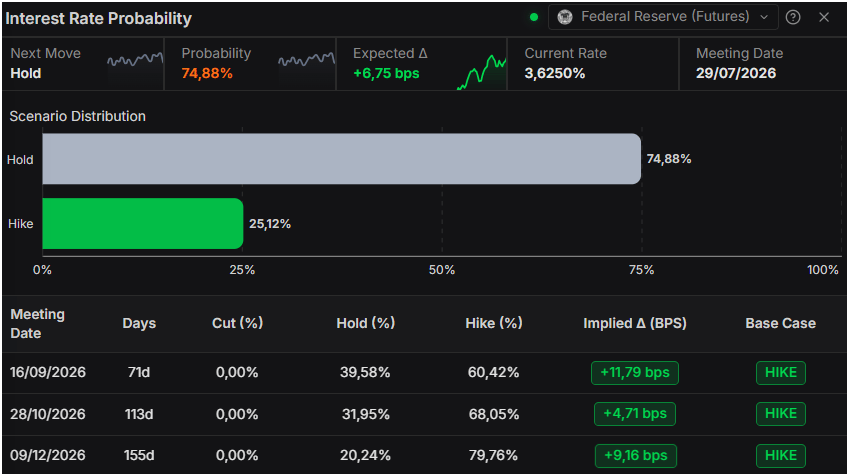
Money markets had increased the chances for a rate hike at the September meeting, with odds standing at a 60.42%, for the July 29 meeting, there’s a nearly 75% chance that the Fed will keep rates unchanged,
In the UK, the economic docket remained absent, yet Sterling has benefited from the drop of Oil prices, which so far remained positively correlated with the Greenback, exerting downward pressure on the Pound.
Furthermore, the likely next Prime Minister, Andy Burnham, reiterated tha the will commit ot the fiscal rules, easing fears amongst traders, who feared that further spending could trigger a jump in UK GILTS and weakness in the GBP/USD.
GBP/USD Price Forecast: Technical outlook
In the daily chart, GBP/USD trades at 1.3375, keeping a mildly bearish tone as it remains capped beneath the latest reading of the 50/100/200-day simple moving average cluster at 1.3403. The pair is trading between the reclaimed upward support trend line anchored near 1.3159 and the descending resistance trend line that comes in at 1.3511, suggesting a consolidative phase within a broader corrective setup. The Relative Strength Index (14) at about 55 has lifted back into positive territory but only hints at stabilizing momentum rather than a clear bullish shift while price action holds below the stacked moving averages.
On the topside, initial resistance is seen at the triple simple moving average cluster around 1.3403, and a sustained break higher would open the way toward the descending trend-line barrier near 1.3511. On the downside, the next meaningful structural floor is the rising support trend line originating from 1.3159, where buyers are likely to defend the broader medium-term uptrend; a daily close below that area would reinforce the bearish bias and expose deeper losses toward the mid-1.31 region.
(The technical analysis of this story was written with the help of an AI tool. Know more.)
Pound Sterling FAQs
The Pound Sterling (GBP) is the oldest currency in the world (886 AD) and the official currency of the United Kingdom. It is the fourth most traded unit for foreign exchange (FX) in the world, accounting for 12% of all transactions, averaging $630 billion a day, according to 2022 data. Its key trading pairs are GBP/USD, also known as ‘Cable’, which accounts for 11% of FX, GBP/JPY, or the ‘Dragon’ as it is known by traders (3%), and EUR/GBP (2%). The Pound Sterling is issued by the Bank of England (BoE).
The single most important factor influencing the value of the Pound Sterling is monetary policy decided by the Bank of England. The BoE bases its decisions on whether it has achieved its primary goal of “price stability” – a steady inflation rate of around 2%. Its primary tool for achieving this is the adjustment of interest rates. When inflation is too high, the BoE will try to rein it in by raising interest rates, making it more expensive for people and businesses to access credit. This is generally positive for GBP, as higher interest rates make the UK a more attractive place for global investors to park their money. When inflation falls too low it is a sign economic growth is slowing. In this scenario, the BoE will consider lowering interest rates to cheapen credit so businesses will borrow more to invest in growth-generating projects.
Data releases gauge the health of the economy and can impact the value of the Pound Sterling. Indicators such as GDP, Manufacturing and Services PMIs, and employment can all influence the direction of the GBP. A strong economy is good for Sterling. Not only does it attract more foreign investment but it may encourage the BoE to put up interest rates, which will directly strengthen GBP. Otherwise, if economic data is weak, the Pound Sterling is likely to fall.
Another significant data release for the Pound Sterling is the Trade Balance. This indicator measures the difference between what a country earns from its exports and what it spends on imports over a given period. If a country produces highly sought-after exports, its currency will benefit purely from the extra demand created from foreign buyers seeking to purchase these goods. Therefore, a positive net Trade Balance strengthens a currency and vice versa for a negative balance.













