

EUR/USD Price Forecast: 1.1400 to be key support level after ECB’s policy outcome
- EUR/USD rises to near 1.1470 as the US Dollar drops; the outlook of the pair remains grim.
- The Euro shows mixed performance ahead of the ECB’s monetary policy announcement.
- The Fed is unlikely to cut interest rates in the near term.
The EUR/USD pair is 0.16% higher to near 1.1470 during the European trading session on Thursday. The major currency pair gains as the US Dollar (USD) drops slightly, following a strong upside move on Wednesday.
As of writing, the US Dollar Index (DXY), which tracks the Greenback’s value against six major currencies, trades 0.1% lower to near 100.15, but is still close to its over nine-month high of 100.54 posted last week.

The US Dollar gained on Wednesday after the Federal Reserve’s (Fed) monetary policy outcome, in which the United States (US) central bank left interest rates unchanged in the range of 3.50%-3.75%, as expected, and refrained from support for monetary easing in the near term, citing that inflation progress has stalled.
Meanwhile, the Euro (EUR) demonstrates a mixed performance ahead of the European Central Bank’s (ECB) monetary policy announcement at 13:15 GMT. The ECB is widely anticipated to leave interest rates unchanged for the sixth meeting in a row. Therefore, investors will pay close attention to the monetary policy statement and ECB President Christine Lagarde’s speech to get fresh cues on the interest rate outlook, and the likely impact of Middle East conflicts on prices and the economy.
EUR/USD technical analysis
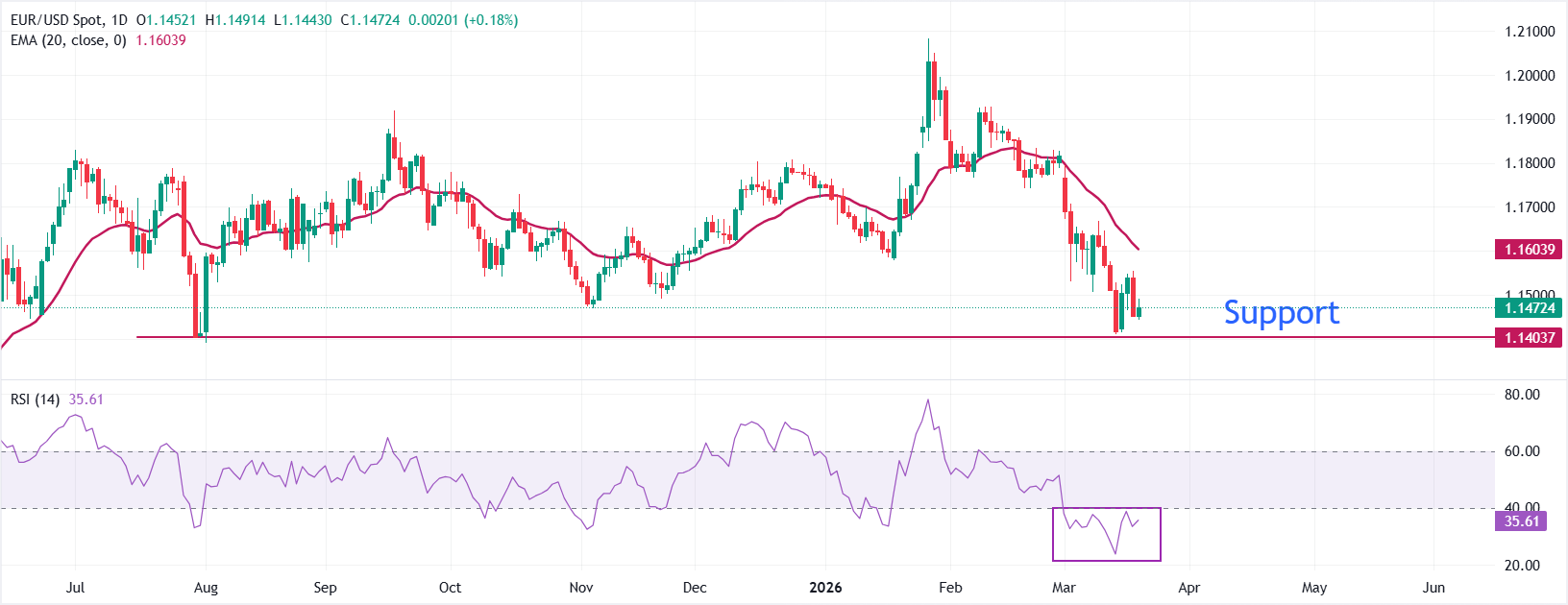
EUR/USD trades higher to near 1.1470 ahead of THE ECB's interest rate decision. The pair maintains a bearish near-term bias as price holds below the descending 20-day Exponential Moving Average (EMA) around 1.1600, confirming a negative short-term trend after the rejection from the 1.19 region. The 14-day Relative Strength Index (RSI) at 35.00 after failing to return above the 40 mark is indicating sellers control and the continuation of the bearish momentum.
Immediate support emerges at 1.1450, with a clear break opening the way toward the August 2025 low around 1.1400. On the topside, initial resistance aligns with the 1.1550 area, followed by the 1.1630 region where the 20-day EMA caps the upside, and then 1.1780 as a stronger barrier. Only a daily close back above 1.1630 would ease the current bearish pressure and point to a more sustained corrective bounce.
(The technical analysis of this story was written with the help of an AI tool.)
ECB FAQs
The European Central Bank (ECB) in Frankfurt, Germany, is the reserve bank for the Eurozone. The ECB sets interest rates and manages monetary policy for the region. The ECB primary mandate is to maintain price stability, which means keeping inflation at around 2%. Its primary tool for achieving this is by raising or lowering interest rates. Relatively high interest rates will usually result in a stronger Euro and vice versa. The ECB Governing Council makes monetary policy decisions at meetings held eight times a year. Decisions are made by heads of the Eurozone national banks and six permanent members, including the President of the ECB, Christine Lagarde.
In extreme situations, the European Central Bank can enact a policy tool called Quantitative Easing. QE is the process by which the ECB prints Euros and uses them to buy assets – usually government or corporate bonds – from banks and other financial institutions. QE usually results in a weaker Euro. QE is a last resort when simply lowering interest rates is unlikely to achieve the objective of price stability. The ECB used it during the Great Financial Crisis in 2009-11, in 2015 when inflation remained stubbornly low, as well as during the covid pandemic.
Quantitative tightening (QT) is the reverse of QE. It is undertaken after QE when an economic recovery is underway and inflation starts rising. Whilst in QE the European Central Bank (ECB) purchases government and corporate bonds from financial institutions to provide them with liquidity, in QT the ECB stops buying more bonds, and stops reinvesting the principal maturing on the bonds it already holds. It is usually positive (or bullish) for the Euro.














