

Gold price slips as Iran escalation overshadows soft US PPI
- Soft US PPI follows cooler CPI, halving Fed hike expectations.
- Middle East escalation lifts Oil, stalling Gold’s rebound attempt.
- Jobless claims, Retail Sales and Fed speakers drive next move.
The Gold price turns negative on Wednesday, even though the last two US inflation reports showed that prices are dropping, though developments in the Middle East sent energy prices higher. At the time of writing, the XAU/USD traded at $4,034, down some 0.53%.
XAU/USD falls as Oil-driven Dollar risks cap recovery

Data in the US showed the Producer Price Index (PPI) dipped from 6% to 5.5% YoY, below estimates of a 6.2% increase. Core PPI, which excludes energy and food prices, rose from 4.6% to 4.7% YoY, yet below forecasts of 5.2%.
Overall, the latest two inflation reports over the last two days eased pressure on the Federal Reserve (Fed).
On Tuesday, before the release of the Consumer Price Index (CPI), money markets were expecting at least 35 basis points of Fed tightening toward the end of the year. After the data, investors cut expectations for a rate hike in half, to just 22 bps, according to Prime Terminal data.
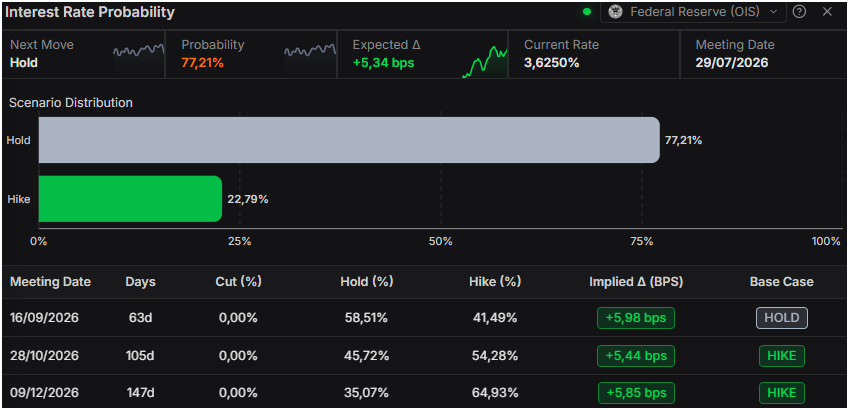
Geopolitics are also a driver that has kept Gold prices contained amid the rise in energy prices. Since the beginning of the US-Iran conflict, Oil has shown a positive correlation with the US Dollar, which has appreciated amid market players' expectations of higher interest rates, a headwind for Bullion prices.
Consequently, the ongoing escalation of the conflict after the US launched another wave of strikes against Iran stalled Gold’s recovery, which was poised to test the $4,150 mark.
Furthermore, Washington has reimposed the blockade on Iran, while the latter threatened to shut off more regional energy exports.
The US Dollar Index (DXY), which tracks the buck’s value against a basket of six currencies, is down 0.5% at 100.42, refreshing the current week’s low. At the same time, the US 10-year Treasury yield is down nearly four basis points at 4.549%, providing a tailwind for the yellow metal.
Fed officials’ stance remained unchanged
Meanwhile, Fed Chair Kevin Warsh is making headlines. He stated that the rise in prices is partly due to AI and mentioned that short-term disruptions from its impact cannot be ruled out.
New York Fed President John Williams stated there’s no clear interest rate path, noting solid economic growth and a strong labor market. He mentioned the Middle East conflict poses “significant risks” that the US economy has so far absorbed.
What to expect on July 16?
Ahead, the US economic docket will feature Initial Jobless Claims, Retail Sales for June, and further Fed speakers, led by Vice Chair Philip Jefferson and Regional Bank Presidents Lorie Logan and Jeffrey Schmid.
XAU/USD technical outlook: Gold’s downtrend intact below $4,100
Gold’s trend remains downwards but is about to turn neutral. Although momentum remains bearish, as indicated by the Relative Strength Index (RSI), the slope has flattened, suggesting sideways trading ahead. Also, buyers stepping in puts pressure on the psychological $4,100 mark, which, if broken, can set the stage for a rally.
In that outcome, the first resistance is the July 14 high of $4,103. Once surpassed, the next stop is a downslope resistance trendline at around $4,125-$4,130, before XAU/USD could aim toward the psychological $4,150 level. Above this level lies $4,200.
However, if Gold stays below $4,100, a resumption of the downtrend is likely. The first support would be the psychological $4,000 level. A decisive break will expose the July 14 daily low at $3,983, before sellers test the current-year-to-date (YTD) low at $3,942.
Gold FAQs
Gold has played a key role in human’s history as it has been widely used as a store of value and medium of exchange. Currently, apart from its shine and usage for jewelry, the precious metal is widely seen as a safe-haven asset, meaning that it is considered a good investment during turbulent times. Gold is also widely seen as a hedge against inflation and against depreciating currencies as it doesn’t rely on any specific issuer or government.
Central banks are the biggest Gold holders. In their aim to support their currencies in turbulent times, central banks tend to diversify their reserves and buy Gold to improve the perceived strength of the economy and the currency. High Gold reserves can be a source of trust for a country’s solvency. Central banks added 1,136 tonnes of Gold worth around $70 billion to their reserves in 2022, according to data from the World Gold Council. This is the highest yearly purchase since records began. Central banks from emerging economies such as China, India and Turkey are quickly increasing their Gold reserves.
Gold has an inverse correlation with the US Dollar and US Treasuries, which are both major reserve and safe-haven assets. When the Dollar depreciates, Gold tends to rise, enabling investors and central banks to diversify their assets in turbulent times. Gold is also inversely correlated with risk assets. A rally in the stock market tends to weaken Gold price, while sell-offs in riskier markets tend to favor the precious metal.
The price can move due to a wide range of factors. Geopolitical instability or fears of a deep recession can quickly make Gold price escalate due to its safe-haven status. As a yield-less asset, Gold tends to rise with lower interest rates, while higher cost of money usually weighs down on the yellow metal. Still, most moves depend on how the US Dollar (USD) behaves as the asset is priced in dollars (XAU/USD). A strong Dollar tends to keep the price of Gold controlled, whereas a weaker Dollar is likely to push Gold prices up.













