

Gold tumbles as Oil surge lifts yields, USD ahead of the Fed
- Gold falls as rising Oil prices push Treasury yields higher.
- Strong Durable Goods Orders reinforced the case for steady Fed rates.
- Traders now await Powell’s press conference and Fed policy guidance.
Gold (XAU/USD) price retreats over 1% on Wednesday as high energy prices are driving US Treasury yields soaring, signaling that investors are not expecting any rate cuts by the Federal Reserve (Fed), which is expected to hold rates unchanged late at around 18:00 GMT. XAU/USD trades at $4,541 after hitting a daily high of $4,610.

Fed decision looms as oil shock wipes out rate-cut hopes for 2026
Sentiment remains deteriorated as US President Donald Trump instructed the blockade over Iranian ports will extend until Tehran signs a deal that involves nuclear issues. Meanwhile, high energy prices, with WTI above $100 per barrel on Wednesday, are underpinning the Greenback, with the US Dollar Index (DXY) trading near two-day highs at 98.89.
Yields on US Treasury securities are rising, as evidenced by the 10-year Treasury note increasing by 5 basis points to 4.40%. This upward movement indicates reduced investor confidence that the Federal Reserve will lower borrowing costs in the immediate future.
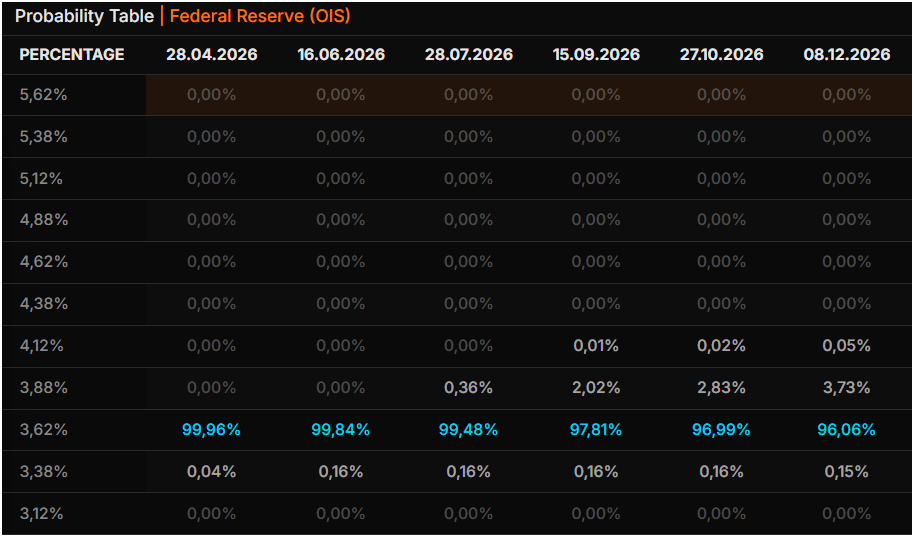
The probability that the Federal Reserve might skip cutting rates faded completely, with traders not expecting rate cuts during 2026, according to Prime Terminal data.
Fed probability table
Eyes would be on the Federal Reserve Chair Jerome Powell press conference, where he could be questioned about staying on at the Fed once his term as chief of the US central bank expires, as Kevin Warsh hurdled the first stage of confirmation by the US Senate.
Data-wise, US Core Durable Goods Orders jumped by 3.3%, up from 1.6% in February and far above the expected 0.6% increase. This suggests that companies are boosting their spending, particularly on AI, to enhance profit margins. Overall goods orders also improved, rising from a yearly decline of 1.2% to a 0.8% gain, beating forecasts of 0.5%.
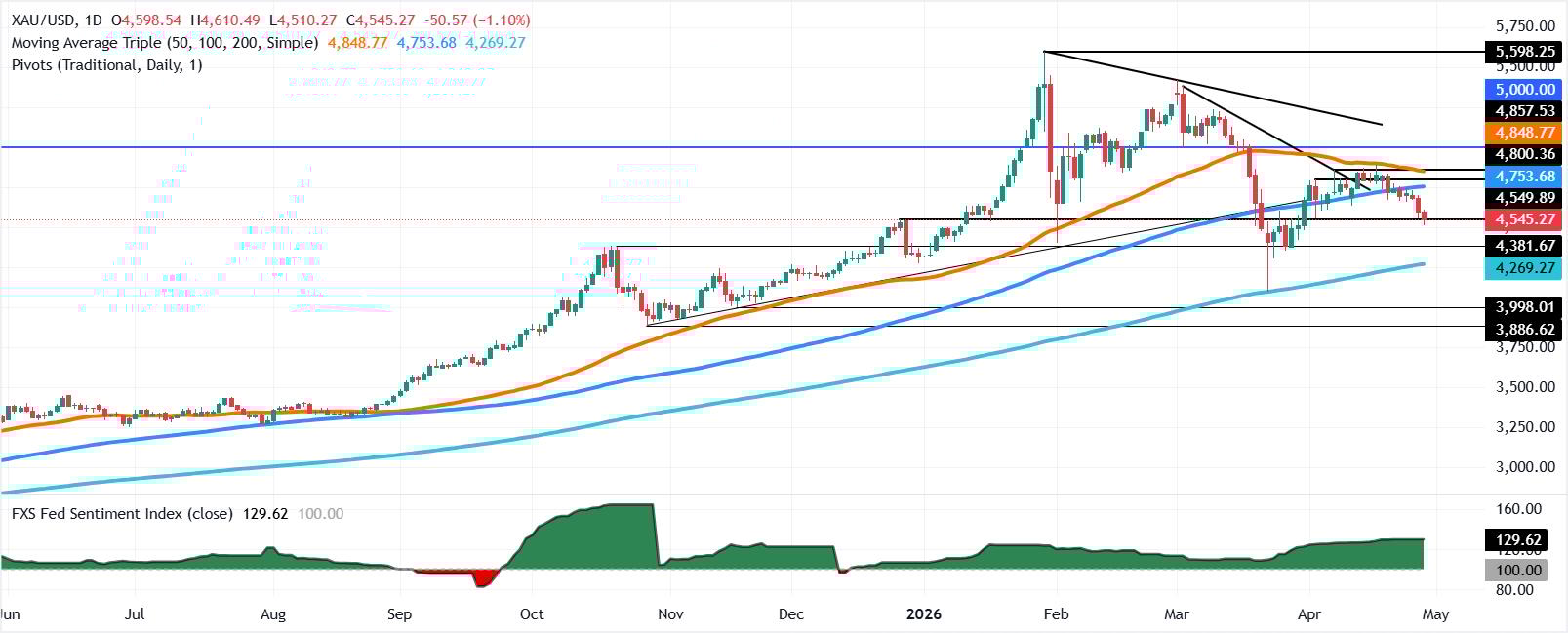
XAU/USD technical outlook: Bears push Gold to four-week lows, further downside eyed
The Gold price is neutral to bearish, trading near four-week lows around $4,510, with momentum favoring further downside as the Relative Strength Index (RSI) approaches oversold territory.
If Gold drops below $4,500, the first support level would be the March 31 low at $4,482, followed by the March 26 swing low at $4,351. The next support would be the 200-day Simple Moving Average (SMA) at $4,269.
On the flip side, buyers must reclaim the $4,600 mark, followed by the 100-day SMA at $4,753. On further strength, the next resistance would be the 50-day SMA at $4,848.
Gold FAQs
Gold has played a key role in human’s history as it has been widely used as a store of value and medium of exchange. Currently, apart from its shine and usage for jewelry, the precious metal is widely seen as a safe-haven asset, meaning that it is considered a good investment during turbulent times. Gold is also widely seen as a hedge against inflation and against depreciating currencies as it doesn’t rely on any specific issuer or government.
Central banks are the biggest Gold holders. In their aim to support their currencies in turbulent times, central banks tend to diversify their reserves and buy Gold to improve the perceived strength of the economy and the currency. High Gold reserves can be a source of trust for a country’s solvency. Central banks added 1,136 tonnes of Gold worth around $70 billion to their reserves in 2022, according to data from the World Gold Council. This is the highest yearly purchase since records began. Central banks from emerging economies such as China, India and Turkey are quickly increasing their Gold reserves.
Gold has an inverse correlation with the US Dollar and US Treasuries, which are both major reserve and safe-haven assets. When the Dollar depreciates, Gold tends to rise, enabling investors and central banks to diversify their assets in turbulent times. Gold is also inversely correlated with risk assets. A rally in the stock market tends to weaken Gold price, while sell-offs in riskier markets tend to favor the precious metal.
The price can move due to a wide range of factors. Geopolitical instability or fears of a deep recession can quickly make Gold price escalate due to its safe-haven status. As a yield-less asset, Gold tends to rise with lower interest rates, while higher cost of money usually weighs down on the yellow metal. Still, most moves depend on how the US Dollar (USD) behaves as the asset is priced in dollars (XAU/USD). A strong Dollar tends to keep the price of Gold controlled, whereas a weaker Dollar is likely to push Gold prices up.














