

Indian Rupee ticks down against US Dollar, US data in focus
- The Indian Rupee edges down against the US Dollar as investors shift focus to an array of US data.
- Lower oil prices continue to limit the downside in the Indian Rupee.
- FIIs turned out to be net sellers on Monday.
The Indian Rupee (INR) opens slightly lower against the US Dollar (USD) on Tuesday. The USD/INR pair edges up to near 94.65 as the US Dollar trades firmly amid caution surrounding the United States (US) Nonfarm Payrolls (NFP) data for June, which will be released on Thursday.
At press time, the US Dollar Index (DXY), which gauges the Greenback’s value against six major currencies, trades 0.2% higher to near 101.32.
US NFP to be key trigger for global markets
The US NFP data always holds significant importance for the Federal Reserve’s (Fed) interest rate expectations. However, this time, its impact is expected to be higher as remarks from new Fed Chairman Kevin Warsh in his monetary policy conference this week showed that he would refrain from delivering forward-looking statements.
“Absent, also, is so-called forward guidance—which we agreed was not well suited to the current policy conjuncture,” according to the transcript of Fed Chairman Warsh’s Press Conference.
According to estimates, the US economy created 110K fresh jobs, lower than 172K in May. The Unemployment Rate remains steady at 4.3%.
In Tuesday’s session, investors will focus on the US JOLTS Job Openings data for May, which will be published at 14:00 GMT. The data is expected to show that employers posted 7.3 million fresh jobs, lower than 7.618 million in April.
This week, investors will also focus on the US ADP Employment Change and the ISM Manufacturing PMI data for June, which will be released on Wednesday.
Lower oil prices continue to offer support to Indian Rupee
Oil prices remaining lower due to the maintenance of a ceasefire between the US and Iran continue to support the Indian Rupee.
Currencies from economies, such as India, which rely heavily on oil imports to meet their energy needs, tend to outperform when oil prices remain lower.
Meanwhile, Iran continues to demand recognition of its authority near the Strait of Hormuz, a critical chokepoint to almost 20% of global energy supply, for which it is in talks with Oman.
On Monday, Iranian Deputy Foreign Minister Kazem Gharibabadi stated in a post on X, formerly known as Twitter, that Tehran has concluded a meeting with Oman in which it reviewed current issues related to the Hormuz, and also exchanged views on the future management of the waterway.
FIIs remain net sellers in Indian stock market on Monday
Foreign Institutional Investors (FIIs) continue to pare their stake in the Indian stock market even as lower oil prices have improved India Inc.’s earnings projections. On Monday, FIIs remained net sellers, offloading their stake worth Rs. 1,350.10 crore.
Technical Analysis: USD/INR trades in tight range inside Descending Triangle
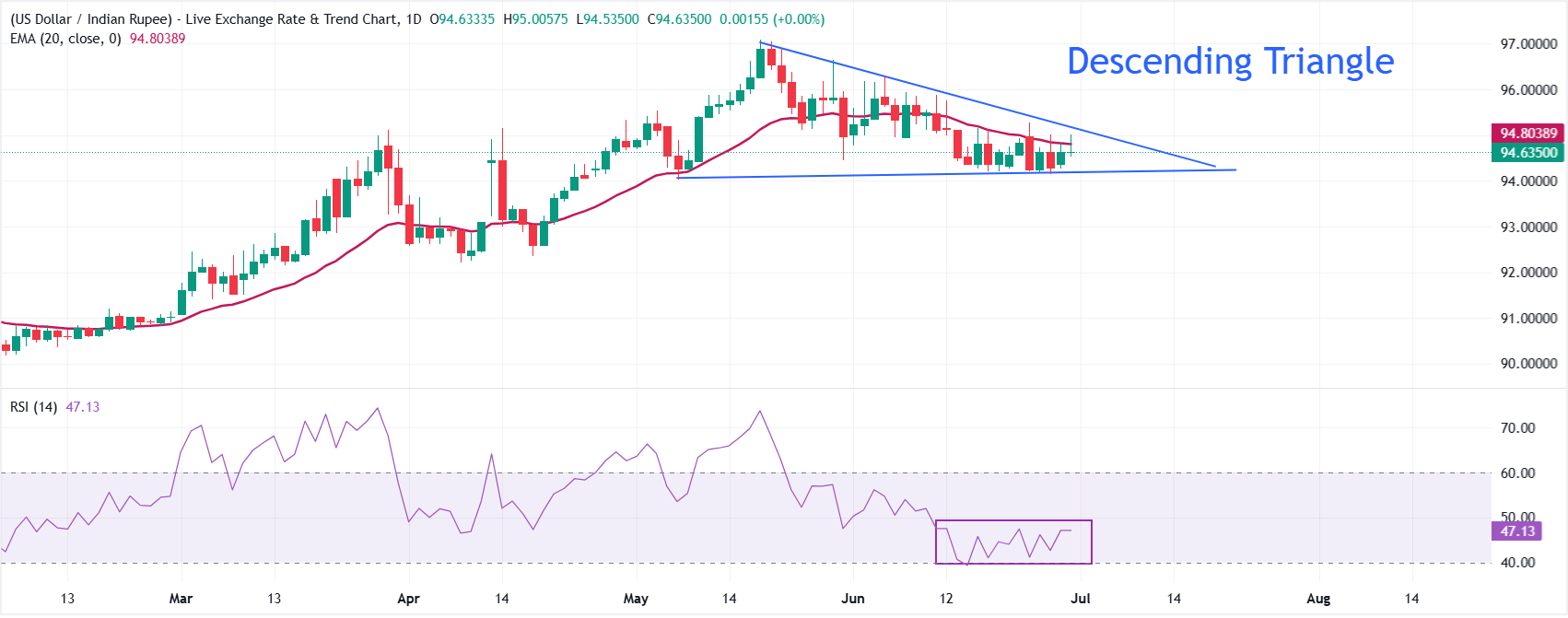
USD/INR trades at around 94.65, keeping a bearish near-term tone as it holds beneath the 20-period Exponential Moving Average (EMA) at 94.80 and the downward-sloping border of the Descending Triangle formation, whose break level sits at 95.18.
The exchange rate has slipped back into the lower half of the recent range, while the Relative Strength Index (RSI) at 47 suggests neutral-to-soft momentum rather than outright oversold conditions, hinting that downside pressure persists but without capitulation.
On the topside, immediate resistance is seen at the 20-period EMA at 94.80, followed by the downtrend-line break level at 95.1822, with the origin of that bearish line near 97.0285 acting as a more distant cap. On the downside, the horizontal border of the above-mentioned chart pattern at around 94.00 is the key support zone; a break below that would expose the pair to the April 15 high at 93.47.
(The technical analysis of this story was written with the help of an AI tool.)
Indian Rupee FAQs
The Indian Rupee (INR) is one of the most sensitive currencies to external factors. The price of Crude Oil (the country is highly dependent on imported Oil), the value of the US Dollar – most trade is conducted in USD – and the level of foreign investment, are all influential. Direct intervention by the Reserve Bank of India (RBI) in FX markets to keep the exchange rate stable, as well as the level of interest rates set by the RBI, are further major influencing factors on the Rupee.
The Reserve Bank of India (RBI) actively intervenes in forex markets to maintain a stable exchange rate, to help facilitate trade. In addition, the RBI tries to maintain the inflation rate at its 4% target by adjusting interest rates. Higher interest rates usually strengthen the Rupee. This is due to the role of the ‘carry trade’ in which investors borrow in countries with lower interest rates so as to place their money in countries’ offering relatively higher interest rates and profit from the difference.
Macroeconomic factors that influence the value of the Rupee include inflation, interest rates, the economic growth rate (GDP), the balance of trade, and inflows from foreign investment. A higher growth rate can lead to more overseas investment, pushing up demand for the Rupee. A less negative balance of trade will eventually lead to a stronger Rupee. Higher interest rates, especially real rates (interest rates less inflation) are also positive for the Rupee. A risk-on environment can lead to greater inflows of Foreign Direct and Indirect Investment (FDI and FII), which also benefit the Rupee.
Higher inflation, particularly, if it is comparatively higher than India’s peers, is generally negative for the currency as it reflects devaluation through oversupply. Inflation also increases the cost of exports, leading to more Rupees being sold to purchase foreign imports, which is Rupee-negative. At the same time, higher inflation usually leads to the Reserve Bank of India (RBI) raising interest rates and this can be positive for the Rupee, due to increased demand from international investors. The opposite effect is true of lower inflation.














