

Neither inflation nor the RBA: What's actually driving the Australian Dollar lower
The Australian Dollar (AUD) is navigating rough waters, in the stark divergence between persistent domestic inflation and slowing economic growth. While the Reserve Bank of Australia (RBA) maintains a restrictive policy stance to counter re-accelerating price pressures fueled by tight labor conditions and the energy shock, recent disappointing gross domestic product (GDP) figures have triggered a swift technical sell-off in major Aussie-related pairs. This combination of structural inflation and cooling growth, coupled with the recent correction, has prompted analysts to re-evaluate the currency's near-term support levels.

Hawkish RBA stance driven by persistent inflation risks
Analysts at BNY report that the Reserve Bank of Australia (RBA) remains highly vigilant as domestic price pressures have intensified. Despite aggressive interest-rate hikes implemented earlier in the year, a combination of robust growth, tight employment markets, and geopolitical uncertainties in the Middle East are expected to keep underlying inflation elevated well above comfort levels for an extended period.
[RBA Governor Michele] Bullock said headline inflation may peak above 4.5% in the June quarter, with underlying inflation above target until mid-2027.
Technical support tested after disappointing GDP data
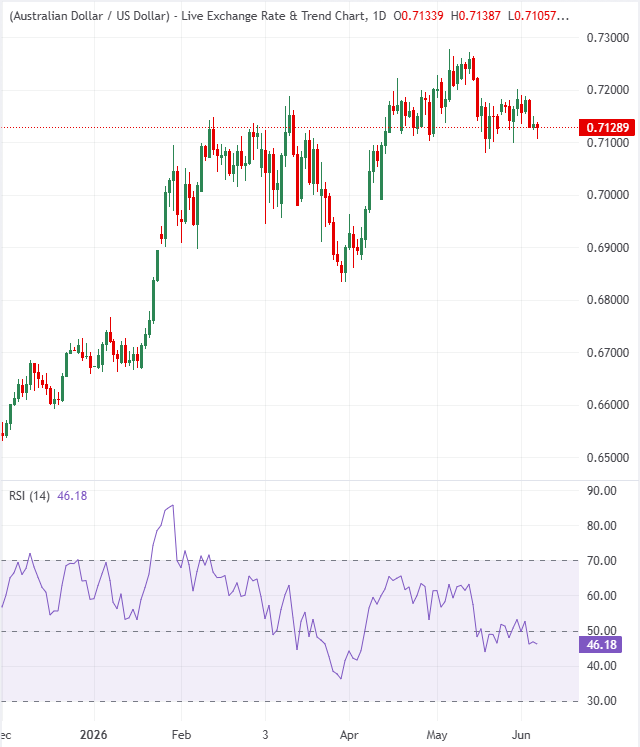
Technical experts at UOB highlight that the Australian Dollar has suffered a sharp and rapid decline against the US Dollar following weaker-than-expected economic growth data for Australia. While the velocity of the sell-off has left the currency pair temporarily oversold near immediate technical baselines, the underlying momentum remains heavily skewed to the downside, threatening deeper structural losses.
There has been a tentative increase in downward momentum, and if AUD breaks and holds below 0.7120, it could lead to a drop to 0.7095. The probability of AUD breaking clearly below 0.7120 will remain intact as long as 0.7185 is not breached.
How significant will the Aussie correction be?
Some analysts anticipate a downward-biased and vulnerable trend for the Australian Dollar. Although BNY details an economic backdrop of sticky inflation and elevated interest rates that would normally provide yield support for a currency, the immediate growth concerns have overshadowed this narrative. As a result, UOB projects that the currency is poised to test and potentially break key technical floors, leaving the Australian Dollar exposed to further depreciation.
(This article was created with the help of an Artificial Intelligence tool and reviewed by an editor.)














