
News & AnalysisCareer

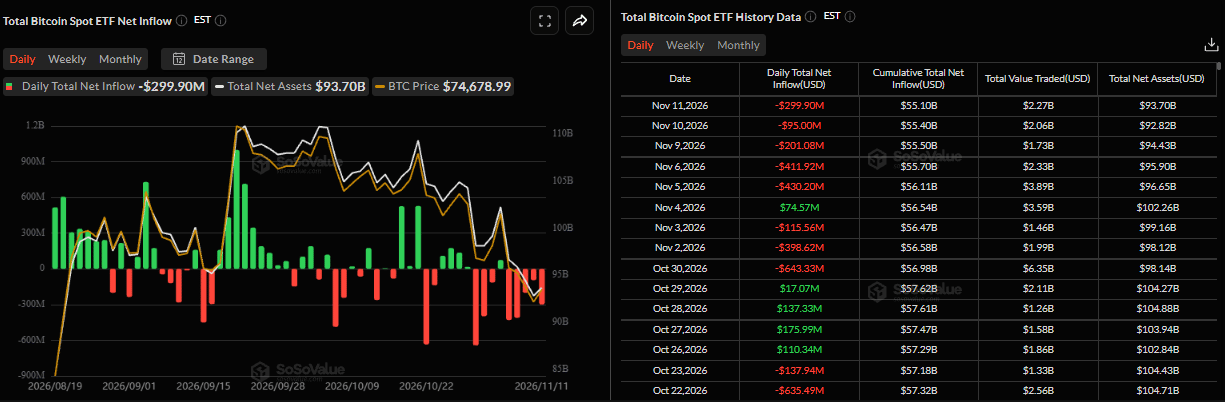
Losses of more than 1.5% so far this week have left Bitcoin (BTC) trading below $73,800 on Thursday, with the cryptocurrency still under pressure. Wednesday’s announcement by global index provider MSCI that it will remove Strategy (MSTR) and other BTC-holding companies from its global indices deepened bearish sentiment, putting billions in fund flows at risk. Institutional appetite has also deteriorated this week. Spot exchange-traded funds (ETFs) posted almost $300 million in outflows on Wednesday, their fifth consecutive day of withdrawals, restraining the leading cryptocurrency’s recovery.

With holdings of 850,364 BTC, Strategy is the largest corporate holder of Bitcoin. On Wednesday, global index provider MSCI said it would remove the company from its global indices.
To align their portfolios with the changes, index funds following the affected benchmarks may have to sell their Strategy shares by 30 November. MSCI’s decision applies directly to the company’s shares, not its Bitcoin holdings. Nevertheless, the repercussions could reach the cryptocurrency market because Strategy holds the largest Bitcoin treasury.
The exclusion list also names Tokyo-listed Metaplanet, another company that accumulates and holds Bitcoin, alongside UK-based uranium investment company Yellow Cake. Removal of the companies from the MSCI USA and MSCI World indices takes effect on 1 December.
Potential forced selling could depress the shares of these BTC-holding companies and indirectly weaken sentiment towards Bitcoin. Such companies offer institutions a route to BTC exposure. Prolonged pressure on their shares could therefore erode confidence in corporate Bitcoin treasury strategies, creating a further obstacle to BTC’s recovery.
Net outflows of $299.90 million from BTC spot ETFs on Wednesday extended a run of withdrawals that began last week to five consecutive days, according to SoSoValue. The figures underline the continued weakening of institutional demand for Bitcoin this week. Should withdrawals persist and accelerate through the rest of the week, the additional pressure could drive BTC into a deeper price correction.
A 3.55% rally in the Nasdaq on Monday was accompanied by a gain of just 0.69% in BTC, illustrating Bitcoin’s continued underperformance against the index this week. That marked divergence between the two risk-sensitive assets continued on Wednesday: the technology-heavy index advanced nearly 2%, whereas Bitcoin rose only 0.30%.
A K33 report found that, in all five observed instances, Bitcoin’s performance over the following 20 days moved in the same direction as the Nasdaq. In a broader sample of 16 strong Nasdaq rebounds after market corrections, Bitcoin gained in eight of the nine cases in which the Nasdaq kept rising (Figure 15), delivering a median return of 2.9%. By contrast, BTC fell in all seven cases in which the Nasdaq’s recovery faltered (Figure 16), with a median loss of 21%. Whether the Nasdaq can maintain its recovery therefore appears central to Bitcoin’s near-term prospects.
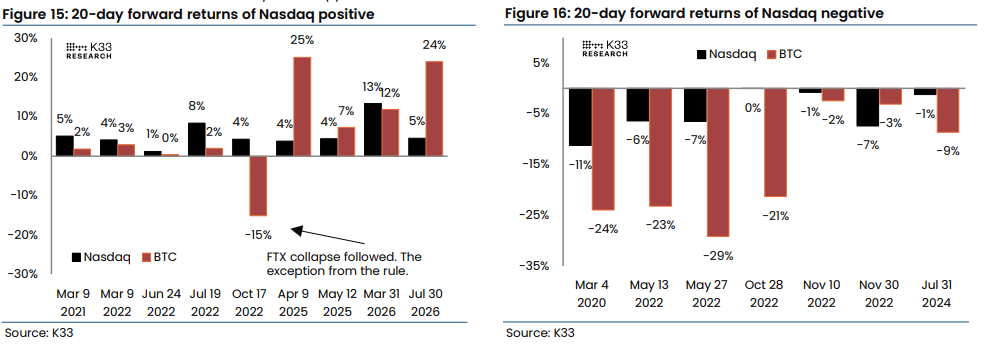
Almost all of last week’s losses in the technology-heavy index have been recouped so far this week; Bitcoin, by comparison, has fallen 1.5% over the same period. Despite a recovery in equity-market risk appetite, the cryptocurrency remains relatively weak. Historical observations suggest that a failed Nasdaq recovery could leave BTC facing substantially larger losses than the technology index.
A continuing equity rebound, on the other hand, could lend Bitcoin support. Even so, its recent lag suggests that improving risk appetite may not immediately produce a stronger recovery in BTC.
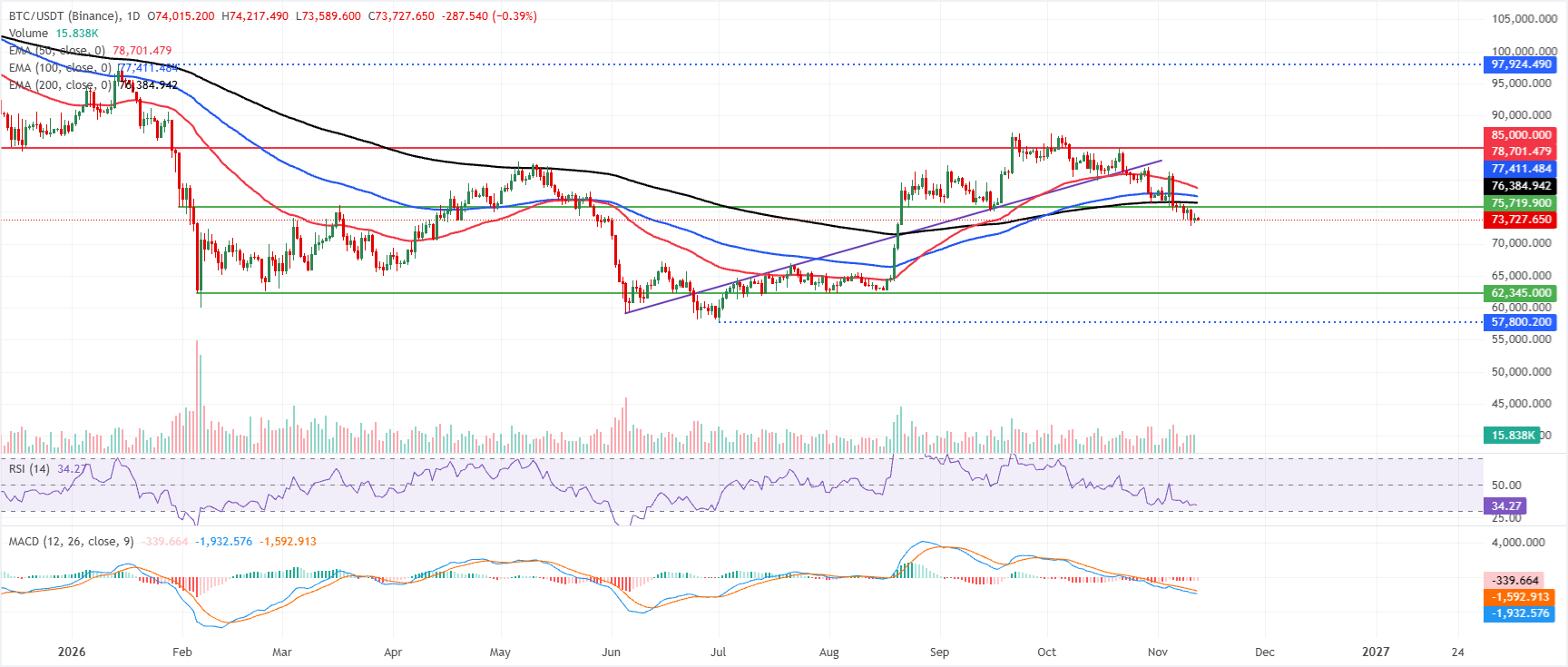
At $73,727 on Thursday, Bitcoin remains beneath key exponential moving averages (EMAs), leaving its near-term bias bearish. Overhead sit the 200-day EMA at $76,384, the 100-day EMA at $77,411 and the 50-day EMA at $78,701. These levels suggest the latest rebound is still constrained within a broader corrective phase.
The momentum indicators support that assessment. With the Relative Strength Index (RSI) close to 34 and the Moving Average Convergence Divergence (MACD) indicator remaining negative, sellers appear to retain control despite occasional rebounds.
The first upside barrier is the 200-day EMA around $76,384. Beyond it lie the 100-day EMA near $77,411 and the 50-day EMA at about $78,701. Together, these averages present a substantial resistance zone that buyers would need to regain to relieve downward pressure. Further up, horizontal resistance at $85,000 represents a more significant obstacle, where earlier selling interest could re-emerge.
With no nearby support mapped out, a break beneath current levels would point BTC towards the psychological support area around $70,000 before the price stabilises.
(The technical analysis of this story was written with the help of an AI tool. Know more.)
Designed to function as money, Bitcoin is a virtual currency and the largest cryptocurrency by market capitalisation. No single person, group or entity can control this means of payment, removing the need for third-party involvement in financial transactions.
The term altcoin covers any cryptocurrency other than Bitcoin. Some also exclude Ethereum, however, on the grounds that forks originate from these two cryptocurrencies. Under that interpretation, Litecoin is the first altcoin: it was forked from the Bitcoin protocol and is therefore an “improved” version of it.
A stablecoin is a cryptocurrency intended to maintain a stable price, backed by a reserve of the asset it represents. Its value is pegged to a commodity or financial instrument, such as the US dollar (USD), while an algorithm or demand regulates its supply. Stablecoins primarily offer a way into and out of the cryptocurrency market for those wishing to trade and invest in it. They also enable investors to store value, as cryptocurrencies are generally subject to volatility.
The proportion of total cryptocurrency market capitalisation accounted for by Bitcoin is known as Bitcoin dominance. This measure gives a clear indication of investor interest in Bitcoin. BTC dominance is typically high before and during a bull run, when investors favour relatively stable cryptocurrencies with large market capitalisations, such as Bitcoin. Falling BTC dominance usually signals that investors are shifting capital and/or profits into altcoins in search of higher returns, often triggering a surge in altcoin rallies.










The information provided on this website is of a general nature only and does not constitute personal financial advice. Before acting on any information on this website, you should consider the suitability of the information in relation to your objectives, financial situation and needs. Investing in CFDs and FX Margin Contracts carries significant risks and is not suitable for all investors. You may lose more than your initial deposit. You do not own, or have, any interest in the underlying asset. We recommend that you seek independent advice and ensure you fully understand the risks involved before trading. It is important that you read and consider the disclosure document before you acquire any product listed on the website. The information and advertisements offered on this website are not intended for use by any person in any country or jurisdiction where such use would be contrary to local laws and regulations. The Products and Services offered on this website are not intended for residents of the United States, Malaysia and Thailand.
TMGM is authorized and regulated in various jurisdictions.
Trademax Australia Limited, trading as TMGM, is regulated by the Australian Securities and Investments Commission (ASIC), AFSL no. 436416 and is located at Level 28, One International Tower, 100 Barangaroo Avenue, 2000 Sydney, NSW Australia.
Email: support@tmgm.com.au
Trademax Global Limited, trading as TMGM, is authorized and regulated by the Vanuatu Financial Services Commission (VFSC), registration number 40356 and registered at 1276, Kumul Highway, Port Vila, Vanuatu, Republic of Vanuatu.
Email: support@tmgm.com
Trademax Global Markets (SE) Limited, trading as TMGM, is authorized and regulated by the Financial Services Authority (FSA) of Seychelles, with license number SD224. The company is registered at Office No 13, Providence Estate ABIS Centre, Mahe, Seychelles.
Email: support@tmgm.com
Trademax Global Markets (International) Pty Ltd, trading as TMGM, is authorized and regulated by the Financial Services Commission, Mauritius (FSC) with license no. GB22201012, and registered at 33, Edith Cavell Street C/o IQ EQ Fund Services (Mauritius) Ltd Port Louis, 11324 Mauritius.
Email: support@tmgm.com
Copyright © TMGM. All rights reserved


