
News & AnalysisCareer

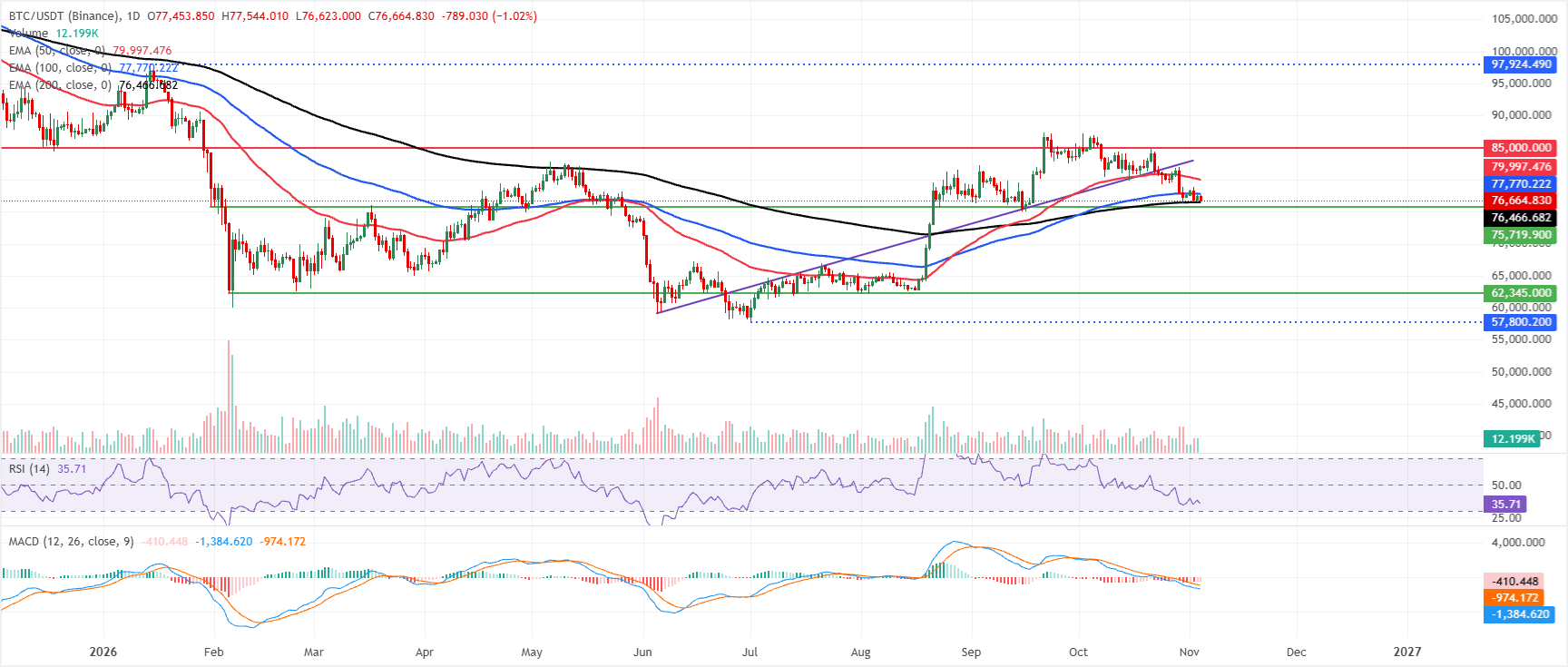
Key support around $76,466 is approaching for Bitcoin (BTC) on Wednesday, with a decisive close beneath it potentially paving the way for further declines. Bearish momentum continues to weigh on BTC, Ethereum (ETH) and Ripple (XRP). ETH remains below important resistance, while XRP is being rejected at the upper boundary of a falling channel, leaving all three exposed to further losses.

At $76,466, the 200-day Exponential Moving Average (EMA) provides nearby support for Bitcoin, which trades at $76,664 on Wednesday. The near-term outlook remains bearish: although BTC is holding just above that average, the 100-day EMA at $77,770 continues to limit its advance.
Further overhead resistance comes from the 50-day EMA near $79,997. A Relative Strength Index (RSI) reading around 35 indicates that selling pressure may be easing, though it offers no clear sign of recovery. Despite tentative stabilisation above the 200-day EMA, the Moving Average Convergence Divergence (MACD) remains below zero, indicating that bearish momentum retains the upper hand.
Any rebound would first encounter the 100-day EMA at $77,770, before reaching the 50-day EMA around $79,997. Beyond these averages, the horizontal resistance near $85,000 presents a more substantial obstacle.
Immediate downside support lies at the 200-day EMA at $76,466. A decisive breach of this area would likely leave BTC vulnerable to a deeper correction over the coming sessions.
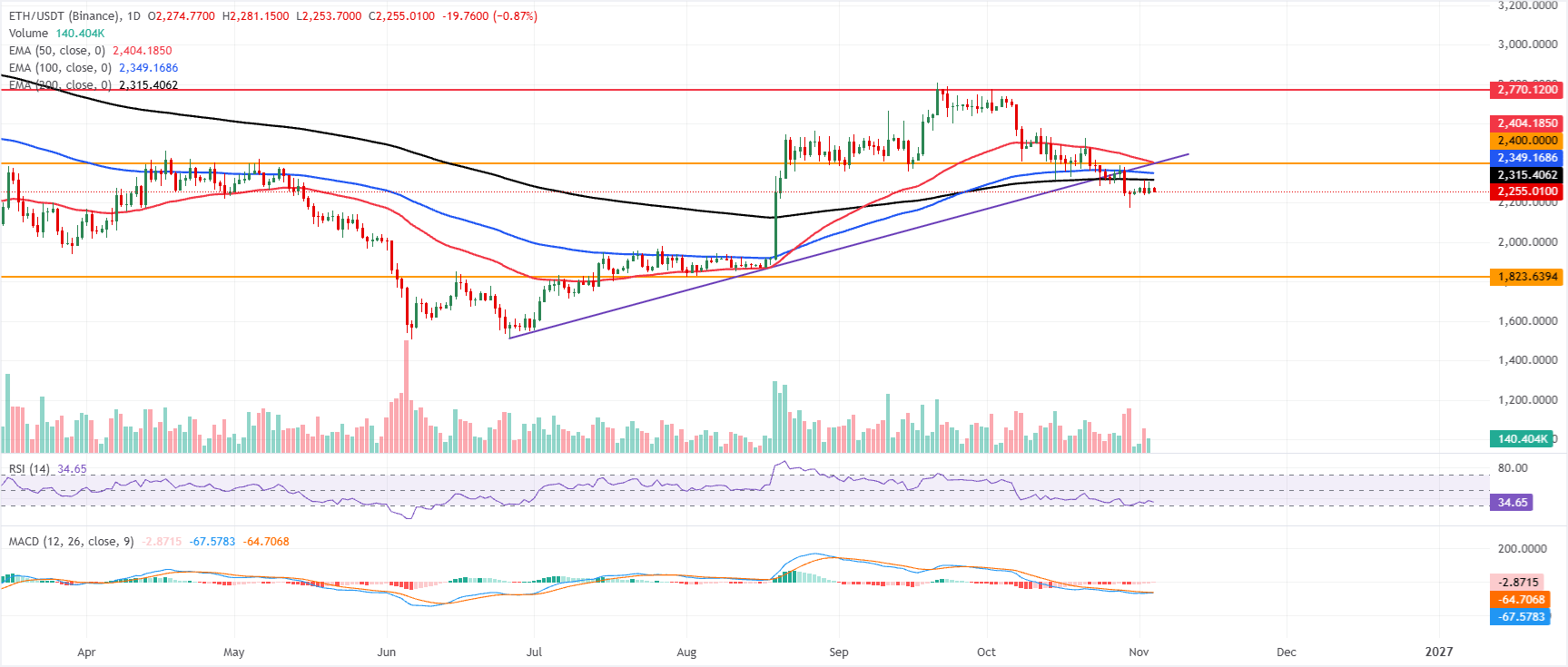
The 200-day and 100-day EMAs, at $2,315 and $2,349 respectively, remain above Ethereum as it trades at $2,255 on Wednesday, keeping the near-term outlook bearish. ETH has also fallen beneath its former rising trendline, which now offers resistance near $2,399. With the RSI at 34, close to oversold territory, and the MACD still negative, downward pressure persists even as bearish momentum slows.
A recovery would initially meet the 200-day EMA at $2,315, then the 100-day EMA at $2,349. The former trendline around $2,399 and nearby horizontal resistance at $2,400 present the next obstacles. A stronger advance would then encounter the 50-day EMA at $2,404, ahead of the higher barrier at $2,770.
Should the decline continue, buyers would be expected to take greater interest around $1,824, where the horizontal support zone forms the key structural floor.
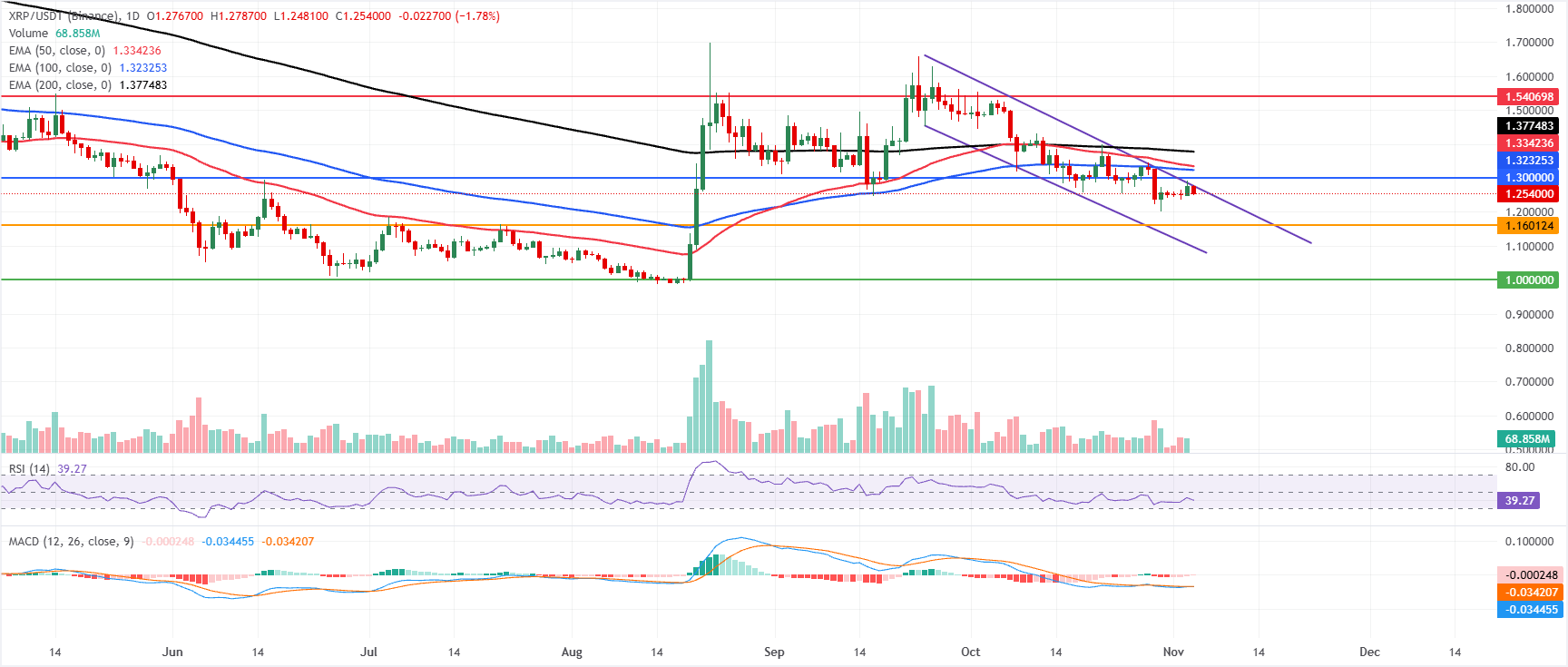
Below its key EMAs, XRP retains a bearish near-term outlook as it trades at $1.254 on Wednesday. Successive layers of overhead resistance come from the 50-day EMA at $1.334, the 100-day EMA at $1.323 and the 200-day EMA at $1.377. These barriers reinforce the downward bias, with the price also remaining below the previous downward trendline break at $1.275.
An RSI around 39 and a marginally negative MACD indicate subdued momentum. Selling pressure therefore remains dominant, although the immediate continuation lower lacks force.
A rebound would first face the former trendline break around $1.275, ahead of horizontal resistance at $1.300. Beyond that lie the grouped EMAs at $1.323 and $1.334, followed by the higher barrier at $1.377, reinforcing the broader corrective structure. Any more substantial recovery would likely meet additional supply near $1.540 and $1.900.
The first downside support lies at $1.160, followed by a lower floor at $1.000. A sustained move beneath these levels would leave scope for a more pronounced bearish extension over the coming sessions.
(The technical analysis of this story was written with the help of an AI tool. Know more.)
Demand and adoption among market participants are influenced by token launches. When an asset is listed on a cryptocurrency exchange, its liquidity increases and new participants join its network. Such developments are generally positive for the digital asset’s price.
During a hack, an attacker uses exploits, bugs or other methods to seize a large quantity of an asset from a DeFi bridge, an exchange’s hot wallet or another cryptocurrency platform. The stolen tokens are then moved off exchange platforms, ultimately to be sold or exchanged for other cryptocurrencies or stablecoins. Widespread panic often follows such incidents, prompting a sell-off in the affected assets.
The direct effect on the US dollar is the main channel through which macroeconomic events, such as the US Federal Reserve’s interest rate decisions, influence crypto assets. Higher interest rates generally weigh on Bitcoin and altcoin prices, while lower rates tend to have the opposite effect. A fall in the US Dollar index makes risk assets and the leverage used to trade them cheaper, thereby pushing cryptocurrency prices higher.
By cutting miners’ block rewards in half, halvings constrain the supply of an asset and are therefore generally viewed as bullish events. When demand remains unchanged, a reduction in supply pushes the asset’s price higher.










The information provided on this website is of a general nature only and does not constitute personal financial advice. Before acting on any information on this website, you should consider the suitability of the information in relation to your objectives, financial situation and needs. Investing in CFDs and FX Margin Contracts carries significant risks and is not suitable for all investors. You may lose more than your initial deposit. You do not own, or have, any interest in the underlying asset. We recommend that you seek independent advice and ensure you fully understand the risks involved before trading. It is important that you read and consider the disclosure document before you acquire any product listed on the website. The information and advertisements offered on this website are not intended for use by any person in any country or jurisdiction where such use would be contrary to local laws and regulations. The Products and Services offered on this website are not intended for residents of the United States, Malaysia and Thailand.
TMGM is authorized and regulated in various jurisdictions.
Trademax Australia Limited, trading as TMGM, is regulated by the Australian Securities and Investments Commission (ASIC), AFSL no. 436416 and is located at Level 28, One International Tower, 100 Barangaroo Avenue, 2000 Sydney, NSW Australia.
Email: support@tmgm.com.au
Trademax Global Limited, trading as TMGM, is authorized and regulated by the Vanuatu Financial Services Commission (VFSC), registration number 40356 and registered at 1276, Kumul Highway, Port Vila, Vanuatu, Republic of Vanuatu.
Email: support@tmgm.com
Trademax Global Markets (SE) Limited, trading as TMGM, is authorized and regulated by the Financial Services Authority (FSA) of Seychelles, with license number SD224. The company is registered at Office No 13, Providence Estate ABIS Centre, Mahe, Seychelles.
Email: support@tmgm.com
Trademax Global Markets (International) Pty Ltd, trading as TMGM, is authorized and regulated by the Financial Services Commission, Mauritius (FSC) with license no. GB22201012, and registered at 33, Edith Cavell Street C/o IQ EQ Fund Services (Mauritius) Ltd Port Louis, 11324 Mauritius.
Email: support@tmgm.com
Copyright © TMGM. All rights reserved

