
News & AnalysisCareer

Trading around 1.4245 at the time of writing, USD/CAD is down 0.04% on Thursday, leaving it little changed and close to a one-month high. The Canadian Dollar (CAD) remains under pressure from broad US Dollar (USD) strength and diverging interest rate expectations for the Federal Reserve (Fed) and the Bank of Canada (BoC).

A softening Canadian labour market relative to the US underpins TD Securities’ view that the US Dollar has further room to strengthen against selected major currencies. Its analysts say that “across global major currencies, we see room for the USD to rally selectively against CAD and KRW in the near-term.” They also argue that “diverging employment data releases will likely keep USDCAD supported above 1.40,” pointing to the relative weakness in Canada’s labour market. TD highlights in particular that a “rising unemployment rate amid falling wage growth rate in Canada also reduces the market pricing of a December BoC rate hike relative to the Fed,” supporting its expectation of continued near-term pressure on the Canadian Dollar against the Dollar.
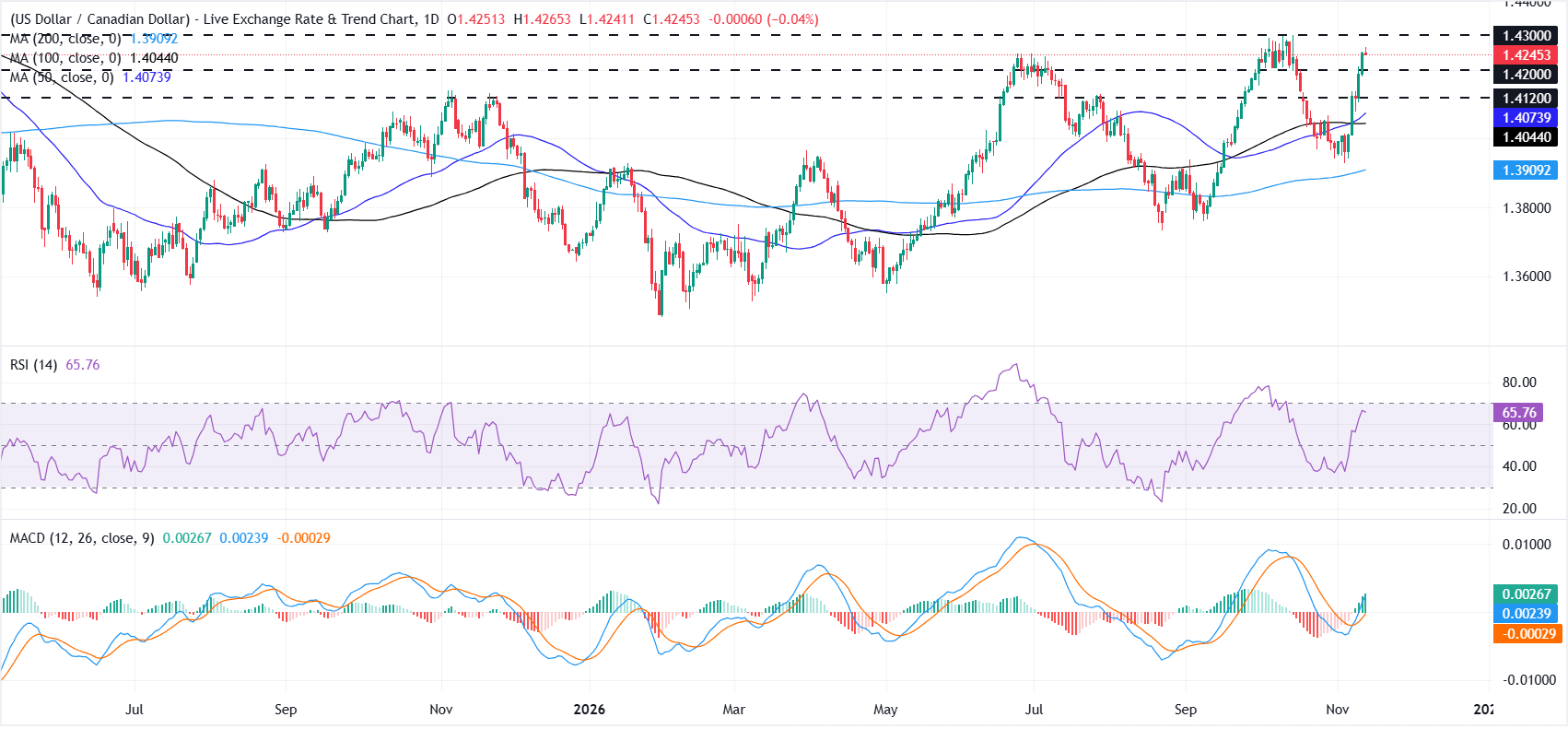
Having recovered all its October losses, USD/CAD now trades above both the 50-day and 100-day Simple Moving Averages (SMAs), leaving buyers in control. The 200-day SMA sits well beneath the prevailing price.
The momentum indicators also support the bullish outlook. At around 66, the Relative Strength Index (RSI) is approaching overbought territory, while the Moving Average Convergence Divergence (MACD) holds in positive territory above its recent lows, suggesting that buying interest persists.
A pullback would first encounter support around 1.4200 and then at 1.4120, a former resistance level that now provides support. Further down, a group of trend-supporting averages, bounded by the 50-day SMA at 1.4074 and the 100-day SMA at 1.4044, should provide an additional cushion before the longer-term 200-day SMA at 1.3909.
For further advances, the first hurdle is the October high around 1.4300. Clearing that resistance could allow the pair to extend its gains towards the psychological level of 1.4400.
(The technical analysis of this story was written with the help of an AI tool. Know more.)
Interest rates set by the Bank of Canada (BoC), oil prices, economic health, inflation and the trade balance are among the principal influences on the Canadian Dollar (CAD). Oil is Canada’s largest export, while the trade balance measures the difference between the value of the country’s exports and imports. Investor sentiment matters too: a willingness to hold riskier assets (risk-on) generally supports the CAD, whereas a preference for safe havens is known as risk-off. The state of the US economy is another important influence, given that the US is Canada’s largest trading partner.
By setting the interest rate at which banks can lend to each other, the Bank of Canada (BoC) exerts considerable influence on the Canadian Dollar and on borrowing rates throughout the economy. Its primary objective is to keep inflation within 1-3%, raising or lowering interest rates to achieve that aim. Relatively high rates generally support the CAD. The BoC can also alter credit conditions through quantitative easing, which is negative for the CAD, or quantitative tightening, which is positive for the currency.
As petroleum is Canada’s largest export, changes in oil prices tend to feed through immediately to the Canadian Dollar’s value. Rising oil prices generally lift overall demand for the currency and push the CAD higher; falling prices typically have the reverse effect. More expensive oil also tends to increase the likelihood of a trade surplus, providing further support for the Canadian Dollar.
Traditionally, inflation was regarded as harmful to a currency because it erodes the value of money. In modern times, however, the easing of cross-border capital controls has meant that the reverse has applied. When inflation rises, central banks tend to increase interest rates, drawing in more capital from international investors seeking attractive returns. Those inflows raise demand for the domestic currency, which in Canada is the Canadian Dollar.
By providing a measure of economic health, macroeconomic releases can move the Canadian Dollar. GDP, manufacturing and services PMIs, employment figures and consumer sentiment surveys are all capable of shaping the CAD’s direction. Economic strength supports the currency by attracting additional foreign investment and potentially prompting the Bank of Canada to raise interest rates. Weak figures, by contrast, are likely to weigh on the CAD.










The information provided on this website is of a general nature only and does not constitute personal financial advice. Before acting on any information on this website, you should consider the suitability of the information in relation to your objectives, financial situation and needs. Investing in CFDs and FX Margin Contracts carries significant risks and is not suitable for all investors. You may lose more than your initial deposit. You do not own, or have, any interest in the underlying asset. We recommend that you seek independent advice and ensure you fully understand the risks involved before trading. It is important that you read and consider the disclosure document before you acquire any product listed on the website. The information and advertisements offered on this website are not intended for use by any person in any country or jurisdiction where such use would be contrary to local laws and regulations. The Products and Services offered on this website are not intended for residents of the United States, Malaysia and Thailand.
TMGM is authorized and regulated in various jurisdictions.
Trademax Australia Limited, trading as TMGM, is regulated by the Australian Securities and Investments Commission (ASIC), AFSL no. 436416 and is located at Level 28, One International Tower, 100 Barangaroo Avenue, 2000 Sydney, NSW Australia.
Email: support@tmgm.com.au
Trademax Global Limited, trading as TMGM, is authorized and regulated by the Vanuatu Financial Services Commission (VFSC), registration number 40356 and registered at 1276, Kumul Highway, Port Vila, Vanuatu, Republic of Vanuatu.
Email: support@tmgm.com
Trademax Global Markets (SE) Limited, trading as TMGM, is authorized and regulated by the Financial Services Authority (FSA) of Seychelles, with license number SD224. The company is registered at Office No 13, Providence Estate ABIS Centre, Mahe, Seychelles.
Email: support@tmgm.com
Trademax Global Markets (International) Pty Ltd, trading as TMGM, is authorized and regulated by the Financial Services Commission, Mauritius (FSC) with license no. GB22201012, and registered at 33, Edith Cavell Street C/o IQ EQ Fund Services (Mauritius) Ltd Port Louis, 11324 Mauritius.
Email: support@tmgm.com
Copyright © TMGM. All rights reserved

