

Crypto Today: Bitcoin and Ethereum wobble as XRP rises, anchored by increasing ETF inflows
- Bitcoin trades sideways below the 100-day EMA amid growing institutional interest.
- Ethereum trades slightly below the daily open of $2,360 as bulls battle to regain momentum, supported by steady ETF inflows.
- XRP extends gains above $1.40, building on robust momentum indicators.
Cryptocurrency prices are broadly consolidating, with Bitcoin (BTC) extending sideways action slightly below the $75,000 threshold, even as institutional inflows continue to support the market.
Meanwhile, Ethereumeum (ETH) trades below its daily open of $2,360 while holding above the immediate support at $2,300. On the other hand, Ripple (XRP) edges up above $1.40, underscoring growing investor risk appetite.

Bitcoin, Ethereum and XRP ETFs inflows extend amid renewed investor interest
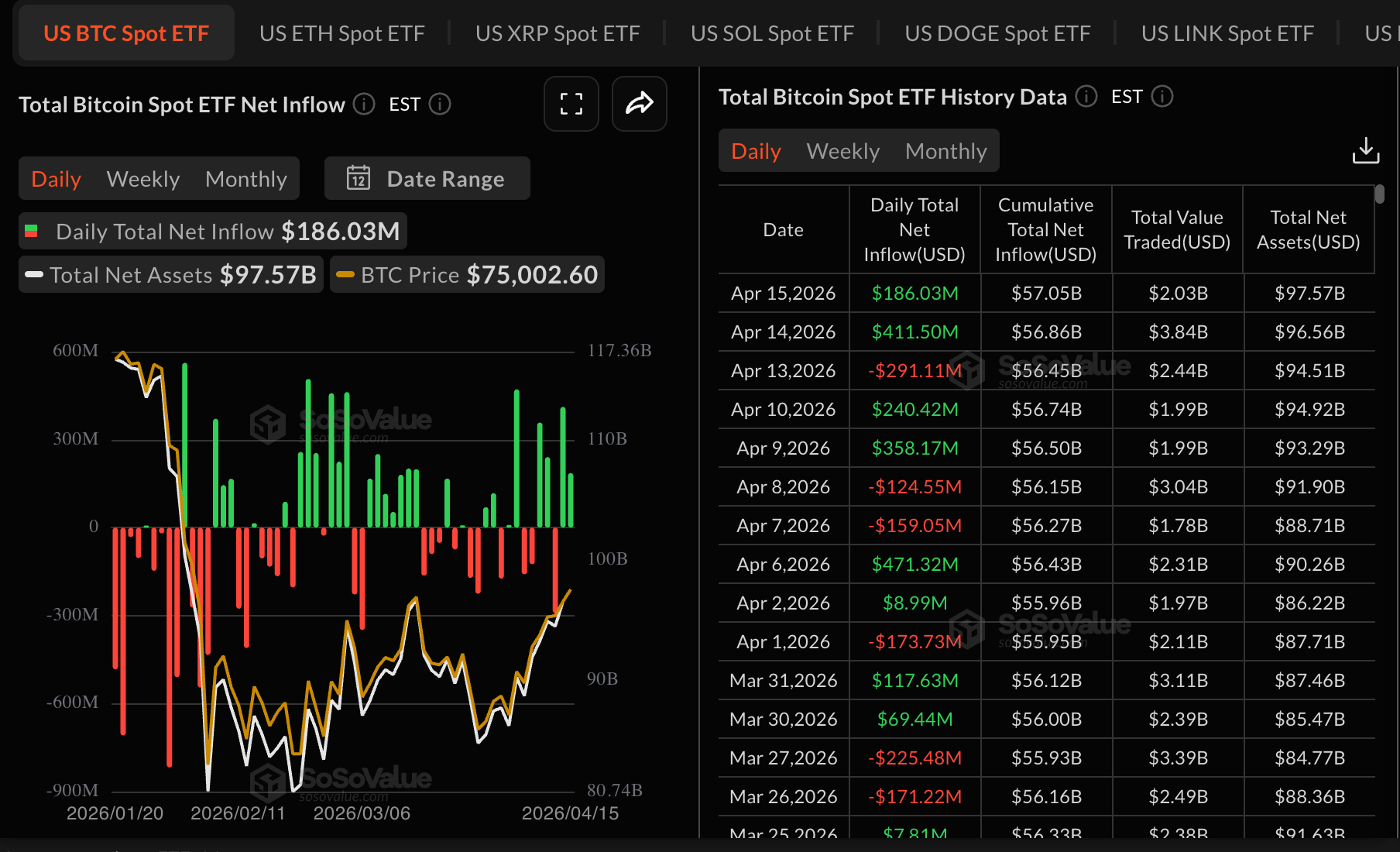
Institutional investors appear to have regained interest in crypto assets, as reflected in US-listed Bitcoin spot Exchange-Traded Funds (ETFs), which saw roughly $186 million in inflows on Wednesday. Despite geopolitical tensions in the Middle East, optimism about the potential for a second round of peace talks between the United States and Iran is drawing investors from the sidelines.
Cumulative inflows currently stand at $57.05 billion, with net assets under management averaging $97.57 billion. If inflows into the spot ETFs continue amid growing risk appetite, prices could steadily increase, with Bitcoin grinding toward the $80,000 psychological level.
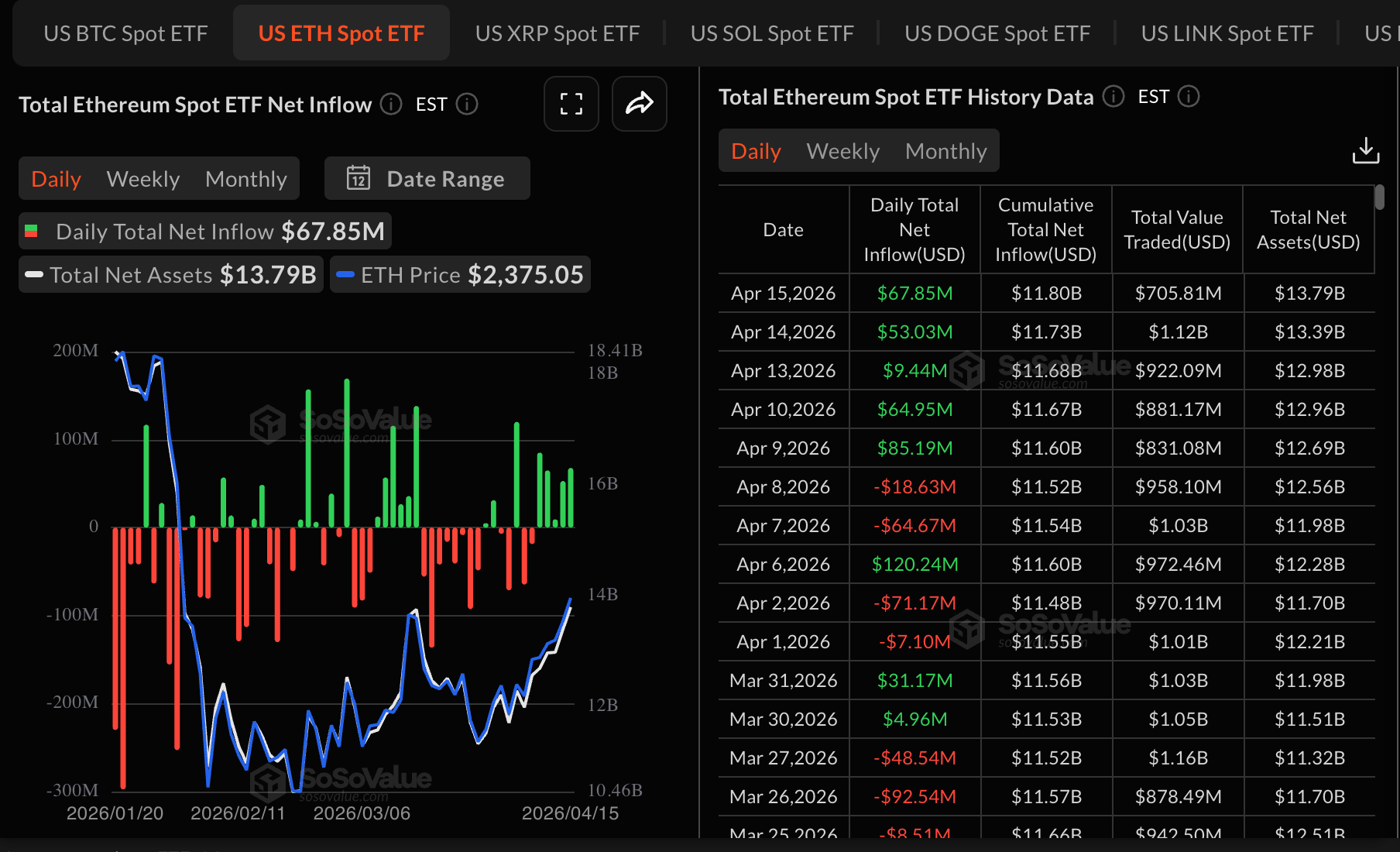
Ethereum similarly recorded inflows of nearly $68 million on Wednesday, extending the bullish streak for the fifth consecutive day. Renewed investor risk appetite has propelled cumulative inflows into ETH spot ETFs to an average of $11.80 billion, while net assets under management now stand at $13.79 billion.
Should ETF inflows remain robust throughout the week, market sentiment toward Ethereum is likely to strengthen, potentially fueling a more sustained recovery in ETH price.
Meanwhile, demand for XRP spot ETFs continues to track closely with Bitcoin and Ethereum, as evidenced by Wednesday’s robust $17 million in inflows, an increase from about $11 million the previous day. Cumulative inflows stand at $1.25 billion and net assets under management at $1.02 billion, which underscores growing interest in XRP and related investment products.
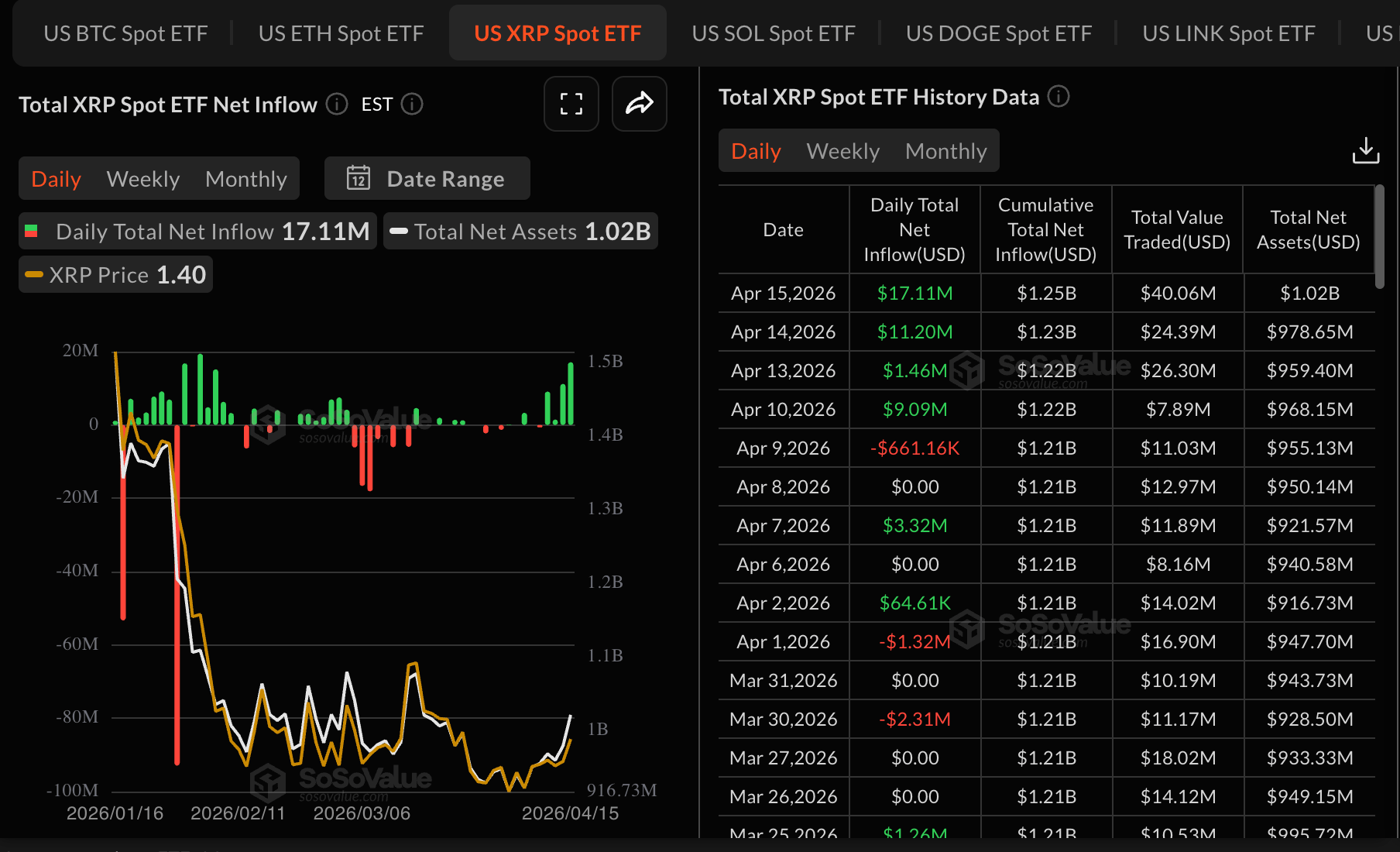
Chart of the day: Bitcoin stalls ahead of a potential breakout
Bitcoin trades at 74,589, holding a bullish near-term bias as price sits modestly above the 50-day Exponential Moving Average (EMA) around $71,289 as well as the reclaimed 38.2% Fibonacci retracement at $74,404 drawn between the January 14 high of $97,924 and the February 6 low of $60,000.
The Crypto King has broken above a downward resistance trendline, which now serves as underlying demand, while upside momentum remains constructive with the Relative Strength Index (RSI) hovering in the low 60s on the daily chart. At the same time, the Moving Average Convergence Divergence (MACD) remains positive on the same chart, suggesting that buyers retain control despite nearby overhead levels.
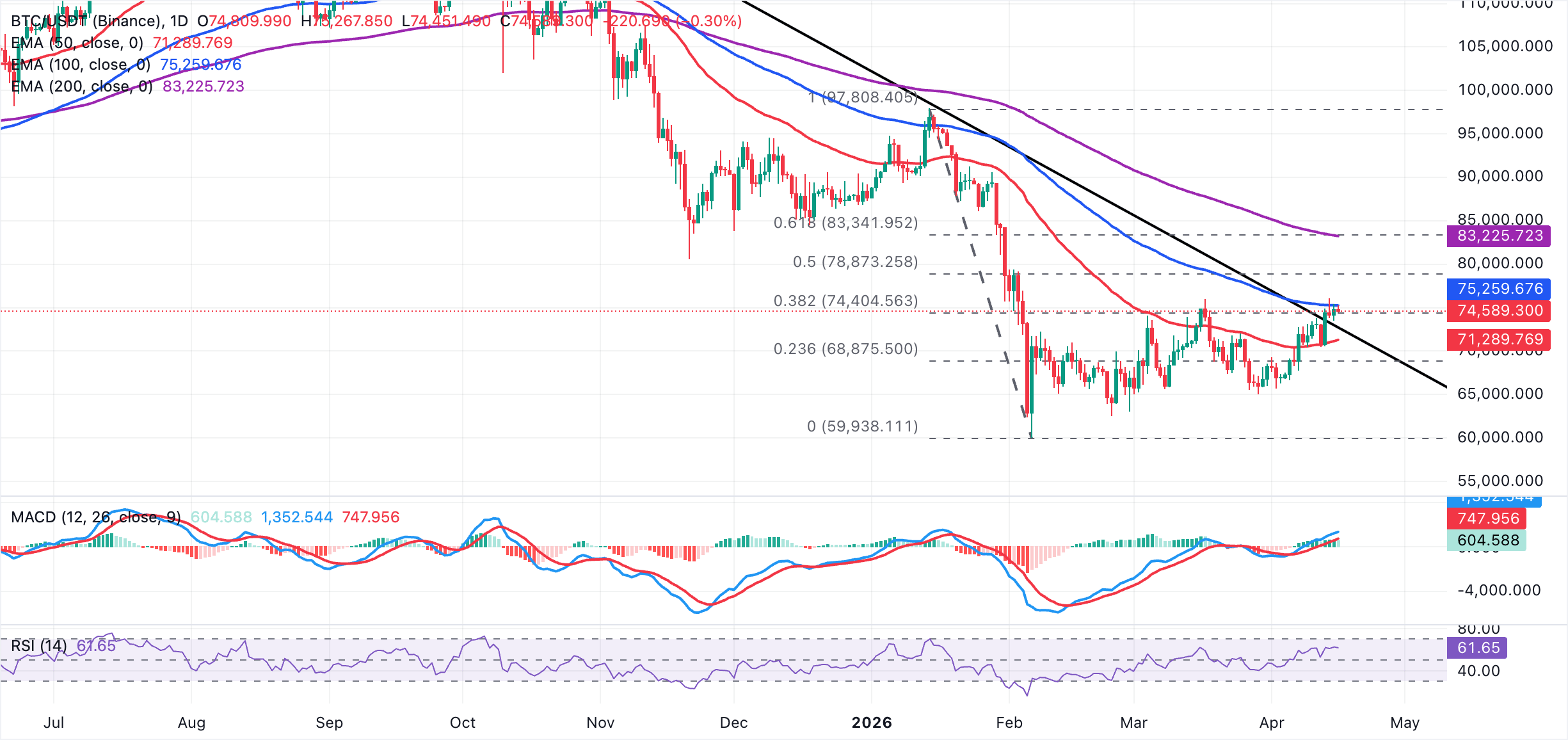
On the topside, initial resistance lies at the 100-day EMA near $75,259, with a more meaningful barrier at the 50% Fibonacci retracement at $78,873. Beyond that supply zone, the 200-day EMA at $83,226 and the 61.8% retracement near 83,342 form a strong medium-term cap.
On the downside, immediate support is now aligned at the 38.2% Fibonacci level at $74,404, followed by the broken descending trendline near $72,602 and the 50-day EMA around $71,289. A deeper pullback would expose the 23.6% retracement at $68,876 before the broader bullish structure is challenged closer to the cycle low region at $60,000.
Altcoins technical outlook: Ethereum upside capped as XRP gains momentum
Ethereum is trading at $2,344, holding a capped tone as it sits above the 50-day EMA at $2,189 but remains below the 100-day EMA at $2,356 and the 200-day EMA at $2,668. This configuration suggests that, despite an improving backdrop, the broader downtrend context still prevails.
Momentum readings are constructive, with the RSI hovering near 61 on the daily chart and the MACD indicator histogram staying positive.
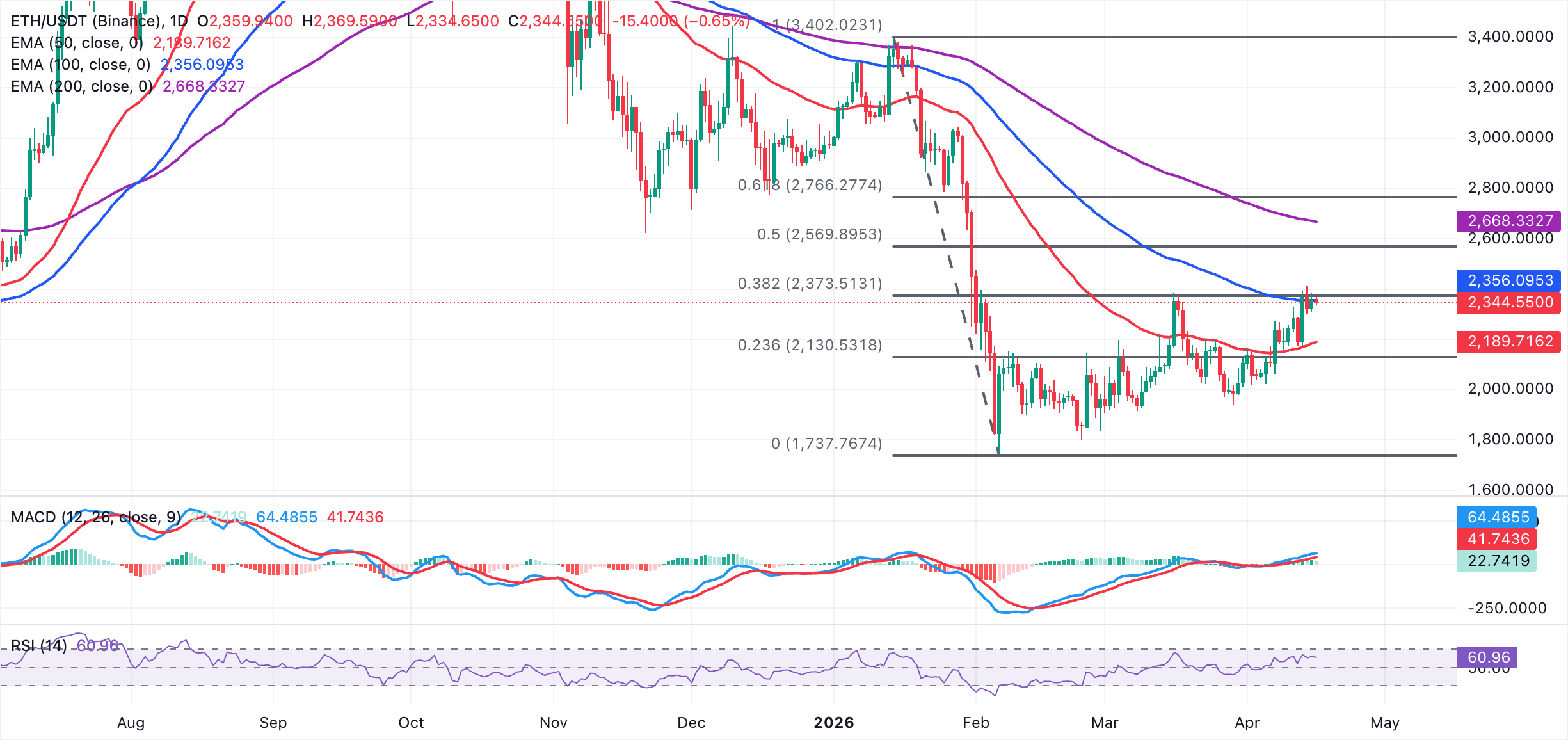
On the topside, immediate resistance is seen at the 100-day EMA around $2,356, followed closely by the 38.2% Fibonacci retracement of the latest swing at $2,373, applied between the January 14 high of $3,403 and the February 6 low of $1,748. A daily close above this cluster would open the way toward the 50% retracement in the $2,570 region, with further hurdles at the 200-day EMA at $2,668 and the 61.8% Fibonacci retracement around $2,766.
On the downside, initial support is aligned with the 50-day EMA at $2,190, ahead of the 23.6% Fibonacci retracement at $2,130, where buyers would be expected to re-enter. A decisive break below this band would weaken the current rebound structure and expose deeper losses within the broader corrective phase.
As for XRP, the price holds a mildly constructive tone as it remains marginally above the 50-day EMA around $1.41 and the 50% Fibonacci retracement at $1.39, drawn from the February 6 low of $1.12 and February 15 high of $1.67. However, the broader trend remains capped while the remittance token trades beneath the 100-day EMA near $1.55, with the RSI hovering in the upper-50s and the MACD turning positive, suggesting recovering but not yet dominant bullish momentum.
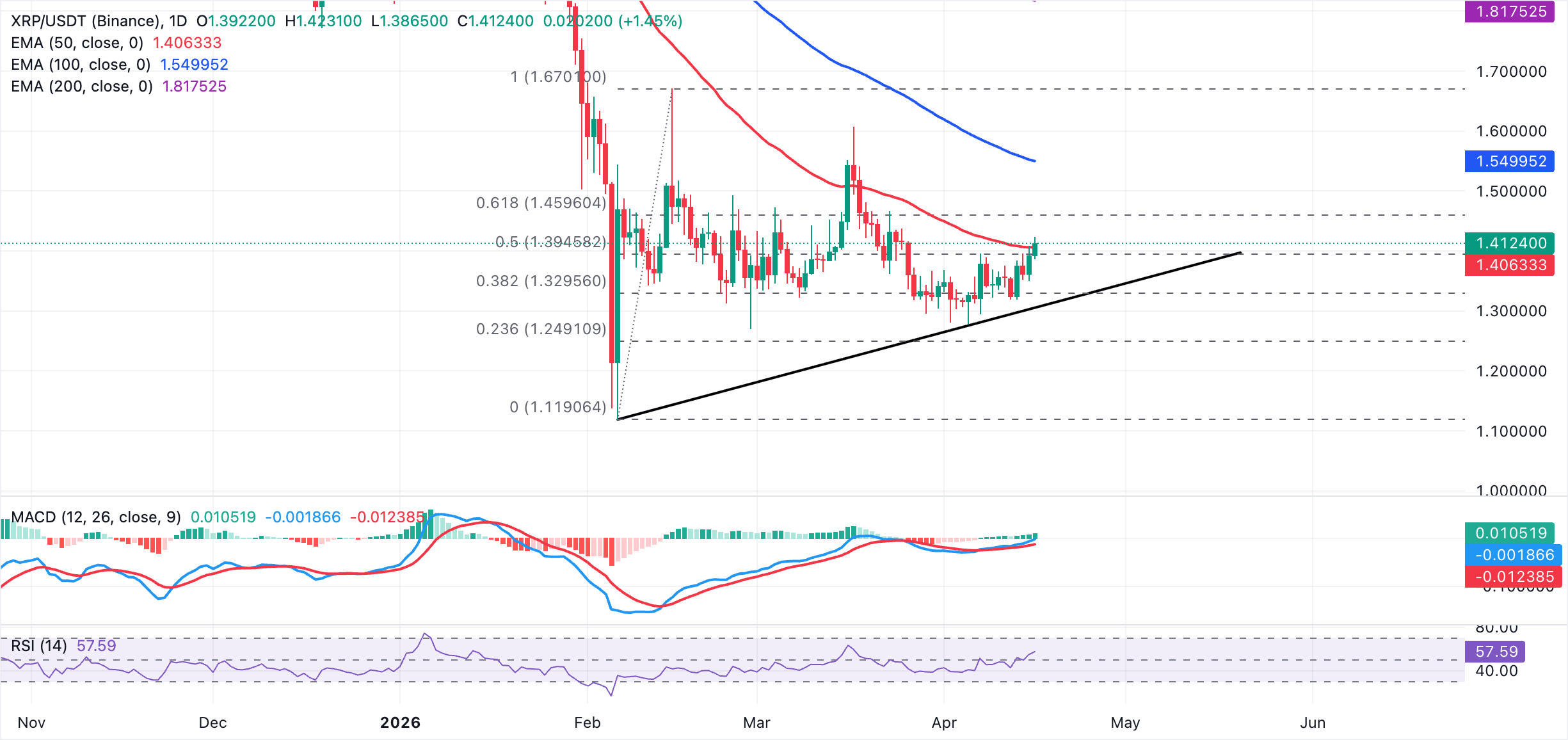
On the topside, initial resistance is seen at the 61.8% Fibonacci retracement at $1.46, followed by a more significant barrier in the $1.55 area where the 78.6% retracement aligns with the 100-day EMA, ahead of the 200-day EMA up at $1.82. On the downside, immediate support is reinforced by the 50-day EMA at $1.41 and the 50% retracement at $1.39, with deeper cushions at the 38.2% Fibonacci retracement around $1.33 and the trendline near $1.31.
Crypto ETF FAQs
An Exchange-Traded Fund (ETF) is an investment vehicle or an index that tracks the price of an underlying asset. ETFs can not only track a single asset, but a group of assets and sectors. For example, a Bitcoin ETF tracks Bitcoin’s price. ETF is a tool used by investors to gain exposure to a certain asset.
Yes. The first Bitcoin futures ETF in the US was approved by the US Securities & Exchange Commission in October 2021. A total of seven Bitcoin futures ETFs have been approved, with more than 20 still waiting for the regulator’s permission. The SEC says that the cryptocurrency industry is new and subject to manipulation, which is why it has been delaying crypto-related futures ETFs for the last few years.
Yes. The SEC approved in January 2024 the listing and trading of several Bitcoin spot Exchange-Traded Funds, opening the door to institutional capital and mainstream investors to trade the main crypto currency. The decision was hailed by the industry as a game changer.
The main advantage of crypto ETFs is the possibility of gaining exposure to a cryptocurrency without ownership, reducing the risk and cost of holding the asset. Other pros are a lower learning curve and higher security for investors since ETFs take charge of securing the underlying asset holdings. As for the main drawbacks, the main one is that as an investor you can’t have direct ownership of the asset, or, as they say in crypto, “not your keys, not your coins.” Other disadvantages are higher costs associated with holding crypto since ETFs charge fees for active management. Finally, even though investing in ETFs reduces the risk of holding an asset, price swings in the underlying cryptocurrency are likely to be reflected in the investment vehicle too.
(The technical analysis of this story was written with the help of an AI tool.)














