

Gold rallies on hopes for US-Iran talks and falling US Treasury yields
- Gold rises above $4,500 as hopes for US-Iran talks improve market sentiment.
- Falling US yields offset a firmer Dollar, helping bullion recover from recent losses.
- Markets still price a hawkish Fed stance as inflation and energy risks remain elevated.
Gold price (XAU/USD) gains nearly 2% on Wednesday as Oil futures prices tumbled amid growing speculation that the US and Iran would begin talks to end the conflict that started nearly four weeks ago. At the time of writing, XAU/USD trades at $4,556.
Bullion rebounds as easing war fears drag Crude lower; US Treasury yields tumble
The US sent Iran a 15-point proposal that could end the war that began nearly four weeks ago. If Tehran agrees to resume talks with Washington, they could begin as early as Thursday and be held in either Pakistan or Turkey.
After the headline, risk appetite improved; Oil sank, and bullion capped its losses.
In the meantime, the Greenback continues to appreciate, as reflected in the US Dollar Index (DXY). The DXY, which tracks the US Dollar performance against a basket of six currencies, is up nearly 0.40% to 99.55.
Recently, Iranian media reported that the regime has rejected the US proposal, but sources said the Iranians will get back to them later on Wednesday.
The Wall Street Journal reported that "Iran is being less strident in private discussions to end the war than it is in public, Arab mediators and other people familiar with the matter said, giving them hope the diplomatic effort they are trying to spark isn't dead on arrival."
The decline in US Treasury bond yields drives bullion's advance during the day. The US 10-year Treasury note falls four basis points to 4.328%, a tailwind for the non-yielding metal.
A weak US Treasury auction on Tuesday of two-year Treasury notes drew unexpectedly weak demand, sending the US 2-year T-note yield up towards 3.936% amid investor speculation that inflation would rise sharply.
US import prices rose the most in four years in February, driven by surging energy costs before the Middle East conflict, an indication that the battle against inflation has not yet been won. Prices rose 1.3%, the largest increase since March 2022, exceeding forecasts for a 0.5% jump, following January's 0.2% increase.
On Tuesday, S&P Global revealed that US businesses paid more for inputs in March, due to surging energy costs and supply chain disruptions.
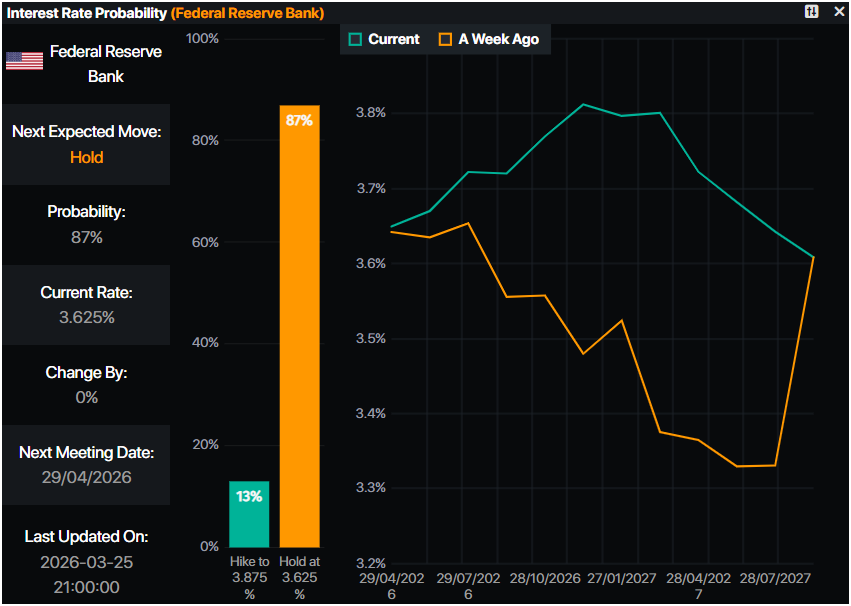
Money markets had priced out rate cuts by the Federal Reserve in 2026; instead, traders are pricing in 4 basis points of tightening, according to Prime Market Terminal.
On Thursday, the US economic docket will feature Initial Jobless Claims for the week ending March 21, along with speeches by the Fed's Cook, Miran, Jefferson, Logan, and Barr.
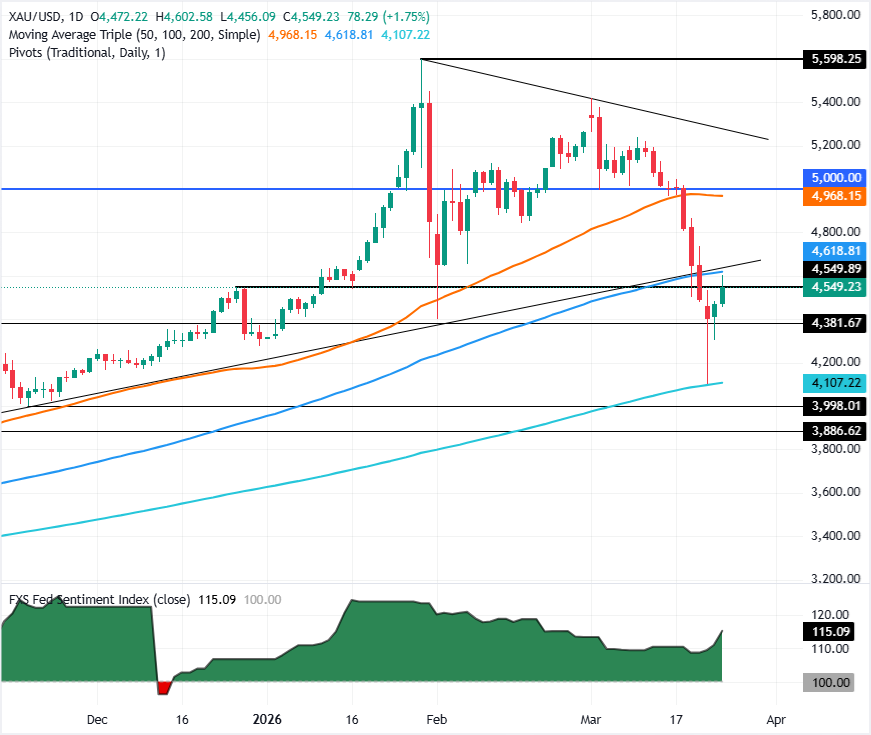
XAU/USD technical outlook: To remain range-bound, trapped within the 100- and 200-day SMAs
Gold price seems to have bottomed during the week after almost testing key support at the 200-day Simple Moving Average (SMA) around $4,083, which exacerbated a recovery towards the Tuesday high of $4,484 ahead of the $4,500 mark.
The Relative Strength Index (RSI), although rising, suggests the yellow metal is bearishly biased, but in the short term seems poised to remain trading sideways.
If Gold clears the 100-day SMA around $4,592, the next target is $4,600. A breach of the latter will expose the 50-day SMA at $4,961.
Conversely, if XAU/USD struggles to remain afloat of $4,500, bears could push prices towards the March 24 daily low of $4,305 ahead of the March 23 swing low of $4,098.
Gold FAQs
Gold has played a key role in human’s history as it has been widely used as a store of value and medium of exchange. Currently, apart from its shine and usage for jewelry, the precious metal is widely seen as a safe-haven asset, meaning that it is considered a good investment during turbulent times. Gold is also widely seen as a hedge against inflation and against depreciating currencies as it doesn’t rely on any specific issuer or government.
Central banks are the biggest Gold holders. In their aim to support their currencies in turbulent times, central banks tend to diversify their reserves and buy Gold to improve the perceived strength of the economy and the currency. High Gold reserves can be a source of trust for a country’s solvency. Central banks added 1,136 tonnes of Gold worth around $70 billion to their reserves in 2022, according to data from the World Gold Council. This is the highest yearly purchase since records began. Central banks from emerging economies such as China, India and Turkey are quickly increasing their Gold reserves.
Gold has an inverse correlation with the US Dollar and US Treasuries, which are both major reserve and safe-haven assets. When the Dollar depreciates, Gold tends to rise, enabling investors and central banks to diversify their assets in turbulent times. Gold is also inversely correlated with risk assets. A rally in the stock market tends to weaken Gold price, while sell-offs in riskier markets tend to favor the precious metal.
The price can move due to a wide range of factors. Geopolitical instability or fears of a deep recession can quickly make Gold price escalate due to its safe-haven status. As a yield-less asset, Gold tends to rise with lower interest rates, while higher cost of money usually weighs down on the yellow metal. Still, most moves depend on how the US Dollar (USD) behaves as the asset is priced in dollars (XAU/USD). A strong Dollar tends to keep the price of Gold controlled, whereas a weaker Dollar is likely to push Gold prices up.














