

Trade The World
Google Reportedly Considering Using Intel Foundry Services for Next-Gen TPUv9, Intel Shares Surge!
By Michael Rodriguez
Date Published: 1 Dec 2025 | Date Modified: 2 Dec 2025


POPULAR ARTICLES

Intel Foundry Services’ extensive production capacity in the United States matches Google’s needs for geographic and capacity diversification. Intel is increasingly focused on ensuring its packaging technologies meet customer requirements.
Intel is aggressively promoting its new generation of AI PC processors. By integrating the CPU, GPU, and NPU, these chips give personal computers much stronger on-device AI inference capabilities, meeting the offline computing needs of generative AI.
In the data center and high-performance computing space, Intel continues to roll out more energy-efficient Xeon processors and acceleration solutions, while also expanding its footprint in edge computing and IoT chips.
The foundry business remains a key pillar of Intel’s transformation. The company emphasizes improving process yield and optimizing its cost structure, in hopes of attracting more customers from the US and Europe and repositioning itself as a contender for the world’s third-largest foundry.
In 2025, the PC market has seen a mild recovery. The spread of AI PCs has driven OEM orders, and Intel’s share in the consumer market has stabilized somewhat. The data center business still faces heavy pressure from AMD and Nvidia, but thanks to Intel’s strong ecosystem and robust supply chain, it has maintained moderate growth.
Surging demand for AI chips has brought forward the server upgrade cycle. Enterprises are migrating from older CPUs to more efficient Xeon processors and discrete accelerators, creating structural incremental growth for Intel.
Since 2025, multiple rounds of cost controls and organizational restructuring have begun to show up in Intel’s financials: revenue has returned to growth, gross margins have improved, operating profit has clearly recovered, and cash flow is better than during the 2023–2024 trough period. AI PCs and high-end server chips have become the main profit engines. Although the foundry business is still in its early stage, its losses have narrowed.
Market Analysis:
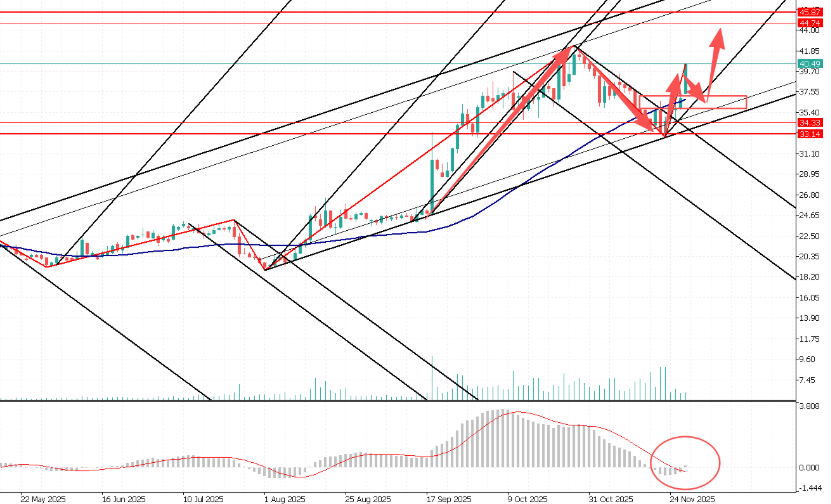
As of December 2025, Intel has clearly rebounded from its previous slump. AI has provided new growth momentum, with the PC, data center, and foundry businesses advancing in parallel and giving Intel renewed upward potential. Its future performance will depend on whether it can continue to improve manufacturing yields, expand its AI ecosystem, and narrow the gap with competitors in high-performance computing.

FXStreet
More than a million users rely on FXStreet for real-time market data, charting tools, expert insights, and forex news. Its comprehensive economic calendar and educational webinars help traders stay informed and make calculated decisions. FXStreet is supported by a team of about 60 professionals, split between the Barcelona headquarters and various global regions.
Read More








