

EUR/USD tumbles towards 1.1600 as strong US data supercharges Dollar
By Christian Borjon Valencia
Date Published: 16 Jan 2026 | Date Modified: 16 Jan 2026


POPULAR ARTICLES

EUR/USD fell to a new yearly low beneath 1.1600 on Thursday, courtesy of solid economic data in the US and broad US Dollar strength. Traders’ appetite improved due to Trump moderating his rhetoric on Iran, while data in the Eurozone, failed to underpin the shared currency.
- EUR/USD hits yearly low beneath 1.1600 as risk appetite improves.
- Markets sharply trim Fed easing bets, reinforcing Dollar demand across major pairs.
- Focus shifts to Eurozone inflation and US Industrial Production for next direction.
EUR/USD fell to a new yearly low beneath 1.1600 on Thursday, courtesy of solid economic data in the US and broad US Dollar strength. Traders’ appetite improved due to Trump moderating his rhetoric on Iran, while data in the Eurozone, failed to underpin the shared currency. The pair trades at 1.1605, down 0.35%.
US Dollar advances on solid data, traders reducing Fed cut bets
Wall Street ended the session with gains, a reflection of risk appetite. Upbeat earnings of Taiwan Semiconductor Manufacturing Co. (TSMC) pushed US equity indices higher, while the Dollar was boosted by a solid jobs report.
The number of Americans filling for unemployment benefits dipped below estimates and the previous week report. That report and speeches by Federal Reserve officials pushed investors to trim their best of further Fed easing in 2026.
Monay markets had priced 46 basis points of easing, down from 52 during Thursday’s open, according to Prime Market Terminal interest rate probability tool.
Moreover, traders digested speeches by Regional Fed Presidents Schmid, Daly, Paulson, Barkin, Bostic and the Fed Governor Michael Barr.
In Europe, the docket was scarce with the release of the Eurozone’s Industrial Production report in November and the release of inflation data in France and Spain, both readings for December.
What’s in the calendar for January 16?
The Eurozone economic schedule will feature inflation in Germany and Italy. In the US, investors will digest Industrial Production figures for December, along with the continuation of the Fed parade.
Daily digest market movers: Euro tumbles at the mercy of the Dollar
- US Initial Jobless Claims for the week ending January 10 fell to 198K from 207K, comfortably below forecasts of 215K, underscoring continued resilience in the labor market.
- Manufacturing indicators also improved. The New York Empire State Manufacturing Index rebounded in January, rising from -3.7 to 7.7; while the Philadelphia Fed Manufacturing Survey far exceeded expectations, jumping to 12.6 versus estimates of -2, signaling a broad-based pickup in regional factory activity.
- The Greenback reacted positively, rallying to a new yearly high, with the US Dollar Index, which tracks the buck’s value versus six currencies, is up 0.30% at 99.35.
- Federal Reserve officials delivered a range of views on the policy outlook. Jeffrey Schmid said monetary policy is not particularly restrictive, cautioning that there is no room for complacent inflation. Mary Daly struck a more balanced tone, saying she expects solid economic growth and that policy is well positioned.
- Meanwhile, Thomas Barkin noted that inflation remains elevated, though he sees signs of stabilization in the labor market. Earlier, Atlanta Fed President Raphael Bostic said growth is likely to run above 2% but warned that persistent inflation pressures argue for a restrictive stance. Chicago Fed President Austan Goolsbee added that the latest jobless claims data was unsurprising, reiterating that the Fed’s core priority is returning inflation to the 2% target.
- Industrial Production in the EZ exceeded forecasts in November, rising 0.7% MoM, defying estimates for a slowdown to 0.5%. On an annual basis, output growth accelerated to 2.5%, up from 2.0% in October and above the 2.0% consensus estimate.
Euro Price This week
The table below shows the percentage change of Euro (EUR) against listed major currencies this week. Euro was the strongest against the Japanese Yen.
| USD | EUR | GBP | JPY | CAD | AUD | NZD | CHF | |
|---|---|---|---|---|---|---|---|---|
| USD | 0.21% | 0.14% | 0.29% | -0.16% | -0.25% | -0.24% | 0.32% | |
| EUR | -0.21% | -0.07% | 0.15% | -0.36% | -0.46% | -0.38% | 0.12% | |
| GBP | -0.14% | 0.07% | 0.19% | -0.30% | -0.40% | -0.35% | 0.18% | |
| JPY | -0.29% | -0.15% | -0.19% | -0.48% | -0.56% | -0.55% | -0.01% | |
| CAD | 0.16% | 0.36% | 0.30% | 0.48% | -0.11% | -0.07% | 0.48% | |
| AUD | 0.25% | 0.46% | 0.40% | 0.56% | 0.11% | 0.03% | 0.55% | |
| NZD | 0.24% | 0.38% | 0.35% | 0.55% | 0.07% | -0.03% | 0.53% | |
| CHF | -0.32% | -0.12% | -0.18% | 0.00% | -0.48% | -0.55% | -0.53% |
The heat map shows percentage changes of major currencies against each other. The base currency is picked from the left column, while the quote currency is picked from the top row. For example, if you pick the Euro from the left column and move along the horizontal line to the US Dollar, the percentage change displayed in the box will represent EUR (base)/USD (quote).
Technical outlook: EUR/USD slumps towards 1.1600 as it turns bearish
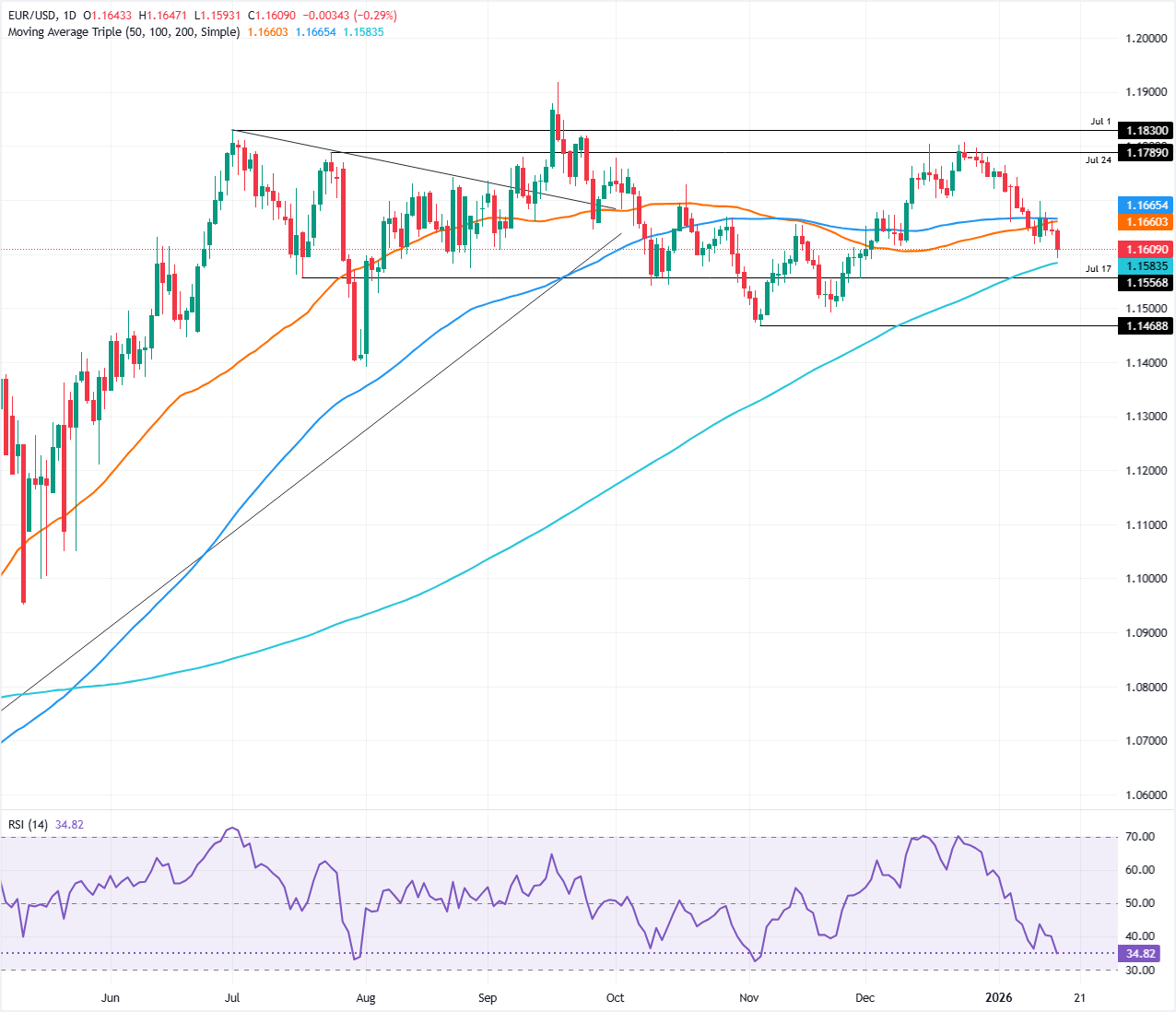
EUR/USD consolidates, yet it briefly cleared 1.1600 to hit a year to date (YTD) low of 1.1593, before recovering the 1.1600 figure. Momentum continues to favor sellers as depicted by the Relative Strength Index (RSI), which stays below its neutral 50 level, signaling that bears retain the upper hand.
For a bearish continuation, sellers must clear 1.1600, which would bring the 200-day SMA at 1.1582 into play. A clear break beneath that level would expose 1.1500, ahead of a deeper move toward the August 1 low at 1.1391.
On the upside, a decisive break above 1.1700 would open the way toward the 1.1750 mark. A sustained move beyond that zone would shift focus to the 1.1800 handle.
Euro FAQs
The Euro is the currency for the 20 European Union countries that belong to the Eurozone. It is the second most heavily traded currency in the world behind the US Dollar. In 2022, it accounted for 31% of all foreign exchange transactions, with an average daily turnover of over $2.2 trillion a day. EUR/USD is the most heavily traded currency pair in the world, accounting for an estimated 30% off all transactions, followed by EUR/JPY (4%), EUR/GBP (3%) and EUR/AUD (2%).
The European Central Bank (ECB) in Frankfurt, Germany, is the reserve bank for the Eurozone. The ECB sets interest rates and manages monetary policy. The ECB’s primary mandate is to maintain price stability, which means either controlling inflation or stimulating growth. Its primary tool is the raising or lowering of interest rates. Relatively high interest rates – or the expectation of higher rates – will usually benefit the Euro and vice versa. The ECB Governing Council makes monetary policy decisions at meetings held eight times a year. Decisions are made by heads of the Eurozone national banks and six permanent members, including the President of the ECB, Christine Lagarde.
Eurozone inflation data, measured by the Harmonized Index of Consumer Prices (HICP), is an important econometric for the Euro. If inflation rises more than expected, especially if above the ECB’s 2% target, it obliges the ECB to raise interest rates to bring it back under control. Relatively high interest rates compared to its counterparts will usually benefit the Euro, as it makes the region more attractive as a place for global investors to park their money.
Data releases gauge the health of the economy and can impact on the Euro. Indicators such as GDP, Manufacturing and Services PMIs, employment, and consumer sentiment surveys can all influence the direction of the single currency. A strong economy is good for the Euro. Not only does it attract more foreign investment but it may encourage the ECB to put up interest rates, which will directly strengthen the Euro. Otherwise, if economic data is weak, the Euro is likely to fall. Economic data for the four largest economies in the euro area (Germany, France, Italy and Spain) are especially significant, as they account for 75% of the Eurozone’s economy.
Another significant data release for the Euro is the Trade Balance. This indicator measures the difference between what a country earns from its exports and what it spends on imports over a given period. If a country produces highly sought after exports then its currency will gain in value purely from the extra demand created from foreign buyers seeking to purchase these goods. Therefore, a positive net Trade Balance strengthens a currency and vice versa for a negative balance.

More than a million users rely on FXStreet for real-time market data, charting tools, expert insights, and forex news. Its comprehensive economic calendar and educational webinars help traders stay informed and make calculated decisions. FXStreet is supported by a team of about 60 professionals, split between the Barcelona headquarters and various global regions.
Read More








