

$4,000: Gold defends key support as traders await US NFP
- Gold holds firm above $4,000 as the US Dollar slips, partly driven by a sudden jump in the Japanese Yen as traders speculate over a possible intervention.
- Traders await the US Nonfarm Payrolls report for clues on the Federal Reserve's interest rate path.
- Technically, XAU/USD needs a decisive break above $4,100 to ease the current bearish pressure.
Gold (XAU/USD) trades on the front foot on Thursday as the US Dollar (USD) weakens amid rumors of a potential intervention by Tokyo after the Japanese Yen (JPY) hit a 40-year low earlier this week. The precious metal, however, remains confined within a one-week trading range between $3,950 and $4,100, with the US Nonfarm Payrolls (NFP) report taking center stage at 12:30 GMT.

At the time of writing, XAU/USD trades around $4,066, up nearly 0.87% on the day. The US Dollar Index (DXY), which tracks the Greenback's value against a basket of six major currencies, trades around 101.08 after hitting a nine-day low of 100.93 earlier in the day.
Economists expect the US economy to add 110,000 jobs in June, down from 172,000 in May. The Unemployment Rate is expected to remain unchanged at 4.3%.
The report will be important for assessing the prospects for Federal Reserve (Fed) interest rate hikes this year and could determine whether Gold extends its gains above $4,000 or breaks decisively below it.
Higher interest rates typically weigh on the non-yielding metal by increasing the opportunity cost of holding Gold.
Markets are currently pricing in a 62% probability of a rate hike at the September meeting, according to the CME FedWatch tool.
A stronger-than-expected jobs report would reinforce expectations that the Federal Reserve (Fed) could raise interest rates in the coming months, while weaker data could temper those expectations.
Still, monetary policy is expected to remain restrictive for longer after Fed Chair Kevin Warsh reiterated his commitment to restoring inflation to its 2% target at the European Central Bank (ECB) Forum on Wednesday. "We are in the price stability business," he said, even as he acknowledged that "inflation risks have come down."
Warsh's remarks come as inflation concerns have eased following the sharp decline in Oil prices after the United States and Iran signed a 60-day Memorandum of Understanding (MoU) last month that partially reopened the Strait of Hormuz. West Texas Intermediate (WTI) crude trades around $67 per barrel, its lowest level since February, retreating from a peak of $113 during the US-Iran war.
In the recent developments, indirect talks between the two sides concluded in Doha, with Qatari mediators reporting "positive progress," although no significant breakthrough was announced.
Technical analysis: XAU/USD recovery stalls below $4,100 resistance
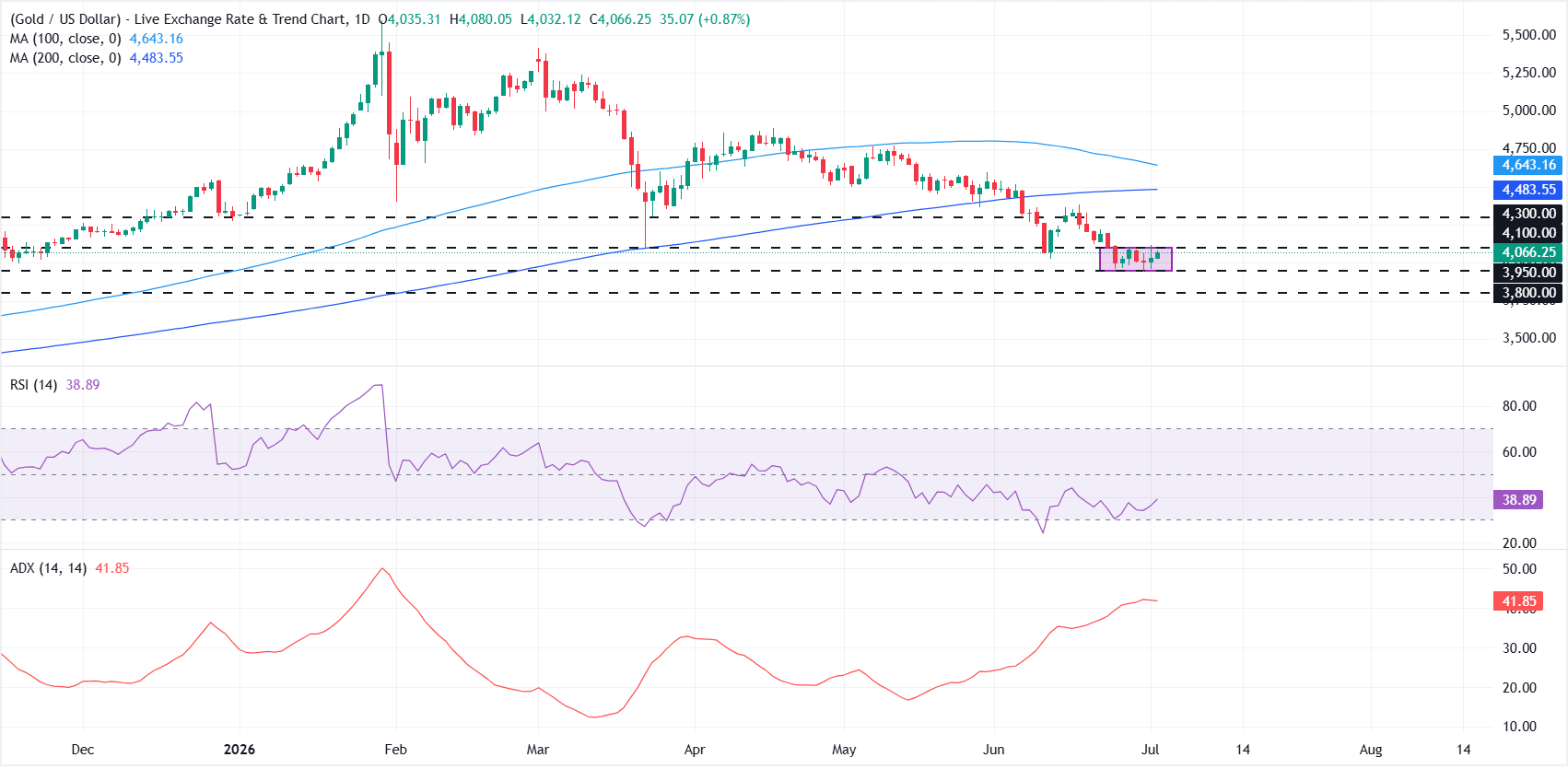
XAU/USD keeps a bearish near-term bias as price holds well below the 200-day Simple Moving Average (SMA) and the 100-day SMA.
The metal is also capped by nearby horizontal resistance at $4,100, reinforcing the idea of a market that remains under corrective pressure rather than in a sustained recovery. The Relative Strength Index (RSI) on the daily chart is at 38, below the neutral 50 mark and hinting at lingering downside momentum, while the Average Directional Index (ADX) is near 41, signaling a relatively strong prevailing trend.
On the topside, initial resistance appears at $4,100, followed by a stronger barrier at $4,300 before the longer-term cap from the 200-day SMA at $4,483 and the 100-day SMA at $4,643.
On the downside, immediate support is seen at $3,950, with a deeper bearish extension exposing the next key floor at $3,800, where buyers would be expected to show more interest if the current slide continues.
(The technical analysis of this story was written with the help of an AI tool.)
Nonfarm Payrolls FAQs
Nonfarm Payrolls (NFP) are part of the US Bureau of Labor Statistics monthly jobs report. The Nonfarm Payrolls component specifically measures the change in the number of people employed in the US during the previous month, excluding the farming industry.
The Nonfarm Payrolls figure can influence the decisions of the Federal Reserve by providing a measure of how successfully the Fed is meeting its mandate of fostering full employment and 2% inflation. A relatively high NFP figure means more people are in employment, earning more money and therefore probably spending more. A relatively low Nonfarm Payrolls’ result, on the either hand, could mean people are struggling to find work. The Fed will typically raise interest rates to combat high inflation triggered by low unemployment, and lower them to stimulate a stagnant labor market.
Nonfarm Payrolls generally have a positive correlation with the US Dollar. This means when payrolls’ figures come out higher-than-expected the USD tends to rally and vice versa when they are lower. NFPs influence the US Dollar by virtue of their impact on inflation, monetary policy expectations and interest rates. A higher NFP usually means the Federal Reserve will be more tight in its monetary policy, supporting the USD.
Nonfarm Payrolls are generally negatively-correlated with the price of Gold. This means a higher-than-expected payrolls’ figure will have a depressing effect on the Gold price and vice versa. Higher NFP generally has a positive effect on the value of the USD, and like most major commodities Gold is priced in US Dollars. If the USD gains in value, therefore, it requires less Dollars to buy an ounce of Gold. Also, higher interest rates (typically helped higher NFPs) also lessen the attractiveness of Gold as an investment compared to staying in cash, where the money will at least earn interest.
Nonfarm Payrolls is only one component within a bigger jobs report and it can be overshadowed by the other components. At times, when NFP come out higher-than-forecast, but the Average Weekly Earnings is lower than expected, the market has ignored the potentially inflationary effect of the headline result and interpreted the fall in earnings as deflationary. The Participation Rate and the Average Weekly Hours components can also influence the market reaction, but only in seldom events like the “Great Resignation” or the Global Financial Crisis.













