

Trading
Explora una amplia gama de mercados con precios competitivos, liquidez profunda y herramientas de trading avanzadas.
Más información 
Plataforma
Opera sin interrupciones con la potente plataforma de TMGM, diseñada para ofrecer velocidad, precisión y una experiencia de trading superior.
Más información Plataforma de trading
Herramientas de trading
Academia
Aprende los fundamentos del trading con recursos ideales para principiantes, incluidas guías, seminarios web y análisis del mercado.
Más información Academia TMGM
Noticias y análisis
Obtén actualizaciones del mercado en tiempo real y análisis de expertos para adelantarte a las oportunidades de trading
Más información Noticias y análisis
Acerca de
Descubre qué distingue a TMGM: nuestra presencia global, solidez regulatoria y compromiso con la innovación en el trading.
Más información Por qué elegir TMGM
ECB's Lagarde speaks three times with the Euro at a 19-month low
- EUR/USD breaks below 1.1000 to a 19-month low on a fifth straight fall.
- Eurozone industry misses forecasts, and Fed hike bets lift the Dollar.
- ECB President Lagarde speaks on each of Wednesday, Thursday and Friday.
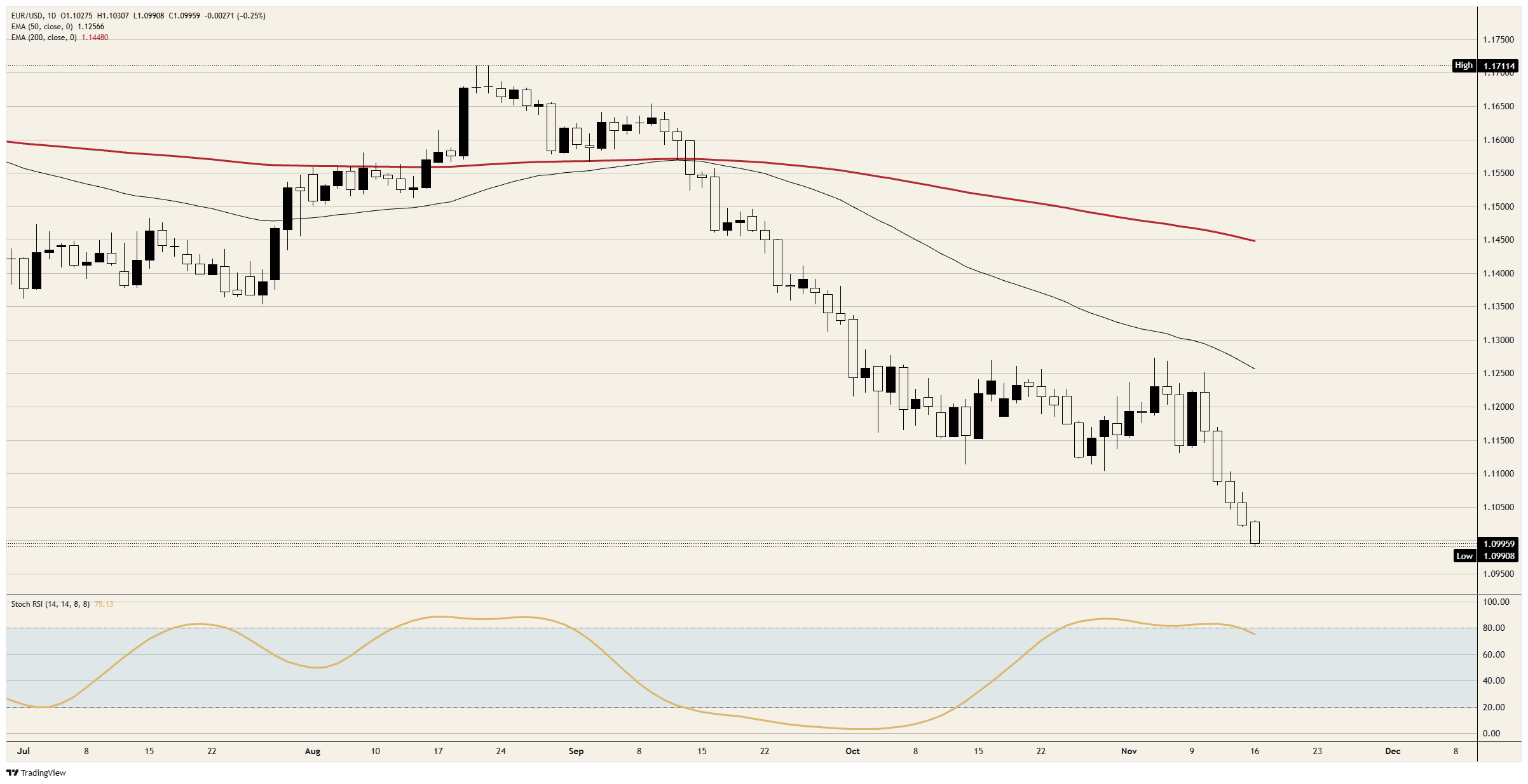
The 1.1000 level gave way on Monday for the first time in 19 months, after a Eurozone industry report missed its forecast and the Dollar kept rising. EUR/USD has fallen five sessions running and is trading just under that level. It has dropped from its November 10 high without one higher daily close.

The rate gap isn't moving in the Euro's favour even with the European Central Bank (ECB) about to hike. All 71 economists in a Reuters poll taken November 10-12 expect the ECB to raise its deposit rate from 2.50% to 2.75% on December 17. Traders fully price a Fed hike eight days earlier from 3.75%-4.00%, so the gap stays where it is.
Eurozone industrial production rose 0.2% in September, below the 0.6% forecast, after a 0.5% fall in August. Bloomberg reported that French political gridlock and missed deficit goals had already weakened the Euro in October. EUR/USD broke the bottom of its October range near 1.1100 on November 11 and hasn't had a daily close above it since.
On the calendar
The ZEW economic sentiment survey is due at 10:00 GMT on Tuesday, forecast at 18.3 after 18.5. October consumer prices follow at 10:00 GMT on Wednesday, with core inflation forecast at 2.5% for a second month. ECB President Lagarde speaks at 14:25 GMT on Wednesday, 13:30 GMT on Thursday and 08:30 GMT on Friday, each a chance to confirm or cool the December 17 hike.
Fed Governor Waller, who has floated a half-point December hike, speaks at 14:10 GMT on Tuesday and 13:25 GMT on Friday. US weekly jobless claims are due at 13:30 GMT on Thursday, forecast at 196K after 200K. A bigger Fed hike would widen the rate gap that a matching ECB move leaves unchanged.
On the charts
EUR/USD is at the lowest point on a daily chart dating back to July, well below the August high just above 1.1700. Its 50-day Exponential Moving Average (EMA) is near 1.1250 and the 200-day EMA near 1.1450, and both are falling. The 50-day crossed below the 200-day in mid-September, and EUR/USD has been under both since.
EUR/USD daily chart
Euro FAQs
The Euro is the currency for the 20 European Union countries that belong to the Eurozone. It is the second most heavily traded currency in the world behind the US Dollar. In 2022, it accounted for 31% of all foreign exchange transactions, with an average daily turnover of over $2.2 trillion a day. EUR/USD is the most heavily traded currency pair in the world, accounting for an estimated 30% off all transactions, followed by EUR/JPY (4%), EUR/GBP (3%) and EUR/AUD (2%).
The European Central Bank (ECB) in Frankfurt, Germany, is the reserve bank for the Eurozone. The ECB sets interest rates and manages monetary policy. The ECB’s primary mandate is to maintain price stability, which means either controlling inflation or stimulating growth. Its primary tool is the raising or lowering of interest rates. Relatively high interest rates – or the expectation of higher rates – will usually benefit the Euro and vice versa. The ECB Governing Council makes monetary policy decisions at meetings held eight times a year. Decisions are made by heads of the Eurozone national banks and six permanent members, including the President of the ECB, Christine Lagarde.
Eurozone inflation data, measured by the Harmonized Index of Consumer Prices (HICP), is an important econometric for the Euro. If inflation rises more than expected, especially if above the ECB’s 2% target, it obliges the ECB to raise interest rates to bring it back under control. Relatively high interest rates compared to its counterparts will usually benefit the Euro, as it makes the region more attractive as a place for global investors to park their money.
Data releases gauge the health of the economy and can impact on the Euro. Indicators such as GDP, Manufacturing and Services PMIs, employment, and consumer sentiment surveys can all influence the direction of the single currency. A strong economy is good for the Euro. Not only does it attract more foreign investment but it may encourage the ECB to put up interest rates, which will directly strengthen the Euro. Otherwise, if economic data is weak, the Euro is likely to fall. Economic data for the four largest economies in the euro area (Germany, France, Italy and Spain) are especially significant, as they account for 75% of the Eurozone’s economy.
Another significant data release for the Euro is the Trade Balance. This indicator measures the difference between what a country earns from its exports and what it spends on imports over a given period. If a country produces highly sought after exports then its currency will gain in value purely from the extra demand created from foreign buyers seeking to purchase these goods. Therefore, a positive net Trade Balance strengthens a currency and vice versa for a negative balance.
Artículos destacados
1Las acciones de semiconductores caen y arrastran al Nasdaq a mínimos de una semana2Previsión del precio de Ethereum: BitMine observa en ETH una tendencia similar a la de la OPV de SpaceX de cara a la OPV de Anthropic3Bitcoin debe defender los 57.800 dólares para preservar su recuperación – Bitfinex4Hammack, de la Fed, apoya subidas graduales de tipos mientras la inflación se generaliza5Eurozona: las perspectivas del sector manufacturero siguen siendo frágiles – ING6Previsión del EUR/USD: Los bajistas buscan una ruptura por debajo de 1,1000 con el RSI cerca de la zona de sobreventa7Forex hoy: el gasto de los consumidores en EE. UU. y el empleo en el Reino Unido acaparan la atención8El yen japonés encuentra apoyo en la demanda de activos refugio y el temor a una intervención9La Fed examina el impacto de la superinteligencia en el empleo, la productividad y la política monetaria


¡Comience ahora!
Regístrese y acceda a los mercados globales en menos de 3 minutos

Conéctese con nosotros









Contactos
Teléfono: +61 2 8036 8388
Fax: +61 2 8036 8388
Correo electrónico: support@tmgm.com
Web: https://www.tmgm.com



La información proporcionada en este sitio web es únicamente de carácter general y no constituye asesoramiento financiero personal. Antes de actuar sobre cualquier información de este sitio web, debe considerar la idoneidad de la información en relación con sus objetivos, situación financiera y necesidades. Invertir en CFD y contratos de margen de FX conlleva riesgos significativos y no es adecuado para todos los inversores. Puede perder más que su depósito inicial. Usted no posee ni tiene ningún interés en el activo subyacente. Le recomendamos que busque asesoramiento independiente y se asegure de comprender plenamente los riesgos involucrados antes de operar. Es importante que lea y considere el documento de divulgación antes de adquirir cualquier producto listado en el sitio web. La información y los anuncios ofrecidos en este sitio web no están destinados al uso por parte de ninguna persona en ningún país o jurisdicción donde dicho uso sea contrario a las leyes y regulaciones locales. Los productos y servicios ofrecidos en este sitio web no están destinados a residentes de Estados Unidos, Malasia y Tailandia.
TMGM está autorizado y regulado en varias jurisdicciones.
Trademax Australia Limited, que opera como TMGM, está regulada por la Comisión Australiana de Valores e Inversiones (ASIC), AFSL n.º 436416, y está ubicada en Level 28, One International Tower, 100 Barangaroo Avenue, 2000 Sydney, NSW Australia.
Correo electrónico: support@tmgm.com.au
Trademax Global Limited, que opera como TMGM, está autorizada y regulada por la Comisión de Servicios Financieros de Vanuatu (VFSC), número de registro 40356, y está registrada en 1276, Kumul Highway, Port Vila, Vanuatu, República de Vanuatu.
Correo electrónico: support@tmgm.com
Trademax Global Markets (SE) Limited, que opera como TMGM, está autorizada y regulada por la Autoridad de Servicios Financieros (FSA) de Seychelles, con número de licencia SD224. La empresa está registrada en Office No 13, Providence Estate ABIS Centre, Mahe, Seychelles.
Correo electrónico: support@tmgm.com
Trademax Global Markets (International) Pty Ltd, que opera como TMGM, está autorizada y regulada por la Comisión de Servicios Financieros de Mauricio (FSC) con licencia n.º GB22201012, y está registrada en 33, Edith Cavell Street C/o IQ EQ Fund Services (Mauritius) Ltd Port Louis, 11324 Mauricio.
Correo electrónico: support@tmgm.com
Copyright © TMGM. Todos los derechos reservados