

Experts agree: Hawkish BoJ bets support Japanese Yen against US Dollar
- The Japanese Yen bounces back against its peers, supported by hawkish BoJ bets.
- Market experts see the BoJ raising interest rates at the September meeting.
- The Fed is expected to leave policy rates steady in September.
The Japanese Yen (JPY) recovers strongly against its major currency peers on Wednesday after underperforming in the past few days. The US Dollar (USD) is down 0.25% against the Japanese currency at around 159.20 during the early European trading session.
Financial markets, remaining confident that the Bank of Japan (BoJ) will raise interest rates at its September meeting, have staged a strong comeback for the Asia-Pacific currency. Firm BoJ interest rate hike expectations remain intact even as Japan’s Q2 flash Gross Domestic Product (GDP) data has come in weaker than projected.

On Monday, the Japanese Cabinet Office reported that the economy grew at a quarterly pace of 0.3% in the second quarter this year, slower than estimates and the prior release of 0.5%. On an annualized basis, the economy expanded at a moderate pace of 1.1% against the previous reading of 1.8%.
Yen selling seen limited as BoJ hike odds stay elevated despite weak Japan GDP
Analysts at MUFG acknowledge that the latest Japan GDP release is “certainly a weaker GDP report” and concede it “will provide a challenge to the messaging from hawks at the central bank pushing for a more aggressive rate hiking path.” Even so, they point out that “the pricing for a 25bp hike at the next meeting in September remains elevated, implying around an 80% probability of a hike,” suggesting markets still see a strong chance of further BoJ tightening. In their view, the combination of “weaker US data and BoJ pricing for a hike in September will help to curtail renewed yen selling over the short-term,” limiting downside for the Yen despite the softer domestic growth backdrop.
Strategists at DBS also underscore the sharp repricing of relative policy risks, noting that “market odds of a September Bank of Japan rate hike have surged to 81% from 21%, while expectations for a Fed hike have plummeted to 32% from 72%.”
“This swing in probabilities highlights how investors are increasingly positioning for tighter policy in Japan even as the likelihood of further tightening by the Fed is perceived to be diminishing,” DBS added.
Meanwhile, analysts at Rabobank observe that, as, the case for another BoJ hike is gradually strengthening," underscoring their view that Japan’s policymakers are increasingly inclined to back recent United States (US)-Japan joint currency support with further monetary tightening.
On the US Dollar front, traders have scaled back hawkish Fed expectations due to weak US data for July, notably the soft Nonfarm Payrolls (NFP) and an expected slowdown in both headline and the core Consumer Price Index (CPI).
“Benign inflation and signs of softness in the US labour market, leaving a September Fed hike highly unlikely at this point,” analysts at Scotiabank said.
USD/JPY Technical Analysis
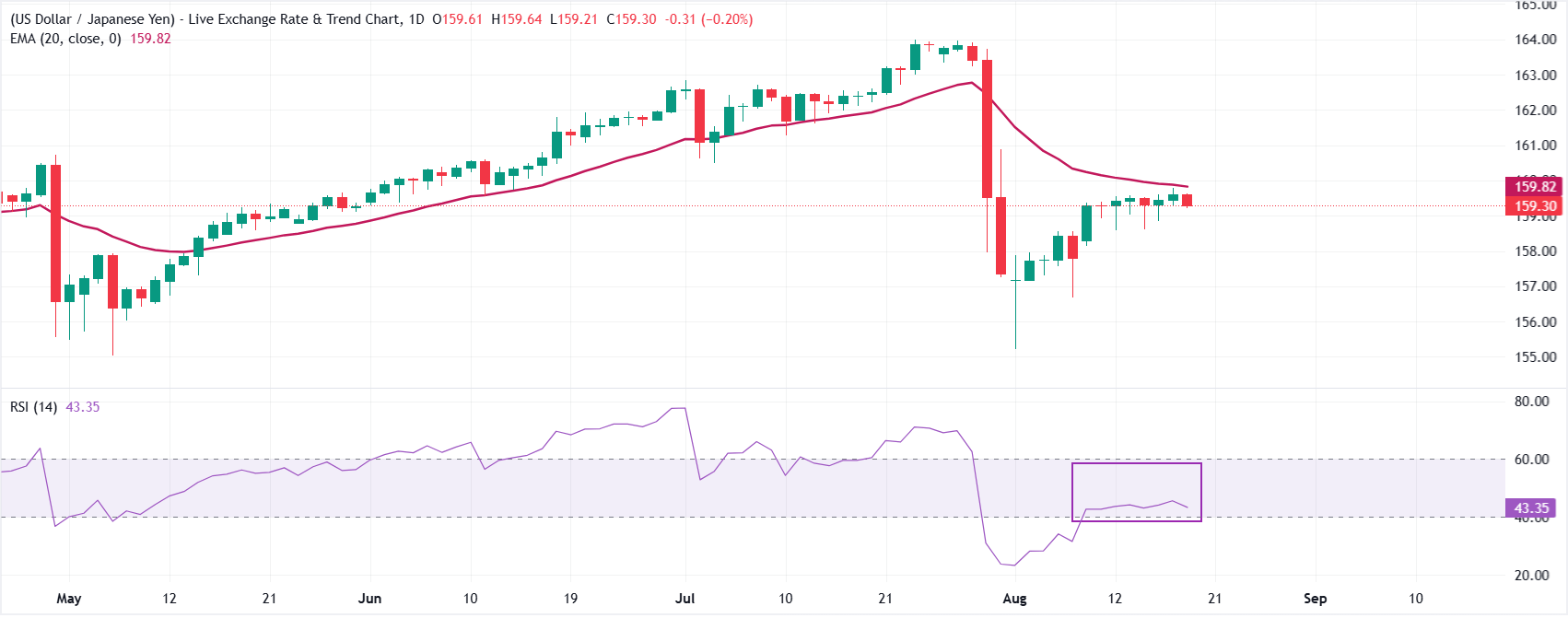
In the daily chart, USD/JPY trades at 159.30. The pair holds below the 20-day exponential moving average (EMA) at 159.82, keeping the near-term tone bearish as price remains capped by this dynamic resistance. The Relative Strength Index (RSI) at 43.36 sits in neutral territory, hinting at subdued bullish momentum and reinforcing the idea of a market that is consolidating under overhead supply rather than gearing for an immediate upside extension.
On the topside, the 20-day EMA at 159.82 is the immediate resistance level; a daily close above this barrier would ease selling pressure and open the way toward higher levels. With no clear nearby technical supports derived from the provided indicators, the focus stays on whether sellers can defend the 159.82 region, as failure to reclaim this EMA would keep USD/JPY vulnerable to further corrective slippage below 159.30.
(The technical analysis of this story was written with the help of an AI tool. Know more.)
Bank of Japan FAQs
The Bank of Japan (BoJ) is the Japanese central bank, which sets monetary policy in the country. Its mandate is to issue banknotes and carry out currency and monetary control to ensure price stability, which means an inflation target of around 2%.
The Bank of Japan embarked in an ultra-loose monetary policy in 2013 in order to stimulate the economy and fuel inflation amid a low-inflationary environment. The bank’s policy is based on Quantitative and Qualitative Easing (QQE), or printing notes to buy assets such as government or corporate bonds to provide liquidity. In 2016, the bank doubled down on its strategy and further loosened policy by first introducing negative interest rates and then directly controlling the yield of its 10-year government bonds. In March 2024, the BoJ lifted interest rates, effectively retreating from the ultra-loose monetary policy stance.
The Bank’s massive stimulus caused the Yen to depreciate against its main currency peers. This process exacerbated in 2022 and 2023 due to an increasing policy divergence between the Bank of Japan and other main central banks, which opted to increase interest rates sharply to fight decades-high levels of inflation. The BoJ’s policy led to a widening differential with other currencies, dragging down the value of the Yen. This trend partly reversed in 2024, when the BoJ decided to abandon its ultra-loose policy stance.
A weaker Yen and the spike in global energy prices led to an increase in Japanese inflation, which exceeded the BoJ’s 2% target. The prospect of rising salaries in the country – a key element fuelling inflation – also contributed to the move.













