




Bitcoin Price Forecast: BTC slides as ETF outflows return, Coldcard wallet attack raises selling fears
- Bitcoin extends its losses on Monday after declining over 2.8% in the previous week.
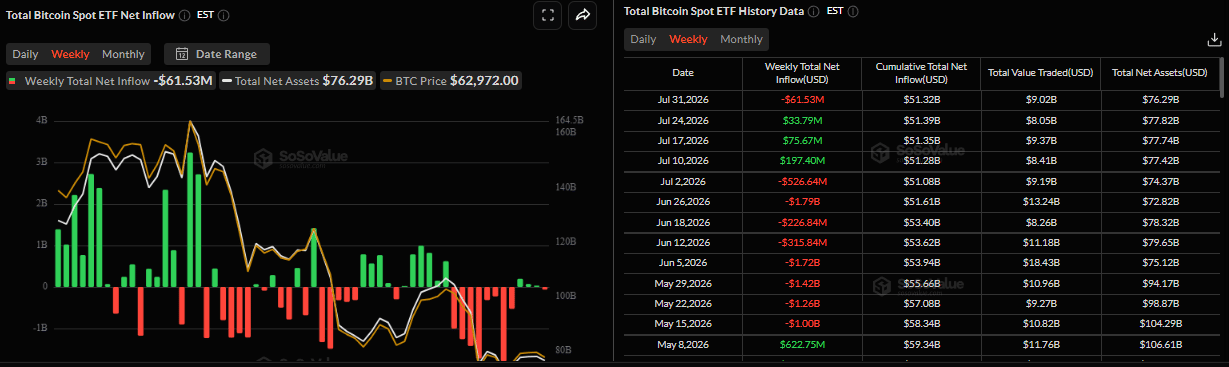
- US-listed BTC spot ETFs recorded a mild outflow of $61.53 million last week, breaking three weeks of positive flows.
- Galaxy Research's Alex Thorn has flagged a potential fourth wave of Coldcard wallet attacks, with 462 victim addresses moving roughly 388.9 BTC to 216 new destinations.
Bitcoin (BTC) extends its decline, trading below $63,000 at the time of writing on Monday after falling more than 2.8% in the previous week. Institutional demand shows cautious signs, with US-listed BTC spot Exchange Traded Funds (ETFs) recording a mild net outflow last week, breaking three weeks of positive flows. Meanwhile, concerns over potential Coldcard wallet attacks, involving the movement of nearly 389 BTC, add another layer of uncertainty and could further pressure the Crypto King’s outlook.

Institutional demand shows cautious signs
Institutional demand shows early signs of weakness. SoSoValue data show that spot BTC ETFs recorded net outflows of $61.53 million last week, breaking three consecutive weeks of positive flows. If these outflows continue and intensify, BTC could see further correction.
Coldcard vulnerability raises concerns
Galaxy Research Head of Research Alex Thorn warned on Monday that a potential fourth organized attack wave may be targeting Coldcard users.
Thorn explained that between blocks 960,778 and 960,792. In total, 218 transactions involving 462 victim addresses moved roughly 388.9 BTC to 216 newly created destinations. The activity was around 45 times higher than the pre-incident baseline, with some funds already transferred to second-hop addresses. Galaxy Research had previously identified three suspected attack waves targeting Coldcard-generated addresses, affecting 4,585 addresses and draining 1,367.05 BTC.
“MOVE YOUR FUNDS OFF COLDCARD DEVICES ASAP AND USE HIGH TX FEES,” Alex Thorn added.
Moreover, K33 research reported last week explained that the attacks are linked to a serious firmware vulnerability affecting the randomness used to generate wallet seeds.
In simple terms, some Coldcards created secrets that were easier to guess than they should have been. An attacker who reproduces an affected seed can steal the bitcoin without touching the device. A hardware wallet must use highly unpredictable data when creating a seed.
Coldcard said it halted shipments and destroyed all remaining COLDCARD devices with the vulnerable firmware. Satscard, Opendime, and Tapsigner are unaffected. The patched firmware protects newly generated seeds, but users must create a new seed and move funds from any seed generated on the vulnerable firmware.
The developments could add near-term selling pressure and weigh on Bitcoin sentiment if more compromised wallets are drained and the stolen BTC is sold. However, the issue is limited to certain Coldcard devices and does not affect Bitcoin’s underlying network or blockchain.
Bitcoin technical outlook: Slips below key support
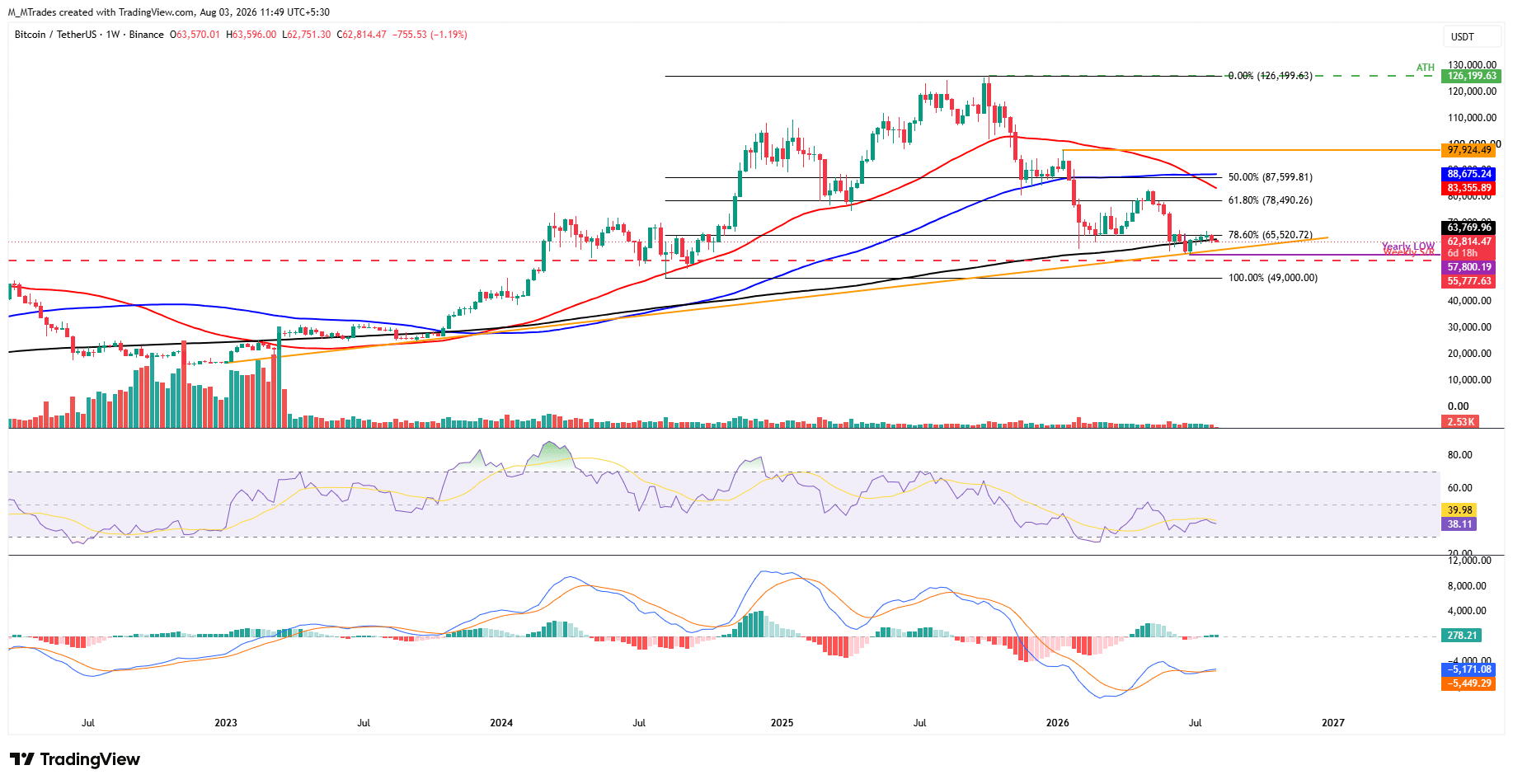
Bitcoin price declined 2.80% last week and closed below the key 200-week Simple Moving Average (SMA) at $63,769. At the start of this week, BTC is trading below $63,000 at the time of writing.
If BTC continues its correction, it could extend toward support near a long-term ascending trendline (drawn by connecting multiple lows since January 2023) around $60,000.
Momentum indicators on the weekly chart show mixed signs. The Relative Strength Index (RSI) is trending lower in negative territory, with a reading of 38 on Monday. However, the Moving Average Convergence Divergence (MACD) bullish crossover in mid-July remains intact, supporting a positive outlook.
If the Crypto King recovers and closes above the immediate resistance at the 78.6% Fibonacci retracement level at $65,520 (drawn from the August 2024 low of $49,000 to the October 2025 record high at $126,199), then BTC could extend the recovery toward the 61.8% Fibonacci retracement level at $78,490.
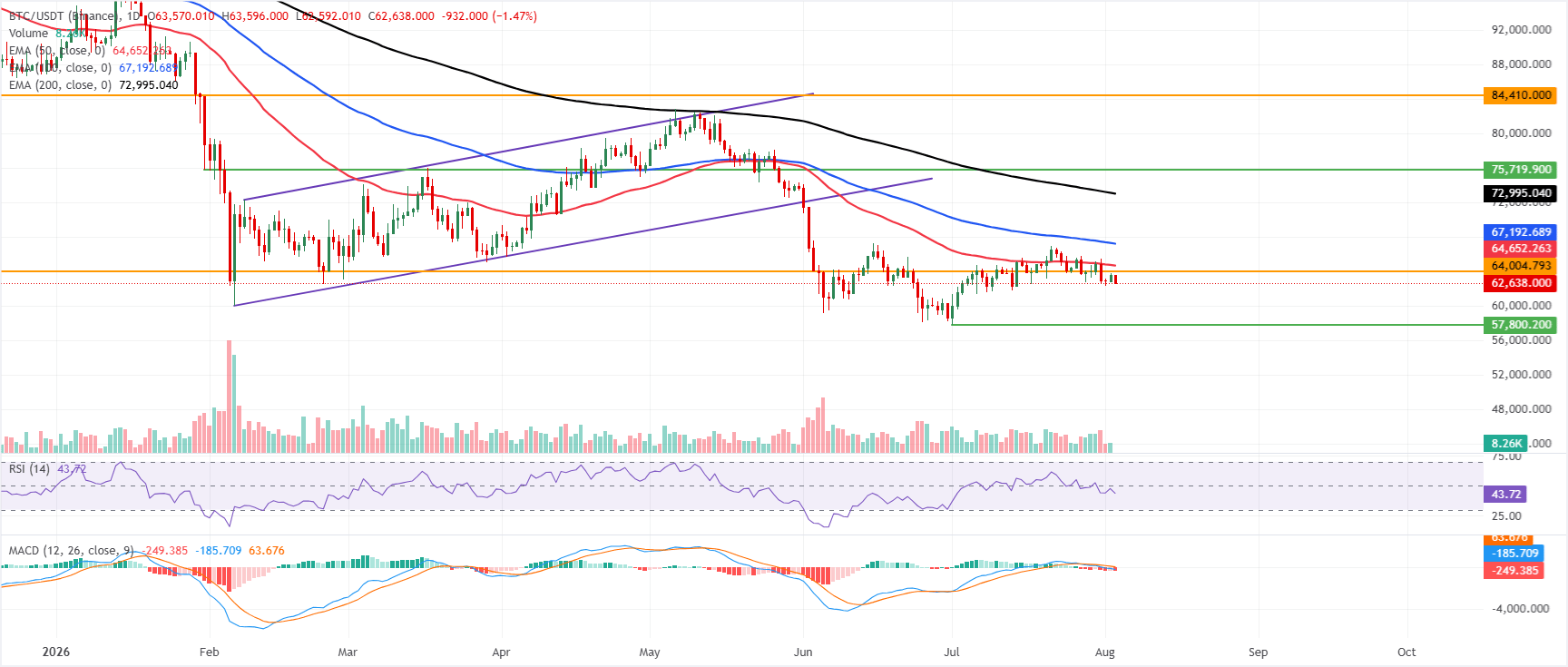
On the daily chart, BTC is extending a bearish tone as price remains capped beneath the 50-day, 100-day and 200-day Exponential Moving Averages (EMAs) at $64,652, $67,192 and $72,995 respectively. The dense overhead structure reinforces downside risk, while the RSI at 43 stays in weak territory and the MACD histogram holds below zero with a negative reading, both suggesting that bearish momentum is still dominant despite intermittent bounces.
On the topside, initial resistance emerges at the nearby horizontal level around $64,004, followed by the 50-day EMA at $64,652, with further barriers at the 100-day EMA near $67,192 and the 200-day EMA at $72,995 before the major structural cap at $84,410.
On the downside, immediate support emerges at the psychological support around $60,000, which roughly coincides with the ascending trendline as shown in the weekly chart above.
(The technical analysis of this story was written with the help of an AI tool. Know more.)
Bitcoin, altcoins, stablecoins FAQs
Bitcoin is the largest cryptocurrency by market capitalization, a virtual currency designed to serve as money. This form of payment cannot be controlled by any one person, group, or entity, which eliminates the need for third-party participation during financial transactions.
Altcoins are any cryptocurrency apart from Bitcoin, but some also regard Ethereum as a non-altcoin because it is from these two cryptocurrencies that forking happens. If this is true, then Litecoin is the first altcoin, forked from the Bitcoin protocol and, therefore, an “improved” version of it.
Stablecoins are cryptocurrencies designed to have a stable price, with their value backed by a reserve of the asset it represents. To achieve this, the value of any one stablecoin is pegged to a commodity or financial instrument, such as the US Dollar (USD), with its supply regulated by an algorithm or demand. The main goal of stablecoins is to provide an on/off-ramp for investors willing to trade and invest in cryptocurrencies. Stablecoins also allow investors to store value since cryptocurrencies, in general, are subject to volatility.
Bitcoin dominance is the ratio of Bitcoin's market capitalization to the total market capitalization of all cryptocurrencies combined. It provides a clear picture of Bitcoin’s interest among investors. A high BTC dominance typically happens before and during a bull run, in which investors resort to investing in relatively stable and high market capitalization cryptocurrency like Bitcoin. A drop in BTC dominance usually means that investors are moving their capital and/or profits to altcoins in a quest for higher returns, which usually triggers an explosion of altcoin rallies.













