

Trading
Esplora una vasta gamma di mercati con prezzi competitivi, elevata liquidità e strumenti di trading avanzati.
Scopri di più 
Piattaforma
Fai trading senza problemi con la potente piattaforma di TMGM, fatta apposta per essere veloce, precisa e per darti un'esperienza di trading fantastica.
Scopri di più Piattaforma di trading
Strumenti di trading
Academy
Impara le basi del trading con le risorse per principianti, tra cui guide, webinar e approfondimenti sul mercato.
Scopri di più Notizie e analisi
Ricevi aggiornamenti sul mercato in tempo reale e analisi di esperti per cogliere le opportunità di trading
Scopri di più Notizie e analisi
Chi siamo
Scopri cosa rende TMGM speciale: la nostra presenza globale, la nostra forza normativa e il nostro impegno per l'innovazione nel trading.
Scopri di più Perché scegliere TMGM
Sponsorizzazioni
XRP Price Forecast: XRP extends losses, shrugging off Ripple's MiCA license approval
- XRP extends its decline, trading around $1.13 on Tuesday, weighed down by fading retail demand.
- Ripple has secured full MiCA authorization in Luxembourg, opening the door to expansion across the 27 European Economic Area countries.
- XRP’s technical outlook remains relatively weak, with the RSI sliding while major moving averages cap the upside.
Ripple (XRP) edges lower while trading around $1.13 at the time of writing on Tuesday. The remittance token upholds a broader bearish bias, attributed to softening retail interest and the lack of strong catalysts to prevent rallies from being sold as investors appear to prefer short-term gains.

Ripple eyes European region expansion with MiCa’s license
Ripple announced on Monday that it had been granted authorization for a Crypto Asset Service Provider (CASP) license from Luxembourg’s Commission de Surveillance du Secteur Financier (CSSF).
This authorization, building on the preliminary approval granted in June 2026, affirms Ripple's full compliance with the Markets in Crypto-Assets (MiCA) regulation.
Ripple’s comprehensive, regulated crypto payments solution is now accessible to financial institutions, corporations, and enterprises throughout the 30-nation European Economic Area (EEA).
“This CASP authorisation means Ripple enters the post-transitional MiCA era fully compliant and ready to scale,” said Cassie Craddock, Managing Director, United Kingdom & Europe at Ripple.
Falling retail demand constrains XRP’s outlook
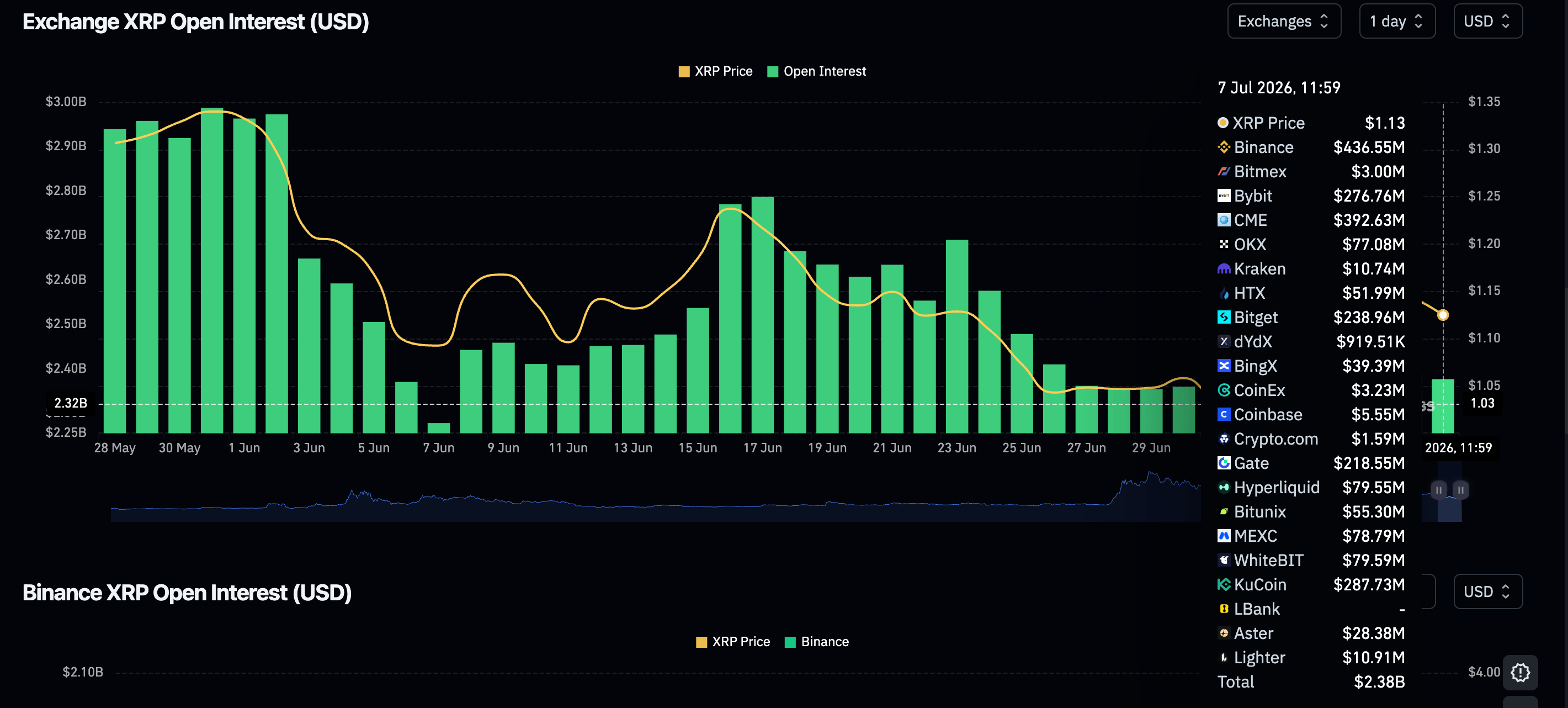
The XRP derivatives market continues to face persistent cooling in retail demand, as reflected in the perpetual futures Open Interest (OI). According to CoinGlass data, the OI has cooled further to $2.38 billion on Tuesday, down from $2.39 billion on Monday and $2.58 billion on Sunday.
An expanded outlook indicates that current retail activity pales significantly in comparison to the OI peak of $10.94 billion on July 22. If this weakness sustains, recovery could remain a pipe dream in the short term amid investor exhaustion.
Price analysis: XRP retains a near-term bearish bias
XRP holds inside a downward parallel channel with a bearish near‑term bias as price remains capped beneath the 50-day, the 100-day and the 200-day Moving Average Exponential (EMA) cluster. The Parabolic SAR at $1.02 sits below spot, hinting at tentative underlying support, while the Relative Strength Index (RSI) has cooled back toward the mid-40s, suggesting fading bullish momentum after the recent bounce.
Meanwhile, the Moving Average Convergence Divergence (MACD) histogram is marginally positive but flattening on the daily chart, which reinforces the view of a waning recovery rather than a sustained uptrend.
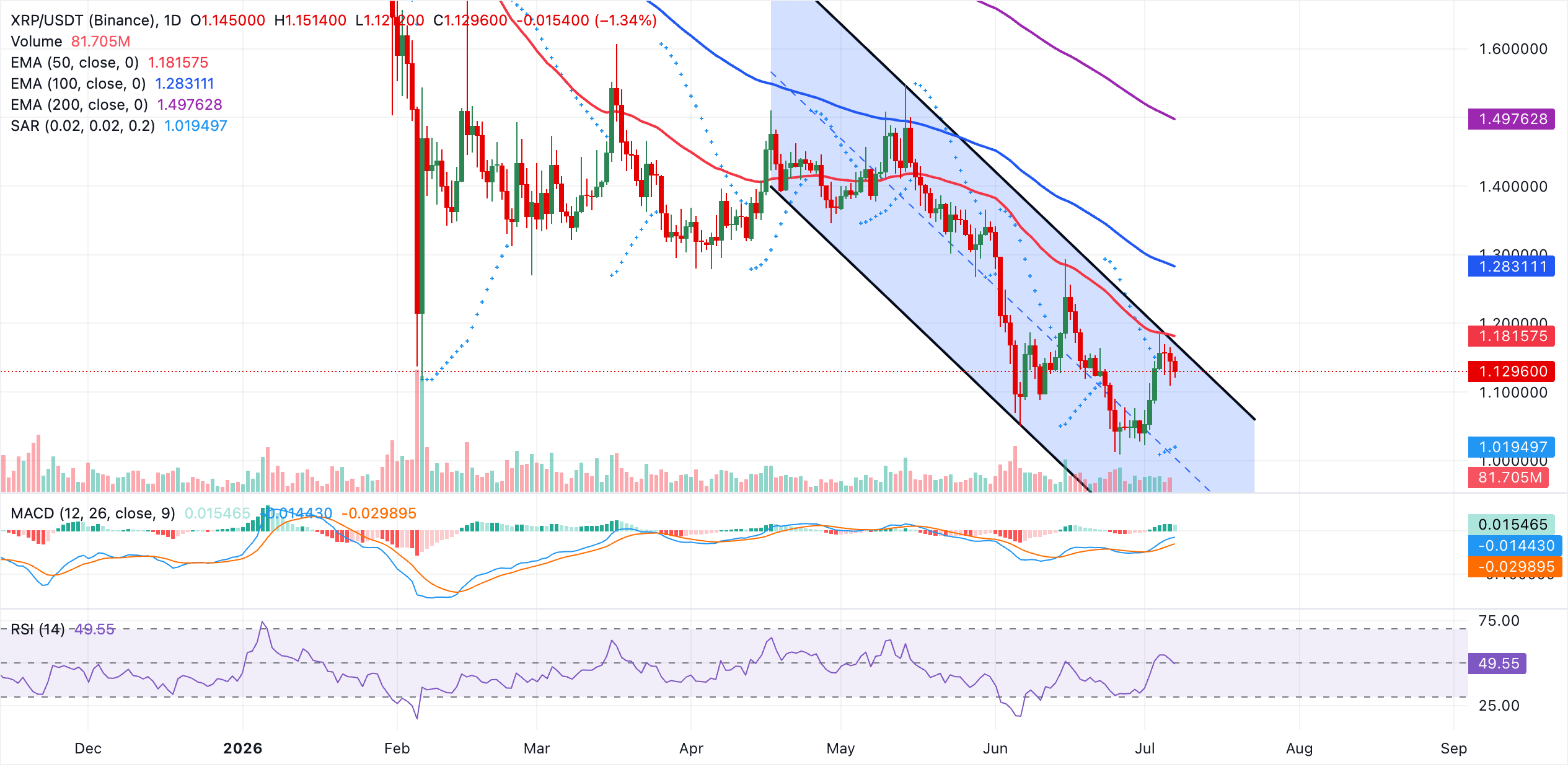
On the topside, initial resistance is aligned with the channel top near $1.17, followed by the 50-day EMA at $1.18, with the 100-day EMA at $1.28 and the distant 200-day EMA at $1.50 marking progressively stronger barriers within the broader downtrend. On the flip side, immediate support is seen near the recent pivot around the current price region, ahead of the Parabolic SAR at $1.02, while a deeper slide would expose the channel floor toward $0.84 as the next major demand zone.
(The technical analysis of this story was written with the help of an AI tool. Know more.)
Ripple FAQs
Ripple is a payments company that specializes in cross-border remittance. The company does this by leveraging blockchain technology. RippleNet is a network used for payments transfer created by Ripple Labs Inc. and is open to financial institutions worldwide. The company also leverages the XRP token.
XRP is the native token of the decentralized blockchain XRPLedger. The token is used by Ripple Labs to facilitate transactions on the XRPLedger, helping financial institutions transfer value in a borderless manner. XRP therefore facilitates trustless and instant payments on the XRPLedger chain, helping financial firms save on the cost of transacting worldwide.
XRPLedger is based on a distributed ledger technology and the blockchain using XRP to power transactions. The ledger is different from other blockchains as it has a built-in inflammatory protocol that helps fight spam and distributed denial-of-service (DDOS) attacks. The XRPL is maintained by a peer-to-peer network known as the global XRP Ledger community.
XRP uses the interledger standard. This is a blockchain protocol that aids payments across different networks. For instance, XRP’s blockchain can connect the ledgers of two or more banks. This effectively removes intermediaries and the need for centralization in the system. XRP acts as the native token of the XRPLedger blockchain engineered by Jed McCaleb, Arthur Britto and David Schwartz.
ARTICOLI POPOLARI
1WTI falls to near $88.50 on G7 reserve release 2US President Donald Trump signs order to ease limits on diesel variety to curb costs3Yemen's Houthis claim missile, drone strikes on multiple targets in Saudi Arabia4The Japanese Yen firms on a BoJ speech about AI and gives it all back5Gold holds steady below $4,150 amid elevated US yields 6Australian Dollar defies rising yields as AUD/USD closes in on 0.707The New Zealand Dollar holds near its lows while business confidence jumps8US Treasury yields scale multi-year highs as inflation fears return9Ethereum Price Forecast: BitMine scoops extra ETH tokens following Q3 outperformance
QUOTAZIONI IN DIRETTA

TUTTO SU TECHNICAL
Che cos'è il trading ICT? Spiegazione dei concetti dell'Inner Circle Trader
Supporto e Resistenza: significato, tipologie, come tracciare i livelli e strategie di trading
Che cos'è la liquidità? Significato nel trading e nei mercati finanziari
Liquidity Sweep: Significato, esempi e strategia di trading
Struttura del mercato nel trading: la guida completa (rialzista, ribassista, laterale)
Cambiamento di Carattere (CHoCH): Definizione, Esempi e Strategia
Che cos'è il pattern Dark Cloud Cover e come si opera con esso?
Che cos'è il pattern candlestick Piercing Line e come si fa trading con esso?
Cosa sono i pattern di candele Tweezer Top e Tweezer Bottom?
Inizia ora!
Registrati e accedi ai mercati globali in meno di 3 minuti

Contattaci









Contatti
Telefono: +61 2 8036 8388
Fax: +61 2 8036 8388
Email: support@tmgm.com
Web: https://www.tmgm.com



Le informazioni fornite su questo sito web hanno esclusivamente carattere generale e non costituiscono consulenza finanziaria personalizzata. Prima di agire sulla base di qualsiasi informazione presente su questo sito web, dovresti valutarne l'adeguatezza in relazione ai tuoi obiettivi, alla tua situazione finanziaria e alle tue esigenze. Investire in CFD e contratti FX con margine comporta rischi significativi e non è adatto a tutti gli investitori. Potresti perdere più del tuo deposito iniziale. Non possiedi, né hai, alcun interesse nell'attività sottostante. Ti raccomandiamo di richiedere una consulenza indipendente e di assicurarti di comprendere pienamente i rischi connessi prima di fare trading. È importante leggere e valutare il documento informativo prima di acquisire qualsiasi prodotto elencato sul sito web. Le informazioni e le pubblicità offerte su questo sito web non sono destinate all'uso da parte di persone in paesi o giurisdizioni in cui tale utilizzo sarebbe contrario alle leggi e ai regolamenti locali. I Prodotti e Servizi offerti su questo sito web non sono destinati ai residenti degli Stati Uniti, della Malesia e della Thailandia.
TMGM è autorizzata e regolamentata in diverse giurisdizioni.
Trademax Australia Limited, operante come TMGM, è regolamentata dalla Australian Securities and Investments Commission (ASIC), AFSL n. 436416 e si trova a Level 28, One International Tower, 100 Barangaroo Avenue, 2000 Sydney, NSW Australia.
Email: support@tmgm.com.au
Trademax Global Limited, operante come TMGM, è autorizzata e regolamentata dalla Vanuatu Financial Services Commission (VFSC), numero di registrazione 40356 e registrata a 1276, Kumul Highway, Port Vila, Vanuatu, Repubblica di Vanuatu.
Email: support@tmgm.com
Trademax Global Markets (SE) Limited, operante con il nome TMGM, è autorizzata e regolamentata dalla Financial Services Authority (FSA) delle Seychelles, con numero di licenza SD224. La società è registrata presso l’Ufficio n. 13, Providence Estate ABIS Centre, Mahé, Seychelles.
Email: support@tmgm.com
Trademax Global Markets (International) Pty Ltd, operante come TMGM, è autorizzata e regolamentata dalla Financial Services Commission, Mauritius (FSC) con licenza n. GB22201012, e registrata al 33, Edith Cavell Street C/o IQ EQ Fund Services (Mauritius) Ltd Port Louis, 11324 Mauritius.
Email: support@tmgm.com
Copyright © TMGM. Tutti i diritti riservati