

Negociação
Explore uma ampla variedade de mercados com preços competitivos, alta liquidez e ferramentas de negociação avançadas.
Saiba Mais 
Plataforma
Negocie sem interrupções com a poderosa plataforma da TMGM, desenvolvida para velocidade, precisão e uma experiência de negociação superior.
Saiba Mais Plataforma de Negociação
Ferramentas de Negociação
Academia
Aprenda os fundamentos da negociação com recursos para iniciantes, incluindo guias, webinars e insights de mercado.
Saiba Mais TMGM Academy
Notícias & Análise
Receba atualizações de mercado em tempo real e análises de especialistas para se antecipar às oportunidades de negociação.
Saiba Mais Notícias & Análise
Sobre
Descubra o que diferencia a TMGM — nossa presença global, força regulatória e compromisso com a inovação em negociação.
Saiba Mais Por Que Escolher a TMGM
British Pound recovers some losses against US Dollar, ISM Services PMI eyed
- The British Pound rebounds against the US Dollar, but is still 0.15% down to near 1.3220.
- Hawkish Fed bets have receded due to soft US NFP data for September.
- Investors keenly await the US ISM Services PMI data.
The British Pound (GBP) claws back some of its early losses against the US Dollar (USD), but is still 0.15% down to near 1.3220 during the European trading session on Monday. The GBP/USD pair recovers slightly as the US Dollar Index retreats after hitting a fresh annual high near 102.53.

It is highly likely that receded hawkish Federal Reserve (Fed) expectations are capping the US Dollar’s upside.
According to the CME FedWatch tool, the odds of the Fed hiking interest rates in the policy meeting later this month have diminished to 19.4% from 70.9% seen a week ago.
Traders have scaled back hawkish Fed expectations after the release of the United States (US) Nonfarm Payrolls (NFP) data for September on Friday, which showed a moderate job growth.
However, market experts believe that the negative reaction in hawkish Fed prospects after the US NFP data release could prove to be short-term, as high inflation is key challenge for the United States (US) central bank.
Societe Generale’s Kenneth Broux argues that the softer US payrolls report has reinforced the recent pullback in expectations for near‑term Fed tightening, but the bank stresses that it is “not a game changer for the hawkish predisposition of the Fed – inflation is the bogeyman.” In their view, the latest jobs print instead “justifies caution over cadence and quantity of future policy adjustments articulated last week by FOMC voter Williams,” tempering the pace and scale of any further tightening even as inflation remains the central focus for policymakers.
During the day, investors will focus on the US ISM Services Purchasing Managers’ Index (PMI) data for September, which will be published at 14:00 GMT. The ISM Services PMI is expected to arrive lower at 55.0 from 55.4 in August.
On the Pound Sterling front, the major trigger will be the United Kingdom (UK) budget, which will be announced later this month.
Strategists at Rabobank highlight that both Prime Minister Burnham and Chancellor Healey “have provided reassurances that former Chancellor Reeves’ fiscal rules will be adhered too.” In Rabobank’s view, the clear implication is that “taxes are likely to be raised again,” a prospect they judge as “neither constructive for the growth outlook nor for voters’ reactions.”
GBP/USD Technical Analysis
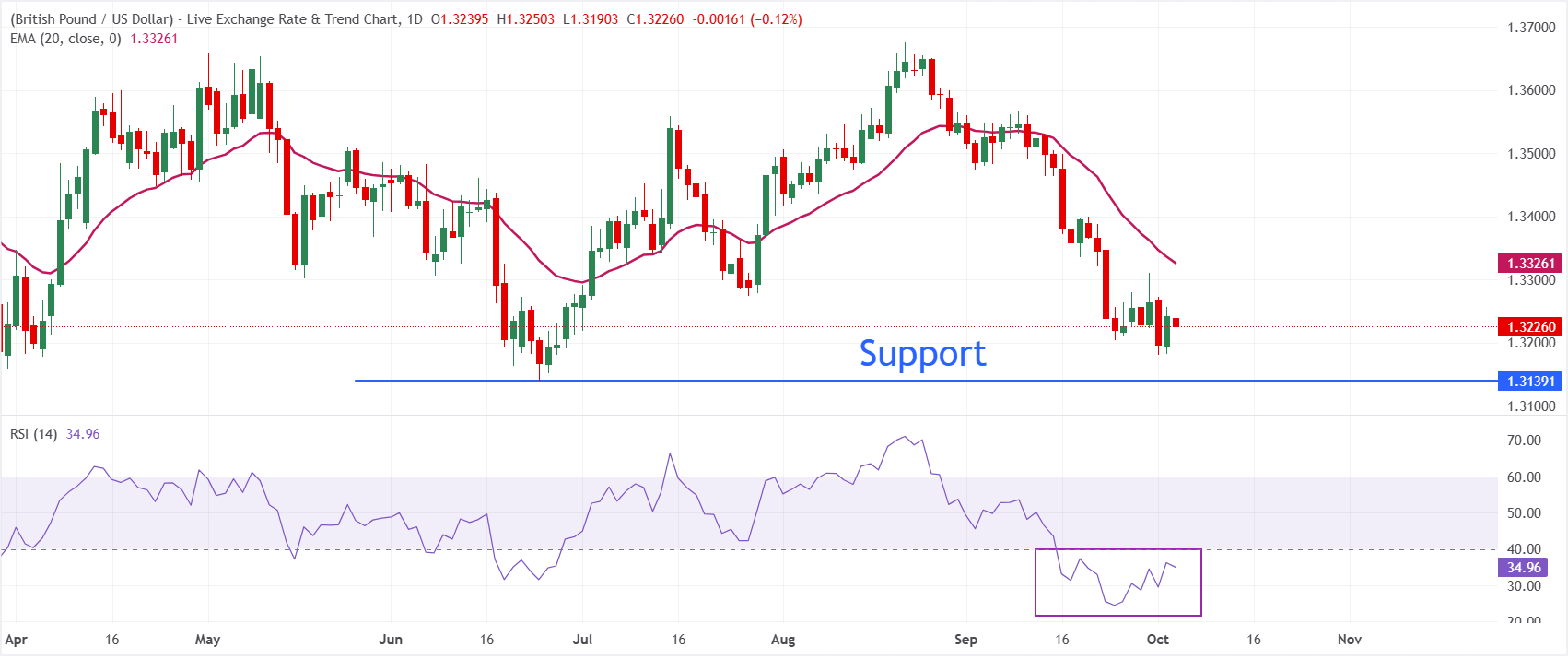
In the daily chart, GBP/USD trades at 1.3225, keeping a bearish near-term tone as spot holds below the 20-day exponential moving average (EMA) at 1.3326. The pair has retreated decisively beneath this short-term trend gauge, suggesting rallies are likely to be capped while price remains under the EMA. The Relative Strength Index (14) at 34.9 sits just above oversold territory, hinting at lingering downside pressure rather than a completed exhaustion phase.
On the topside, immediate resistance is located at the 20-day EMA at 1.3326, which is the key level bulls would need to reclaim to ease the current bearish pressure and open the way for a more sustained recovery. Until that barrier is overcome, the technical stance favors further consolidation or slippage at lower levels, with any bounce likely to be viewed as corrective within the broader pullback from recent highs.
(The technical analysis of this story was written with the help of an AI tool. Know more.)
Economic Indicator
ISM Services PMI
The Institute for Supply Management (ISM) Services Purchasing Managers Index (PMI), released on a monthly basis, is a leading indicator gauging business activity in the US services sector, which makes up most of the economy. The indicator is obtained from a survey of supply executives across the US based on information they have collected within their respective organizations. Survey responses reflect the change, if any, in the current month compared to the previous month. A reading above 50 indicates that the services economy is generally expanding, a bullish sign for the US Dollar (USD). A reading below 50 signals that services sector activity is generally declining, which is seen as bearish for USD.
Read more.Next release: Mon Oct 05, 2026 14:00
Frequency: Monthly
Consensus: 55
Previous: 55.4
Source: Institute for Supply Management
The Institute for Supply Management’s (ISM) Services Purchasing Managers Index (PMI) reveals the current conditions in the US service sector, which has historically been a large GDP contributor. A print above 50 shows expansion in the service sector’s economic activity. Stronger-than-expected readings usually help the USD gather strength against its rivals. In addition to the headline PMI, the Employment Index and the Prices Paid Index numbers are also watched closely by investors as they provide useful insights regarding the state of the labour market and inflation.
ARTIGOS POPULARES
1Oil: Crude forecasts signal inflation surprises ahead - Societe Generale2Canadian Dollar bounces up as US Dollar loses steam with services PMIs in focus3European Central Bank: Contagion risk reshapes rate expectations – MUFG4Australian Dollar: Downside limited against US Dollar – UOB5British Pound recovers some losses against US Dollar, ISM Services PMI eyed6Euro: Pressured yet systemic risk contained – DBS7Silver Price Forecast: XAG/USD jumps to near $61.80 as hawkish Fed bets recede8USD/CHF Price Forecast: Holds below 0.8320 as the Swissie withstands bonds selloff9Gold struggles as dovish Fed repricing meets stronger US Dollar, elevated yields


Comece Agora!
Cadastre-se e acesse os Mercados Globais em menos de 3 minutos

Conecte-se Conosco









Contatos
Telefone: +61 2 8036 8388
Fax: +61 2 8036 8388
Email: support@tmgm.com
Web: https://www.tmgm.com



As informações fornecidas neste website são apenas de natureza geral e não constituem aconselhamento financeiro pessoal. Antes de agir com base em qualquer informação neste website, deve considerar a adequação da informação em relação aos seus objetivos, situação financeira e necessidades. Investir em CFDs e contratos de margem de FX envolve riscos significativos e não é adequado para todos os investidores. Poderá perder mais do que o seu depósito inicial. Não possui, nem detém, qualquer interesse no ativo subjacente. Recomendamos que procure aconselhamento independente e que se certifique de que compreende plenamente os riscos envolvidos antes de negociar. É importante que leia e considere o documento de divulgação antes de adquirir qualquer produto listado no website. As informações e os anúncios oferecidos neste website não se destinam a ser utilizados por qualquer pessoa em qualquer país ou jurisdição onde tal utilização seja contrária às leis e regulamentos locais. Os Produtos e Serviços oferecidos neste website não se destinam a residentes dos Estados Unidos, da Malásia e da Tailândia.
A TMGM é autorizada e regulada em várias jurisdições.
Trademax Australia Limited, operando como TMGM, é regulada pela Comissão Australiana de Valores Mobiliários e Investimentos (ASIC), AFSL nº 436416 e está localizada no Level 28, One International Tower, 100 Barangaroo Avenue, 2000 Sydney, NSW Austrália.
Email: support@tmgm.com.au
Trademax Global Limited, operando como TMGM, é autorizada e regulada pela Comissão de Serviços Financeiros de Vanuatu (VFSC), número de registro 40356 e registrada em 1276, Kumul Highway, Port Vila, Vanuatu, República de Vanuatu.
Email: support@tmgm.com
Trademax Global Markets (SE) Limited, operando como TMGM, é autorizada e regulada pela Autoridade de Serviços Financeiros (FSA) das Seychelles, sob o número de licença SD224. A empresa está registrada no Escritório nº 13, Providence Estate ABIS Centre, Mahe, Seychelles.
Email: support@tmgm.com
Trademax Global Markets (International) Pty Ltd, operando como TMGM, é autorizada e regulada pela Comissão de Serviços Financeiros de Maurício (FSC) com licença nº GB22201012, e registrada em 33, Edith Cavell Street C/o IQ EQ Fund Services (Mauritius) Ltd Port Louis, 11324 Maurício.
Email: support@tmgm.com
Copyright © TMGM. Todos os direitos reservados