

Indian Rupee starts flat, higher oil prices keep outlook uncertain
- The Indian Rupee opens flat at around 95.72 against the US Dollar with investors await the RBI’s monetary policy.
- US President Trump said that Iran has agreed to give up its nuclear ambitions.
- Indian government approves scrapping capital gains tax on foreign investment in government bonds.
The Indian Rupee (INR) opens flat against the US Dollar (USD) on Thursday after a strong Wednesday. The USD/INR pair holds onto previous day’s gains around 95.72 as oil prices remain higher, with United States (US)-Iran negotiations remaining in deadlock.

In the opening trade, MCX Crude Oil price opens 1.2% lower to near 9,120, but is close to its 10-day high of 9,290 posted on Wednesday.
Currencies from economies, such as India, which rely heavily on oil imports to meet their energy needs, tend to underperform in a high oil price environment.
US President Trump remains confident of early deal with Iran
US President Donald Trump said in The New York Post’s "Pod Force One" program on Wednesday that Iran has agreed over not having nuclear weapons, adding, “Iran's Ayatollah [referring Supreme Leader Mojtaba Khamenei] is involved in negotiations with Washington” and he will meet him at some time. However, Trump warned that Iran could change its mind and can pursue its nuclear ambitions.
When asked about the timeframe in which the US and Iran could reach a deal, Trump said a memorandum of understanding (MoU) between the nations could reopen the Strait of Hormuz as early as this week; however, there is a possibility that the US blockade on Iranian sea ports could last till Labor Day, September 7.
India approves scrapping capital gains tax on foreign investment in government bonds
Earlier in the day, the Cabinet meeting has approved the scrapping of capital gains tax on foreign portfolio investment in government bonds, aiming to improve the condition of foreign flows in the Indian economy.
The move was highly anticipated by the Indian government as significant Foreign Institutional Investors (FIIs) selling in the Indian stock market has been one of key reasons behind Indian Rupee’s sharp depreciation.
On Monday, FIIs also remained net sellers in the Indian equity markets, offloading their stake worth Rs. 5,616.56 crore. So far in June, overseas investors have remains net sellers in all three trading days.
RBI’s policy comes into limelight
Going forward, the major trigger for the Indian Rupee will be the Reserve Bank of India’s (RBI) monetary policy, which will be announced on Friday. The RBI is expected to hold the Repo Rate steady at 5.25% and guide a hawkish monetary policy outlook, as higher energy prices have de-anchored inflation expectations.
In the US, investors will pay close attention to the Nonfarm Payrolls (NFP) data for May, which will be released on Friday. The impact of the US NFP data will be significant on the Federal Reserve’s (Fed) monetary policy outlook.
Technical Analysis: USD/INR holds above 20-day EMA
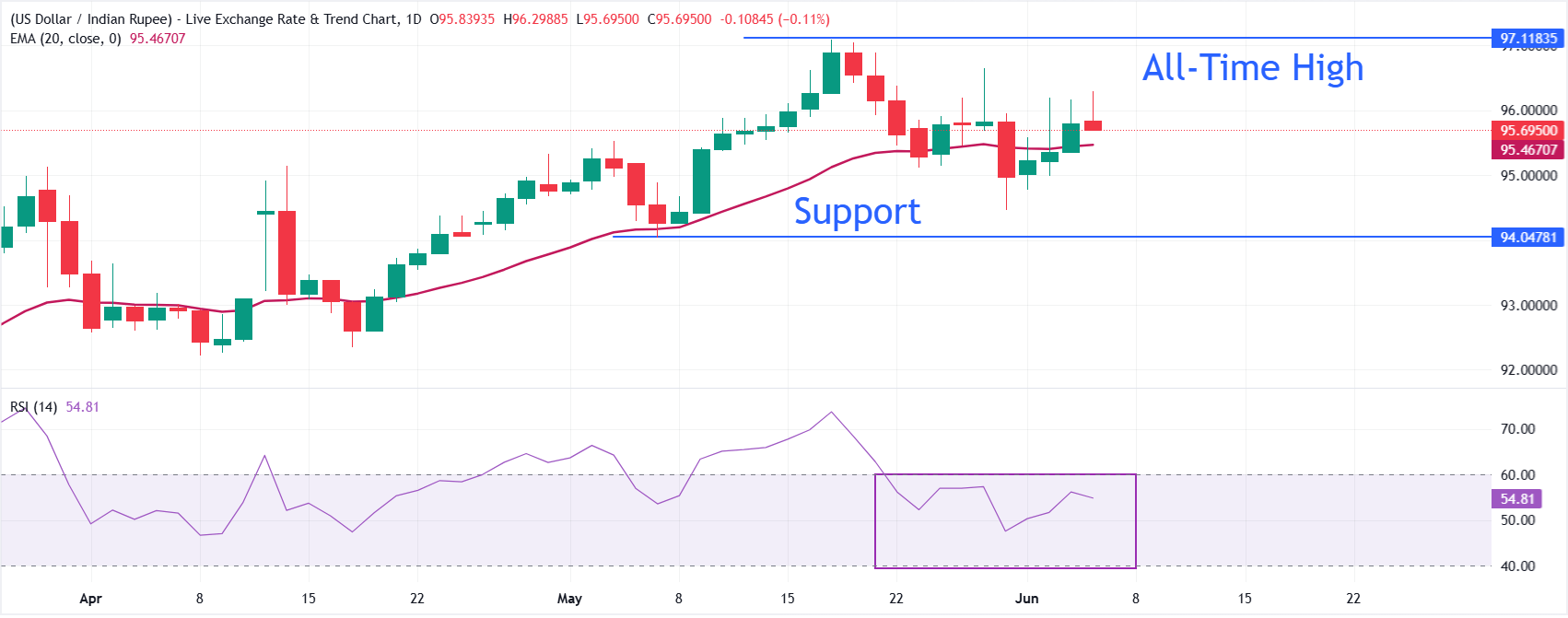
USD/INR trades aLmost flat at around 95.72 in the opening trade. The pair maintain a modest bullish bias as it stays above the 20-day Exponential Moving Average (EMA) at 95.47. The price action consolidates near recent highs while the Relative Strength Index (RSI) at about 54.8 sits slightly above the neutral territory, suggesting steady but not overextended upward momentum.
On the downside, immediate support is aligned with the 20-day EMA around 95.47, which reinforces the underlying demand zone and would need to give way to signal a deeper corrective phase towards the June 2 low at 95.00, followed by the May 7 low at around 94.00. Looking up, the pair could reclaim the all-time high of 97.09 if it manages to rise above the May 28 high at 96.65.
(The technical analysis of this story was written with the help of an AI tool.)
Indian Rupee FAQs
The Indian Rupee (INR) is one of the most sensitive currencies to external factors. The price of Crude Oil (the country is highly dependent on imported Oil), the value of the US Dollar – most trade is conducted in USD – and the level of foreign investment, are all influential. Direct intervention by the Reserve Bank of India (RBI) in FX markets to keep the exchange rate stable, as well as the level of interest rates set by the RBI, are further major influencing factors on the Rupee.
The Reserve Bank of India (RBI) actively intervenes in forex markets to maintain a stable exchange rate, to help facilitate trade. In addition, the RBI tries to maintain the inflation rate at its 4% target by adjusting interest rates. Higher interest rates usually strengthen the Rupee. This is due to the role of the ‘carry trade’ in which investors borrow in countries with lower interest rates so as to place their money in countries’ offering relatively higher interest rates and profit from the difference.
Macroeconomic factors that influence the value of the Rupee include inflation, interest rates, the economic growth rate (GDP), the balance of trade, and inflows from foreign investment. A higher growth rate can lead to more overseas investment, pushing up demand for the Rupee. A less negative balance of trade will eventually lead to a stronger Rupee. Higher interest rates, especially real rates (interest rates less inflation) are also positive for the Rupee. A risk-on environment can lead to greater inflows of Foreign Direct and Indirect Investment (FDI and FII), which also benefit the Rupee.
Higher inflation, particularly, if it is comparatively higher than India’s peers, is generally negative for the currency as it reflects devaluation through oversupply. Inflation also increases the cost of exports, leading to more Rupees being sold to purchase foreign imports, which is Rupee-negative. At the same time, higher inflation usually leads to the Reserve Bank of India (RBI) raising interest rates and this can be positive for the Rupee, due to increased demand from international investors. The opposite effect is true of lower inflation.
give














