

AUD/USD Price Forecast: More upside likely amid hawkish RBA bets
- AUD/USD rises to near 0.7115 as the Australian Dollar gains on hawkish RBA bets.
- The RBA hiked its OCR by 25 bps to 4.1% on Tuesday to contain accelerated inflationary pressures.
- The Fed is expected to leave interest rates unchanged on Wednesday.
The AUD/USD pair trades 0.15% higher at around 0.7115 during the late Asian trading session on Wednesday. The Aussie pair rises as the Australian Dollar (AUD) trades broadly firm, following the Reserve Bank of Australia’s (RBA) monetary policy announcement on Tuesday, in which it raised its Official Cash Rate (OCR) by 25 basis points (bps) 4.1%.
The RBA was anticipated to tighten its monetary conditions as the Iran conflict-led increase in the oil price has prompted price pressures globally. However, the major trigger behind AUD’s strength appears to be confirmation from Governor Michele Bullock that “inflation was already high,” even before the Middle East conflict, and the “cash rate was not high enough to bring inflation back to target”.
Meanwhile, traders expect the RBA to raise interest rates further in the near term. Markets imply a 50-50 chance the Australian central bank will hike again at its next meeting in May, and rates of 4.35% are fully priced by August, Reuters reports.
During the press time, the US Dollar Index (DXY), which tracks the Greenback’s value against six major currencies, trades cautiously near its three-day low around 99.50 ahead of the Federal Reserve’s (Fed) monetary policy announcement at 18:00 GMT. Investors expect the Fed to leave interest rates unchanged in the current range of 3.50%-3.75%.
AUD/USD technical analysis
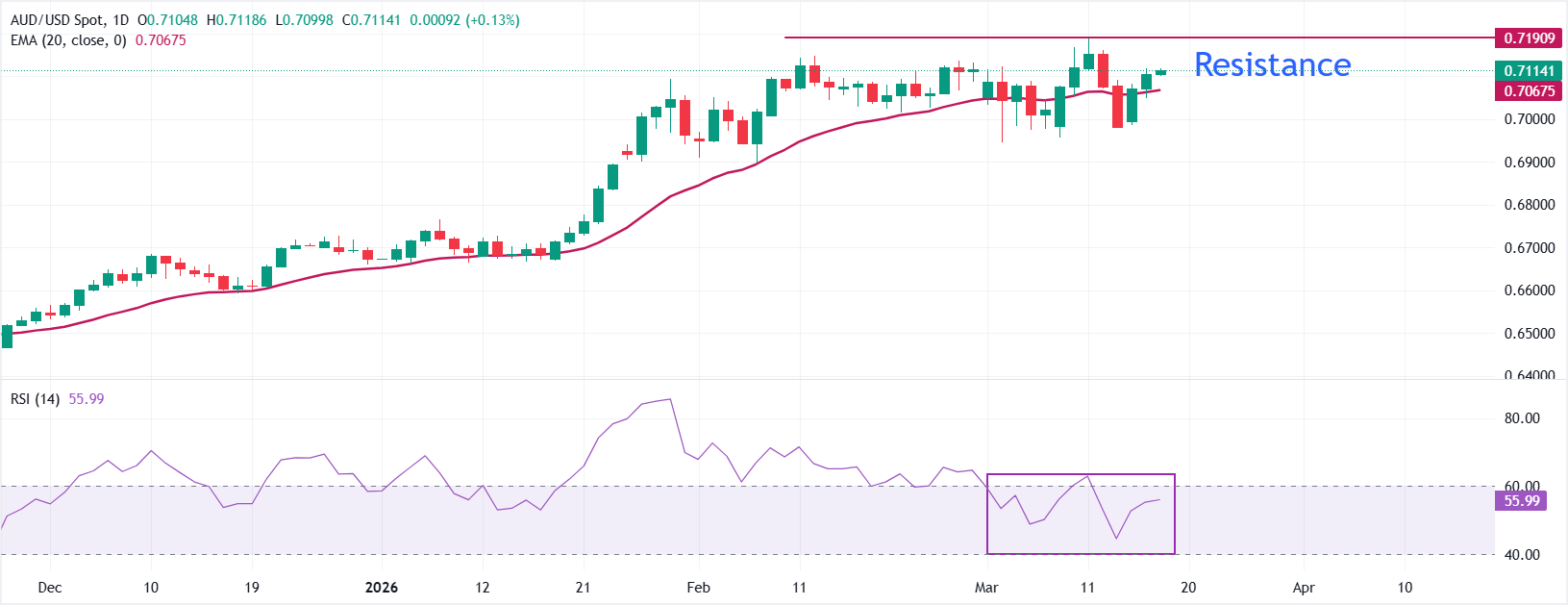
AUD/USD trades higher to near 0.7113 during the press time. The pair holds a modest bullish near-term bias as it continues to trade above the 20-day Exponential Moving Average, which has flattened, but still runs beneath price and cushions shallow pullbacks. The 14-day Relative Strength Index (RSI) is inside the 40.00-60.00 zone after retracing from the 60.00-80.00 range, indicating a balanced momentum with a positive tone.
Initial support emerges near 0.7065, where the 20-day EMA aligns with recent intraday lows, and a break below this area would expose the 0.7020 region as the next downside level. On the topside, immediate resistance stands at 0.7150, the recent local high that capped last week’s advance, followed by a more significant hurdle around 0.7200, where prior supply is likely to reappear if the current recovery extends.
(The technical analysis of this story was written with the help of an AI tool.)
Fed FAQs
Monetary policy in the US is shaped by the Federal Reserve (Fed). The Fed has two mandates: to achieve price stability and foster full employment. Its primary tool to achieve these goals is by adjusting interest rates. When prices are rising too quickly and inflation is above the Fed’s 2% target, it raises interest rates, increasing borrowing costs throughout the economy. This results in a stronger US Dollar (USD) as it makes the US a more attractive place for international investors to park their money. When inflation falls below 2% or the Unemployment Rate is too high, the Fed may lower interest rates to encourage borrowing, which weighs on the Greenback.
The Federal Reserve (Fed) holds eight policy meetings a year, where the Federal Open Market Committee (FOMC) assesses economic conditions and makes monetary policy decisions. The FOMC is attended by twelve Fed officials – the seven members of the Board of Governors, the president of the Federal Reserve Bank of New York, and four of the remaining eleven regional Reserve Bank presidents, who serve one-year terms on a rotating basis.
In extreme situations, the Federal Reserve may resort to a policy named Quantitative Easing (QE). QE is the process by which the Fed substantially increases the flow of credit in a stuck financial system. It is a non-standard policy measure used during crises or when inflation is extremely low. It was the Fed’s weapon of choice during the Great Financial Crisis in 2008. It involves the Fed printing more Dollars and using them to buy high grade bonds from financial institutions. QE usually weakens the US Dollar.
Quantitative tightening (QT) is the reverse process of QE, whereby the Federal Reserve stops buying bonds from financial institutions and does not reinvest the principal from the bonds it holds maturing, to purchase new bonds. It is usually positive for the value of the US Dollar.














