

Bitcoin Price Forecast: BTC struggles near $59,500 amid persistent ETF outflows, US-Iran Doha talks in doubt
- Bitcoin struggles around $59,500 on Tuesday after a massive two-week correction.
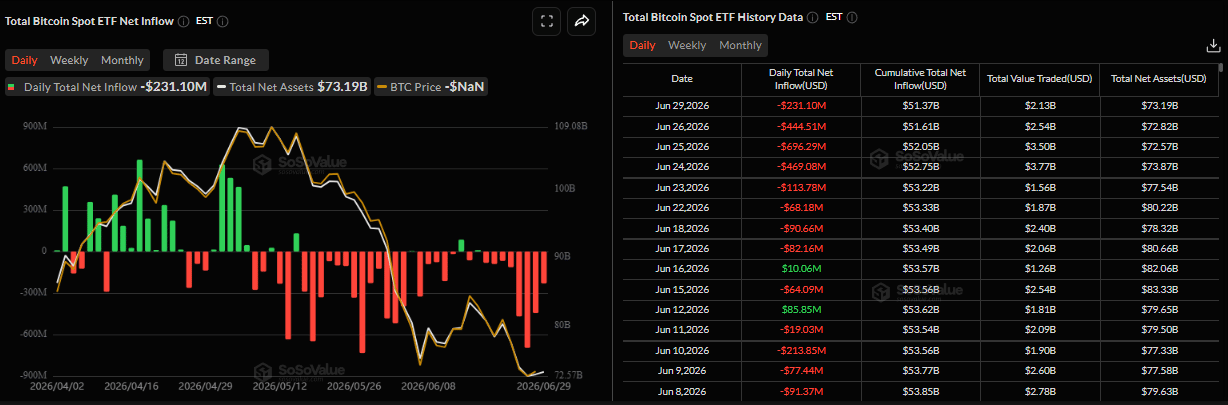
- Institutional sell-off persists as spot ETFs record $231.10 million in outflows on Monday, extending the negative streak.
- Investors remain cautious as the US and Iran offer different signals over whether their delegations will hold direct peace talks in Qatar.
Bitcoin (BTC) struggles around $59,500 at the time of writing on Tuesday after suffering a steep correction over the past two weeks. Institutional selling continues with spot Exchange Traded Funds (ETFs) recording an outflow of $231.10 million on Monday, extending their recent streak of withdrawals. Meanwhile, traders remain cautious as the US and Iran send mixed signals about whether their delegations will hold direct peace talks in Doha, Qatar. The outcome of this could influence global risk sentiment and shape Crypto King’s near-term price direction.

Institutional selling remains robust
Institutional demand began the week on a negative note. SoSoValue data show that spot BTC ETFs recorded an outflow of $231.10 million on Monday, following a $1.70 billion outflow the previous week, the highest weekly outflow since the end of February. If this outflow trend continues this week, BTC could see further correction.
US-Iran Doha talks in doubt
Geopolitical uncertainty remains elevated after mixed signals emerged over potential US-Iran peace talks in Doha. US President Donald Trump wrote on Truth Social that Iran had requested a meeting, and that it will take place in Qatar’s capital, Doha, on Tuesday.
Moments later, Trump’s press secretary, Karoline Leavitt, said, “Special Envoy Witkoff and Jared Kushner will be flying to Doha for high-level meetings this week.”
While Iran is sending its technical delegation to Qatar this week, Foreign Ministry spokesperson Esmaeil Baghaei said this had “no relation” to the Americans’ visit and no talks between the two sides were scheduled.
“We will not have any negotiation meetings at any level with the American side in the coming days,” Baghaei said.
These developments highlight the fragile state of the recent ceasefire agreement. Any breakdown in talks or renewed military escalation between the two countries could weaken risk appetite, potentially triggering a fresh sell-off in BTC.
Bitcoin Price Forecast: BTC struggles around $59,500
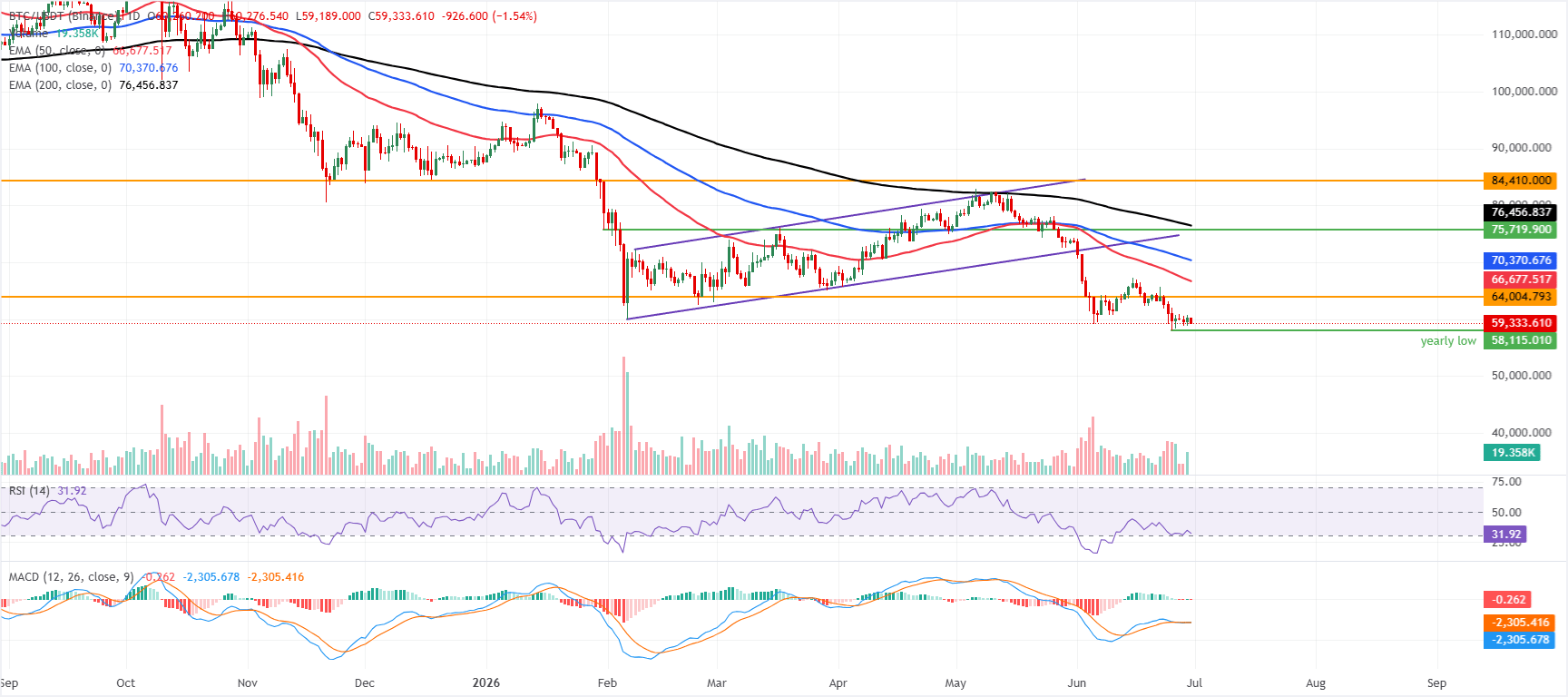
Bitcoin price trades at $59,330 on Tuesday, maintaining a bearish near-term tone as it holds well below the 50-day, 100-day and 200-day Exponential Moving Averages (EMAs), clustered between roughly $66,700 and $76,500. The Relative Strength Index (RSI) sits just above oversold territory near 31 on the daily chart, hinting at weak but stabilizing downside pressure. At the same time, the Moving Average Convergence Divergence (MACD) hovers marginally below the zero line, indicating fading bearish momentum rather than a decisive bullish shift.
On the topside, initial resistance emerges at the horizontal level around $64,004, ahead of the 50-day EMA at $66,677 and the 100-day EMA near $70,373, which together define a dense supply band that could cap any recovery attempts. Above these, the 200-day EMA at $76,456 reinforces the broader bearish structure, with a higher horizontal barrier at $84,410 marking a more distant resistance zone that would need to be reclaimed to challenge the prevailing downtrend.
The absence of nearby defined support leaves BTC vulnerable to further downside probes if selling pressure resumes.
(The technical analysis of this story was written with the help of an AI tool.)
Bitcoin, altcoins, stablecoins FAQs
Bitcoin is the largest cryptocurrency by market capitalization, a virtual currency designed to serve as money. This form of payment cannot be controlled by any one person, group, or entity, which eliminates the need for third-party participation during financial transactions.
Altcoins are any cryptocurrency apart from Bitcoin, but some also regard Ethereum as a non-altcoin because it is from these two cryptocurrencies that forking happens. If this is true, then Litecoin is the first altcoin, forked from the Bitcoin protocol and, therefore, an “improved” version of it.
Stablecoins are cryptocurrencies designed to have a stable price, with their value backed by a reserve of the asset it represents. To achieve this, the value of any one stablecoin is pegged to a commodity or financial instrument, such as the US Dollar (USD), with its supply regulated by an algorithm or demand. The main goal of stablecoins is to provide an on/off-ramp for investors willing to trade and invest in cryptocurrencies. Stablecoins also allow investors to store value since cryptocurrencies, in general, are subject to volatility.
Bitcoin dominance is the ratio of Bitcoin's market capitalization to the total market capitalization of all cryptocurrencies combined. It provides a clear picture of Bitcoin’s interest among investors. A high BTC dominance typically happens before and during a bull run, in which investors resort to investing in relatively stable and high market capitalization cryptocurrency like Bitcoin. A drop in BTC dominance usually means that investors are moving their capital and/or profits to altcoins in a quest for higher returns, which usually triggers an explosion of altcoin rallies.














