

Breaking: Gold jumps above $5,500 for the first time on record
Bởi Lallalit Srijandorn
Ngày xuất bản: 29 Jan 2026 | Ngày chỉnh sửa: 29 Jan 2026


BÀI VIẾT PHỔ BIẾN

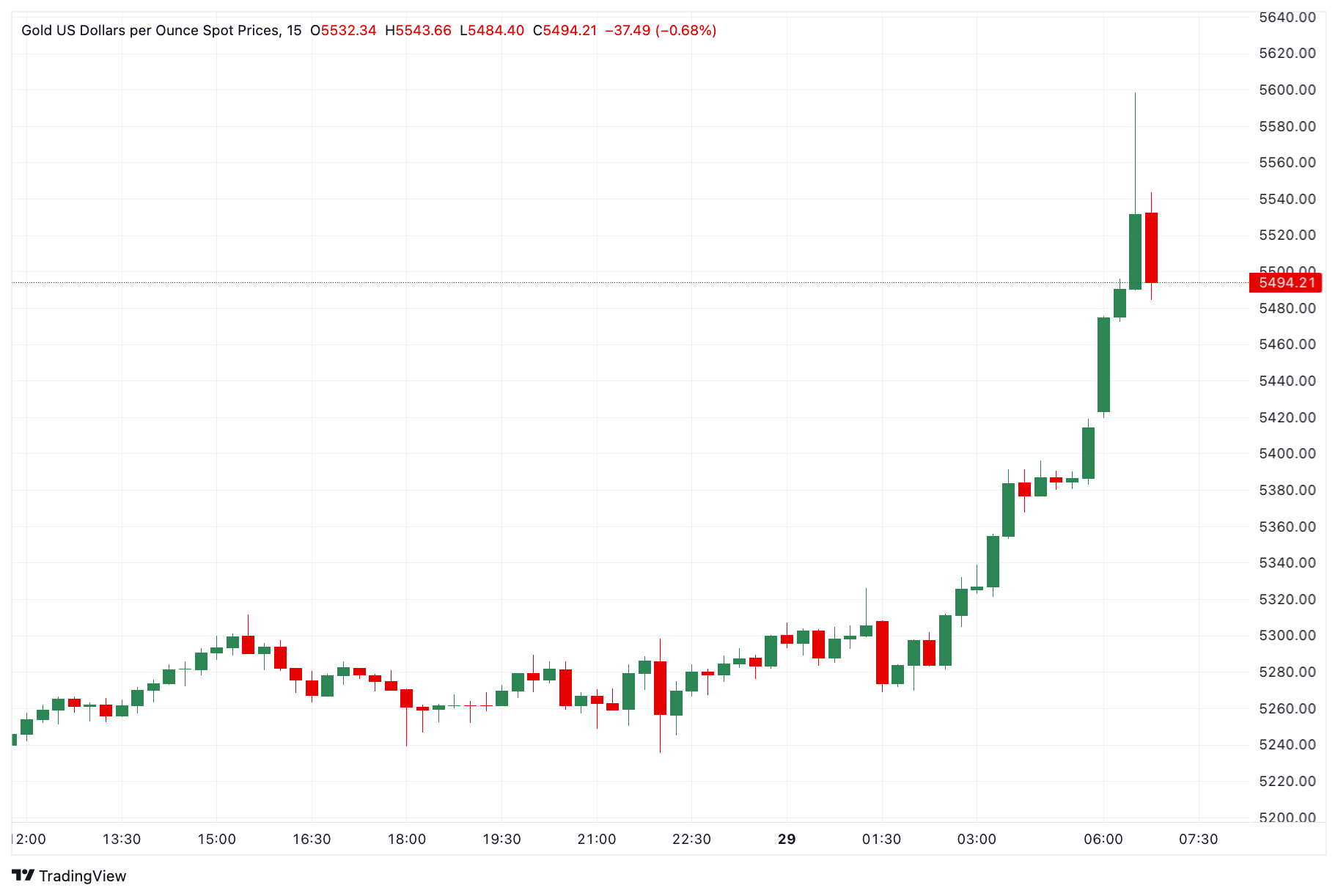
Gold price (XAU/USD) surges to a fresh record high of $5,579 before retreating to around $5,500 in early Asian trading on Thursday. The rally of the precious metal is bolstered by strong safe-haven demand amidst persistent geopolitical tensions, economic uncertainty, and a weaker US Dollar (USD).
- Gold rises to near $5,500 after reaching an all-time high of $5,579 in Thursday’s early Asian session.
- Geopolitical and economic uncertainty boost a traditional safe-haven assets such as Gold.
- The Fed held its key interest steady in a range between 3.5% and 3.75% at its January meeting on Wednesday.
Gold price (XAU/USD) surges to a fresh record high of $5,579 before retreating to around $5,500 in early Asian trading on Thursday. The rally of the precious metal is bolstered by strong safe-haven demand amidst persistent geopolitical tensions, economic uncertainty, and a weaker US Dollar (USD).
Geopolitical tensions persisted after US President Donald Trump issued fresh warning to Iran on Wednesday. Trump urged Iran to “come to the table” and negotiate a “fair and equitable deal” that would prohibit the development of nuclear weapons or the next US attack would be far worse. Meanwhile, Iran responded with a threat to strike back against the US, Israel and those who support them.
The US Federal Reserve's (Fed) decision to keep interest rates steady has contributed to the Gold’s upside. The US central bank kept interest rates steady in the target range of 3.5% to 3.75% following its January policy meeting on Wednesday. Lower interest rates typically reduce the opportunity cost of holding non-yielding assets like gold, making it more attractive to investors.
Trump said earlier on Tuesday that he will announce his pick for the new Fed Chair soon. He added that interest rates will significantly drop as soon as a new Fed chair is at the helm. Traders worry that the Fed would lose its independence after the appointment of a Trump candidate as Fed Chairman, boosting the safe-haven demand.
On the other hand, profit-taking in the yellow metal cannot be ruled out in the near term after a rise of more than 80% year-on-year. "The gains fuelled by sustained central bank buying, relentless momentum from trend-following funds, and strong flight-to-quality demand," said IG market analyst Tony Sycamore. "Although the parabolic nature of the rally suggests a pullback is not far away, the underlying fundamentals are expected to remain supportive throughout 2026, positioning any dips as attractive buying opportunities."
Risk sentiment FAQs
In the world of financial jargon the two widely used terms “risk-on” and “risk off'' refer to the level of risk that investors are willing to stomach during the period referenced. In a “risk-on” market, investors are optimistic about the future and more willing to buy risky assets. In a “risk-off” market investors start to ‘play it safe’ because they are worried about the future, and therefore buy less risky assets that are more certain of bringing a return, even if it is relatively modest.
Typically, during periods of “risk-on”, stock markets will rise, most commodities – except Gold – will also gain in value, since they benefit from a positive growth outlook. The currencies of nations that are heavy commodity exporters strengthen because of increased demand, and Cryptocurrencies rise. In a “risk-off” market, Bonds go up – especially major government Bonds – Gold shines, and safe-haven currencies such as the Japanese Yen, Swiss Franc and US Dollar all benefit.
The Australian Dollar (AUD), the Canadian Dollar (CAD), the New Zealand Dollar (NZD) and minor FX like the Ruble (RUB) and the South African Rand (ZAR), all tend to rise in markets that are “risk-on”. This is because the economies of these currencies are heavily reliant on commodity exports for growth, and commodities tend to rise in price during risk-on periods. This is because investors foresee greater demand for raw materials in the future due to heightened economic activity.
The major currencies that tend to rise during periods of “risk-off” are the US Dollar (USD), the Japanese Yen (JPY) and the Swiss Franc (CHF). The US Dollar, because it is the world’s reserve currency, and because in times of crisis investors buy US government debt, which is seen as safe because the largest economy in the world is unlikely to default. The Yen, from increased demand for Japanese government bonds, because a high proportion are held by domestic investors who are unlikely to dump them – even in a crisis. The Swiss Franc, because strict Swiss banking laws offer investors enhanced capital protection.

Hơn một triệu người dùng dựa vào FXStreet để có dữ liệu thị trường thời gian thực, công cụ biểu đồ, góc nhìn chuyên gia và tin tức Forex. Lịch kinh tế toàn diện và các hội thảo web giáo dục giúp nhà giao dịch luôn cập nhật và đưa ra quyết định có tính toán. FXStreet có khoảng 60 nhân sự, chia giữa trụ sở Barcelona và nhiều khu vực toàn cầu.
Đọc thêm








