

Dow Jones Industrial Average futures surge 1,200 points on ceasefire, but cracks are emerging
- Dow futures jumped more than 2.6% after President Trump suspends planned strikes on Iran for two weeks in exchange for a conditional reopening of the Strait of Hormuz.
- WTI Crude Oil plunges more than 17% to around $93, its sharpest single-session drop in six years, as the threat of a full blockade recedes.
- Semiconductor stocks lead the pre-market rally as supply chain fears ease, with the VanEck Semiconductor ETF jumping close to 5%.
- The ceasefire remains fragile as Israel launches its largest coordinated strike on Lebanon, and Iran warns it may withdraw from the truce.

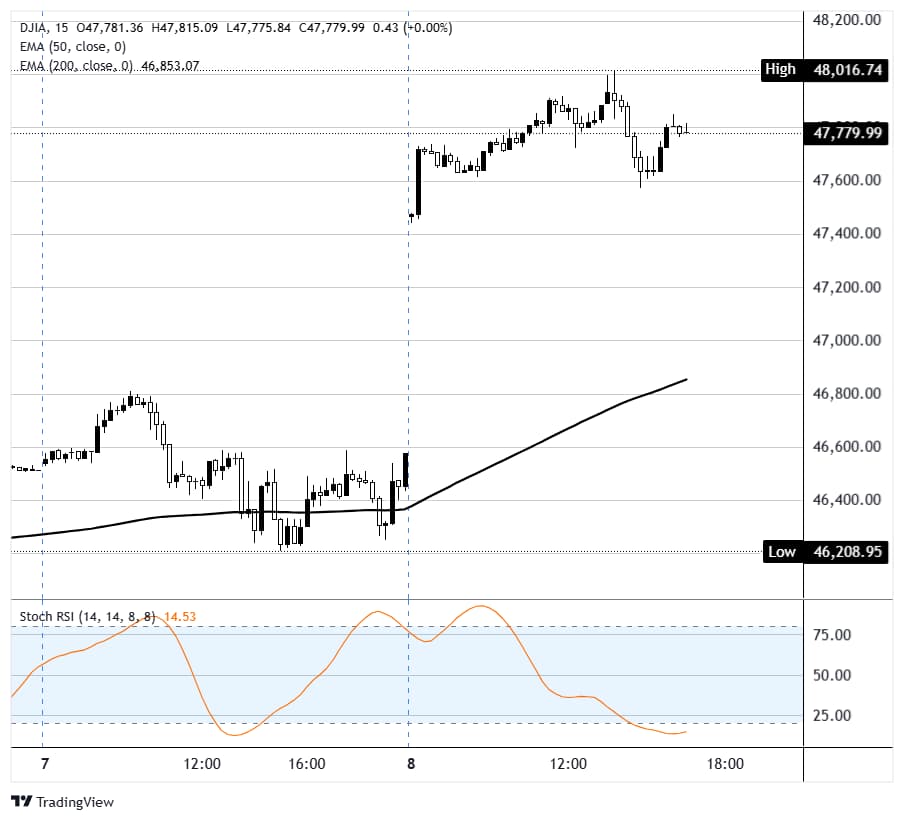
Dow Jones Industrial Average (DJIA) futures surged around 1,200 points on Wednesday, up close to 2.6%, after a last-minute diplomatic breakthrough averted what had been shaping up as a catastrophic escalation of the US-Iran war. S&P 500 futures climbed around 2.4%, while Nasdaq Composite futures led the charge with gains near 2.8%. The rally followed President Donald Trump's decision late Tuesday to suspend his threat to strike Iranian civilian infrastructure, including power plants and bridges, for a period of two weeks. Futures got an additional boost Wednesday morning after Trump posted that the US would work with Iran to remove nuclear material from the country and that the two nations were discussing tariff and sanctions relief.
Pakistan brokers eleventh-hour deal
The ceasefire was brokered by Pakistan, whose Prime Minister Shehbaz Sharif had asked Trump to postpone the deadline and urged Iran to reopen the Strait of Hormuz as a goodwill gesture. Trump described the outcome as a "double-sided ceasefire" and said Iran had submitted a 10-point proposal he called a "workable basis for negotiations." Iranian Foreign Minister Abbas Araghchi confirmed that safe passage through the Strait of Hormuz would be possible for two weeks via coordination with Iran's armed forces. Delegations from both sides are expected in Islamabad on Friday for the first direct talks since the war began in late February.
Oil crashes as Hormuz fears ease
The most immediate market impact was in the crude Oil market, where West Texas Intermediate (WTI) futures plunged more than 17% to around $93 per barrel, its sharpest drop since 2020. The collapse came after weeks of elevated prices driven by the near-total closure of the Strait of Hormuz, through which about a fifth of the world's Oil supply transits during peacetime. The reopening, even on a conditional and temporary basis, was enough to trigger a massive unwind of the war premium that had pushed WTI above $115 earlier this week. Brent Crude for June delivery fell more than 16% to around $92.
Ship-tracking service MarineTraffic confirmed that the first vessels had passed through the Strait of Hormuz on Wednesday. However, industry experts said overall traffic has not picked up meaningfully from the trickle experienced during the war, and shipping giant Maersk said it was making "no changes" to its services pending further risk assessments.
The Oil crash rippled directly into equity sentiment. Falling energy costs ease the stagflation fears that had gripped markets for much of March and early April, reviving expectations that the Federal Reserve (Fed) could still cut interest rates later this year. The Cboe Volatility Index (VIX) collapsed around 15% to near 22, down from above 25 in the prior session, reflecting a sharp reduction in hedging demand.
Ceasefire winners and losers
The pre-market rally was led by those corners of the market that had been hit hardest since the war began. Semiconductor stocks vulnerable to supply chain disruptions surged in early trading, with the VanEck Semiconductor ETF (SMH) jumping close to 5%. Broadcom (AVGO) gained about 4% and Micron (MU) rose 7%. International markets reliant on energy imports rallied sharply, with South Korean equities surging 8% and the iShares MSCI Emerging Markets ETF climbing around 5%.
On the other side of the trade, energy stocks that had been war-time winners gave back gains in pre-market action. Exxon Mobil (XOM) and Chevron (CVX) each fell more than 5% as traders unwound the Oil premium that had driven the energy sector up around 34% in 2026.
Fragile truce already under strain
Despite the euphoria in futures markets, the ceasefire is showing cracks within hours of being announced. Israeli Prime Minister Benjamin Netanyahu said in a statement on Wednesday that Israel supports Trump's decision to suspend strikes against Iran, but that the ceasefire "does not include Lebanon." This directly contradicts Pakistan's Prime Minister Sharif, who said the agreement applied "everywhere, including Lebanon."
Israel's military followed Netanyahu's statement with what it described as the largest coordinated strike of the current war, hitting more than 100 Hezbollah targets in Beirut, southern Lebanon and the Bekaa Valley within 10 minutes. Lebanon's health ministry reported dozens killed and hundreds wounded. Hezbollah responded by saying that if Israel does not adhere to the ceasefire, "no party will commit to it, and there will be a response from the region, including Iran."
Iran's own posture adds to the uncertainty. The Iranian Navy warned that ships attempting to pass through the Strait of Hormuz without Tehran's coordination would be "targeted and destroyed," and Iran temporarily halted traffic through the waterway despite the ceasefire announcement. Meanwhile, Gulf states including Saudi Arabia, the United Arab Emirates and Kuwait reported fresh Iranian drone and missile attacks overnight, with Saudi Arabia intercepting nine drones targeting its territory. Vice President JD Vance, speaking from Budapest, called the arrangement a "fragile truce" and warned that factions within the Iranian system had been "lying" about the nature of the agreement.
What it means for markets
Ed Yardeni, president of Yardeni Research, said the ceasefire confirmed his view that the bottom for equities is in, and lowered his probability of a US recession back to 20% from 35%. However, he cautioned that "a two-week pause is not a resolution" and that markets would remain sensitive to any breakdown in talks. The Russell 2000 remains positive for the year with gains above 5%, while the Dow, Nasdaq and S&P 500 are still in the red on a year-to-date basis.
Gold rose about 2% to near $4,820 per ounce, supported by a weaker US Dollar and lingering safe-haven demand. The US Dollar Index fell more than 1% to around 98.50, its weakest level in weeks, as the de-escalation reduced demand for the Greenback.
The key risk from here is straightforward: this is a two-week window, not a peace deal. If talks in Islamabad collapse, if Israel's strikes on Lebanon provoke an Iranian retaliation that breaches the truce, or if the Strait of Hormuz fails to reopen in any meaningful way, the rally could reverse just as fast as it began.
Dow Jones 15-minute chart
Dow Jones FAQs
The Dow Jones Industrial Average, one of the oldest stock market indices in the world, is compiled of the 30 most traded stocks in the US. The index is price-weighted rather than weighted by capitalization. It is calculated by summing the prices of the constituent stocks and dividing them by a factor, currently 0.152. The index was founded by Charles Dow, who also founded the Wall Street Journal. In later years it has been criticized for not being broadly representative enough because it only tracks 30 conglomerates, unlike broader indices such as the S&P 500.
Many different factors drive the Dow Jones Industrial Average (DJIA). The aggregate performance of the component companies revealed in quarterly company earnings reports is the main one. US and global macroeconomic data also contributes as it impacts on investor sentiment. The level of interest rates, set by the Federal Reserve (Fed), also influences the DJIA as it affects the cost of credit, on which many corporations are heavily reliant. Therefore, inflation can be a major driver as well as other metrics which impact the Fed decisions.
Dow Theory is a method for identifying the primary trend of the stock market developed by Charles Dow. A key step is to compare the direction of the Dow Jones Industrial Average (DJIA) and the Dow Jones Transportation Average (DJTA) and only follow trends where both are moving in the same direction. Volume is a confirmatory criteria. The theory uses elements of peak and trough analysis. Dow’s theory posits three trend phases: accumulation, when smart money starts buying or selling; public participation, when the wider public joins in; and distribution, when the smart money exits.
There are a number of ways to trade the DJIA. One is to use ETFs which allow investors to trade the DJIA as a single security, rather than having to buy shares in all 30 constituent companies. A leading example is the SPDR Dow Jones Industrial Average ETF (DIA). DJIA futures contracts enable traders to speculate on the future value of the index and Options provide the right, but not the obligation, to buy or sell the index at a predetermined price in the future. Mutual funds enable investors to buy a share of a diversified portfolio of DJIA stocks thus providing exposure to the overall index.














